

Tapping Into Consumer Research Hacks for Your Market Research Campaigns
Tapping Into Consumer Research Hacks for Your Market Research Campaigns

In today’s digital, mobile-first age where brands are jockeying for customers’ patronage and attention, brands need to conduct consumer research to understand them. This way, they can align themselves with their consumers and excel at serving all of their consumers’ needs.
81% of consumers buy based on their trust in a brand and 77% of consumers buy from brands that share the same values as they do. Clearly, there is much to consumers that businesses must stay aware of, with values and brand trust making up just two of these matters.
However, despite the importance of this kind of research, less than 40% of marketers use consumer research to drive business decisions. This is a problem for various evident reasons, the most important one being the lack of key insights on the population of people who purchase from you.
Many brands simply don’t know how to conduct proper consumer research or don’t have the time to learn how.
This article delves into consumer research, its importance and four key hacks on conducting it to reap quality consumer intelligence.
Understanding Consumer Research
Although consumer research largely makes up the bulk of market research, the two are distinct concepts and shouldn't be mistaken for one another.
Whereas market research is the all-encompassing practice of studying customers, consumer research is a part of market research that focuses on customer behavior, specifically customer inclinations, motivations and customer buying behavior. In this kind of research, businesses identify these aspects within their target market as a means of studying the psychology behind their customers.
The results of this kind of research allow businesses and organizations to understand their customers on a more granular level. By doing so, they can then create detailed purchasing behavior profiles which they can use to inform all of their marketing campaigns.
There are a variety of consumer research methods to gather this information, which include the overarching approaches of market research techniques. Businesses can use these methods to gain deeper consumer insights, essentially learning about their customers beyond their demographics, location and other outward traits.
Although there are no set-in-stone rules for conducting consumer research, there are several approaches, or hacks you ought to take to hone in on your studies.
This way, you will be able to create well-targeted campaigns on specific consumer segments.
The Importance of Conducting Consumer Research
It’s important to conduct consumer research for a number of reasons.
Consumer research grants you insight into the minds, behaviors, actions and other aspects of the people most inclined to buy from you: your target market. In turn, you’ll have access to in-depth information about your consumers’ desires, needs, expectations and more.
Most importantly, you’ll have access to insights that reveal the “why” behind these phenomena, meaning, you’ll understand the motivations, tendencies and other thought processes that cause your consumers to think and behave in the way that they do.

As such, consumer research provides granular customer intelligence, the kind that allows you to tap into consumer mindsets.
By obtaining this kind of information, businesses can craft tailored marketing personalization and a host of other marketing strategies, including those that make up the strategic planning process.
Unlike strategies and campaigns built on intuition or secondary market research alone, those conducted via primary consumer research provide quality data for decision making — and not just any data that you can easily extract from online sources, but data that is unique, timely and most relevant to your particular target market.
In turn, businesses will be able to form campaigns that don’t merely win over existing customers, but acquire new ones. When you are able to successfully acquire new customers by understanding them on a deeper level, you’ll be able to lower your customer acquisition cost.
By understanding what customers want and how they think, you’ll establish a customer-centric brand in practice as opposed to in theory alone.
You’ll thereby increase your customer satisfaction and keep your brand relevant. As such, you’ll be poised to retain your customers, which is a stronger long-term strategy in comparison to acquiring new customers. This will allow you to increase your customer retention rate, keeping a steady source of customers and the profits they yield.
All in all, consumer research provides the necessary intelligence to win over customers, build consumer loyalty and retain customers, as well as boost your business overall.
Consumer Research Hacks
As aforementioned, there is no hard and fast rule when it comes to conducting consumer research. No technique or set of techniques is set in stone. As a marketer, business owner or market researcher, it is up to you to settle on the methods of running consumer research.
This can be difficult to execute, as there are so many tools and sources available, from secondary sources such as statistics websites and trade magazines, to primary methods such as using a focus group or types of consumer surveys.
Aside from research sources, there are also different research approaches, market research campaigns and types of research you can conduct to learn about the psychology behind your customers. To wade the seemingly difficult waters of consumer research, we’ve laid out four major hacks for conducting consumer research.
The following explains these hacks:
Hack 1: Decide on the Broader Campaign
While there are going to be times in which you simply need to learn how your target market ticks in terms of its consumer preferences and behaviors. However, most of the time, your curiosities about your consumers will not be for stand-alone affairs.
Instead, you may need to collect some in-depth information on how consumers would react to a certain advertisement. You may want to see how they receive emotional marketing, as personality types within your target market will vary.
As such, you should first find the anchoring campaign behind your consumer research. Perhaps it is for a campaign that is already currently running, such as an ad campaign you’d like to A/B test.
Or perhaps, before you embark on another marketing campaign, you seek to gain consumer insights before running it at all. For example, a campaign with a new theme and you need to discover how your customers feel about it.
Come up with your questions or the subject of the questions, at the very least, to guide you and tether your research to a broader business campaign.
Hack 2: Determine the Length and Duration of Your Study
After you tie your consumer research endeavor to an existing or new campaign or undertaking, determine the length and duration of your study. This involves choosing to run another major type of sub-campaign of market research, as certain studies are organized due to their time dependence.
For example, for longer-term consumer research, you may need to conduct longitudinal studies, which aim to gather data on the same set of respondents over a longer period of time. This can last between months and decades.
For short-term consumer research, you may want to conduct cross-sectional studies, in which researchers gather research on a targeted population at one fixed point in time. This type of survey research method is known as being a snapshot of a studied population.
Perhaps you’re interested in studying your consumers’ past habits and experiences. For such a study, you would need to form a retrospective study. Such a study is useful for observing the changes your consumers have undergone, along with picking up on patterns.
Hack 3: Conducting Market Segmentation
The makeup of a target market can be vast, no matter how niche your company and product(s) are. From different age groups, to behavioral aspects, your target market is not composed of a single entity. Rather, it is made up of smaller groups, known as market segments.
It is crucial to conduct market segmentation when executing your consumer research project. This way, you’ll be able to identify the various market segments making up your target market and target them accordingly. Additionally, you ought to segment your target market even further by organizing your segments into customer personas.
These are fictional characters that represent real people in your market segments, except they contain traits that are far more specific than that of a market segment. Personas usually include hobbies and lifestyle aspects. You can then label your different customers by their relation and fit with your personas. Personas allow you to make your messaging even more targeted and satisfy various personalities.
Hack 4: Use a Mixed Style and Multi-Pronged Research Approach
A multi-pronged approach when it comes to conducting and analyzing your consumer research involves using a strong online market research platform. Such a platform should allow you to conduct research via a number of survey types and question formats.
The platform you use should also offer a variety of options for filtering data that you collected, so that it is easy to view and parse. As such, a mixed style involves running multiple kinds of surveys to multiple audiences and relying on numerous kinds of data visualizations.
Variety is important, as different team members aren’t all going to favor the same method of collecting or viewing data. As such, a market research platform that offers a multi-pronged approach to collecting, viewing, exporting and analyzing the data fosters a culture of data democratization, allowing all members of your team to easily take part in consumer research and analysis.
Using Survey Research to Tap Into Consumer Research Hacks
It can be difficult to conduct the proper consumer research with so many sources of information at your disposal. Keep in mind that many of these sources can have dubious or outdated information, rendering your research efforts worse off than they would have been had you never used them.

This is not just a caveat for conducting secondary research via online and offline sources, as certain market research techniques, such as using syndicated research can also be faulty. Although syndicated research can provide you with fresh and original research, it is at the helm of the market research firm conducting the study. Therefore, the firm is in control of how the consumer research study is set up, from its duration to the types of survey questions used.
Instead, you should conduct your own consumer research by using an online survey platform that facilitates the process of creating a DIY survey. Given that online surveys are one of the fastest, affordable and most reliable methods of conducting research, you’d be remiss not to use them for conducting consumer research.
A strong online survey platform grants you quick access to your desired target market sample, extracts data quickly and disqualifies low-quality data.
Delivering the Best for Your Target Market
To deliver the best products, services and CX for your consumers, you need to understand them at a deep level. As such, their age, gender and location alone are superficial aspects in comparison to their behaviors, opinions, needs, sentiments, aversions and more.
In order to tap into all of these consumer aspects, you’ll need to conduct survey campaigns through a potent online survey platform. Such a platform should run on random device engagement (RDE) sampling, which enables you to reach consumers in their natural digital environments, instead of pre-recruiting them. This removes social pressures and will cut back on biases.
You should also use a mobile-first platform, since mobile dominates the digital space.
The platform you select should also offer artificial intelligence and machine learning to remove low-quality data, offer a broad range of survey and question types and disqualify unattentive respondents.
Most importantly, it should allow you to survey anyone. As such, you’ll need a platform with a reach to millions of consumers, along with one that offers the Distribution Link feature.
This feature will allow you to send your survey to specific customers, instead of just deploying them across a network.
When you use an online survey platform with all of these capabilities, you’ll be able to perform quality consumer research.

Diving Into the Customer Service Survey to Meet All Customer Service Demands
Diving Into the Customer Service Survey to Meet All Customer Service Demands

All businesses must conduct a customer service survey from time to time to ensure their consumers are satisfied with their service and all of its associations.
This is because few other things contribute to the success of your business as much as your customer service.
In fact, 90% of Americans use customer service as a factor to decide whether or not to do business with a company. As such, for the vast majority of American consumers, customer service is a make-or-break aspect that can mean patronizing your company or going to your competitor.
Customers have high expectations when it comes to customer service, as they expect to receive customer service from any channel and device. However, 60% of customers don’t see customer service as becoming easier, as 86% of customers have had to contact customer service multiple times for the same reason.
This signifies that brands don’t take care of customer needs, even when they are told upfront through a Voice of Customer (VoC) program.
This article delves into the customer service survey, its importance, when to use it, how to create one and more.
Understanding the Customer Service Survey
As its name suggests, the customer service survey is a kind of consumer survey that deals with the specific matters, concerns, interests, considerations and other feedback that customers have in regards to the customer service of your organization.
Dealing specifically with the customer service aspect of their customer buying journey, this survey provides your customers with an avenue to express their opinions on all things relating to your customer service.
Customer service refers to the support you offer your customers both before and after they buy and use your products or services. Providing customer service ensures that your customers have an easy and enjoyable customer experience with you.
This is of utmost importance because CX is a combination of all the opinions and experiences customers have and associate with your brand. It can mean the difference between them casting aspersions on your brand, thus going to competitors, or enjoying it, raising their consumer loyalty and Customer Lifetime Value.
To improve your customer service and your overall customer experience, you should use the customer experience survey, as it provides various means for understanding your customer service.
As such, the following lists all the functions and abilities that this kind of customer survey provides for your business:
- To rate your customers’ satisfaction with your customer service
- To explain their grievances
- To file complaints
- To express what they liked
- To give suggestions for improvement and more
- To give insight into their consumer preferences as they relate to your service
- To relay their chosen mode of providing feedback
- To discover gaps in the service
- To help customers achieve a certain goal
- To understand your customers’ own questions about your service
The Importance of Customer Service Survey
The customer service survey is important for a variety of reasons, all of which contribute to the success of your business, whether it is with a particular customer segment, for a certain campaign or otherwise.
Firstly, offering good customer service is an important factor for retaining customers and customer retention is more cost-effective than customer retention. This is because it costs five times more to acquire a new customer than it does to keep an existing one.
Additionally, the success rate of selling to current customers is 60-70%, while only 5-10% when selling to new customers. When you deliver consistently good customer service, you’ll be able to build consumer loyalty and retain customers. The longer you keep your customers, the longer you’ll benefit from customer retention.

Moreover, in today’s competitive marketplace, customer service involves far more than merely a telephone support agent. Customers get support via various channels, such as email, chat, text message, social media, in-person and more.
It is imperative that brands adapt to these customer service methods. In doing so, they’ll need to understand exactly what bothers and satisfies their customers as they receive this service in an omnichannel setting.
This kind of survey is also important to use in self-service scenarios, as many companies provide self-service support for their customers. This method allows customers to access customer support at any time convenient to them, rather than only during business hours.
The customer service survey is also useful, as it provides flexibility. It is apt to send this survey before, during and after a customer receives some sort of customer service. Doing so will grant you complete insight into what customers are experiencing and how they perceive all the customer service your employees provide.
While you may consider your employees to be well-trained and adept at providing customer service, your customers may think otherwise, at least at certain points. Thus, the customer service survey provides you with a clear view of customers’ experience with your customer service when you aren’t there to see or hear it — which is impossible to do all the time, even if your company is small.
Lastly, the customer service survey is a critical tool for improving your brand image and reputation. As such, it can help you augment your brand equity, which is the value your business derives from being recognizable. Most importantly, by surveying customers on their customer service, you’re showing them you care and are open to making adjustments to best serve them.
Utilamely, the customer service survey allows you to carry out these improvements, enabling you to increase your brand trust. This is a crucial concept to maintain for your brand, as high levels of trust spur customer retention and interest in your brand, thereby fostering customer acquisition as well.
When you lure new customers with minimal effort, you’ll also be lowering your customer acquisition cost.
When to Use a Customer Service Survey
As mentioned above, you can deploy a customer service survey at various times, not just after customers received customer service.
In fact, when you distribute surveys before your customers receive any customer support, you’ll know their expectations beforehand, arming you with the knowledge of how to serve them during any support session.
The following provides examples of when you should use the customer service survey:
- After your customers bought from you, whether it is in-store or digitally.
- In this example, you inquire into whether or not they asked or received any help from your employees.
- This will let you know whether your employees asked customers if they need help or if they hadn’t, what stopped the customers from asking for help themselves.
- Before your customers head into your store.
- Whether they chat with your company on the phone or via a chat, make sure to send them a survey prior to their arrival at your store.
- Simply ask them first and then send them the link to your survey.
- This also applies if they received customer service before continuing their online customer journey.
- As your customers are speaking with you.
- You can preface your customer service session by mentioning the survey and asking for their consent.
- You can also mention survey incentives if you offer them to raise your survey completion rates.
- When you scheduled a support session, but customers missed it or opted out.
- Send a survey to understand why they missed the scheduled customer service session.
- If the customers opted out beforehand, send a survey to find out why and what would have made them keep their appointment.
- After a customer complains and before they receive customer service to help resolve their issue.
- This involves times of dissatisfaction, whether it’s with a product, service or experience.
- Send the survey after the customers complain, but before you serve them with follow-up service.
- This way, you’ll know the issue and how to go about providing the best customer service to resolve it.
How to Create a Customer Service Survey
There are many approaches you can take with your customer service survey, as laid out above. If you’re still not sure how to go about creating one or need a few pointers, the following will help you.
The following steps guide you on how to create a customer service survey. Check out how to create customer service survey questions.

- Define the goal of your survey.
- Refer to the above section to help you decide what to accomplish with your customer service survey.
- Decide on the correct online survey platform.
- There are a host of online survey tools but they don’t all offer the same capabilities and speed to insights as does Pollfish.
- In the screener section of the survey, select the demographics, location and other traits with which you're going to qualify who gets to take the survey.
- Use screening questions to select respondents even more granularly, as only those who answer in the way you choose will take the survey.
- Come up with a few key preliminary questions for the questionnaire portion and guide the direction of your survey.
- Choose the survey type you need for your campaign.
- In the questionnaire section, add in your preliminary questions. Choose from a multitude of types of survey questions.
- Use advanced skip logic to route respondents to relevant follow-up questions based on their answers.
- With skip logic, you can ask a quantitative question using multiple choice and follow-up with a qualitative, open-ended question.
- Decide who to send your survey to. This may at times include a broad study with all customers on a mailing list or specific customers who will receive or already experienced a customer service interaction.
- If you’re deploying your survey to a mass network via your online survey platform, decide whether to use your brand name logo and other indicators.
- Always make the survey unique to your brand if you send it to specific people instead of mass-sending it as in Step A.
- Write an effective email invitation if you’re sending your survey to specific customers via email.
- Mention the importance of the survey and that you value your customers’ time.
- You can include incentives.
- Include a call to action (CTA) to an online survey, such as one that exists on a landing page, or post-checkout.
- Be sure it stands out to your respondents.
- Thank your customers for taking your survey with follow-up emails and a “Thank You” on the final page of your online survey.
- Analyze your survey and use it to make changes and key customer service decisions.
Satisfying All Your Customers
Brands should always work towards delighting their customers with amazing customer service. Your customer service is a reflection of how your company treats its customers. No matter the values associated with your brand, if you provide poor customer service, customers will always go elsewhere.
To create an insightful customer service survey study, opt for the proper online survey platform.
Such a platform should run on random device engagement (RDE) sampling, enabling you to reach customers in their natural digital environments, instead of being pre-recruited. This removes social pressures and will cut back on biases.
You should also use a mobile-first platform since mobile dominates the digital space.
Most importantly, the survey platform should allow you to survey anyone. As such, you’ll need a platform with a reach to millions of consumers, along with one that offers the Distribution Link feature.
This feature will allow you to send your survey to specific customers, instead of just deploying them across a network.
When you use an online survey platform with all of these capabilities, you’ll be able to collect key customer service data and outperform on future customer service endeavors.

How to Cater to All Kinds of Consumer Preferences
How to Cater to All Kinds of Consumer Preferences

Catering to consumer preferences is an absolute must to succeed, and this requirement is even more pronounced in an omnichannel digital world, as this space has seen constant changes. Many of these changes have been and will continue being connected to the Covid-19 pandemic.
It is of the utmost importance to be attuned to your consumer preferences during this time if you seek to move past it. As expected, this period has experienced many changes in how consumers prefer to shop. For example, baby boomers, who have always almost exclusively shopped in brick-and-mortar stores, have increased their online shopping by almost 50% since the start of the pandemic.
30% of online consumers prefer using a BOPIS (Buy Online, Pickup In-Store) model or the curbside pickup option over delivery. 87% of US consumers now prefer to shop in stores with touchless or self-checkout options.
As such, no matter how well you think you may know your target market, consumer behavior, and consumer preferences, they are subject to change. This is especially compounded with the constant changes in digital and the continuation of the pandemic.
This article examines consumer preferences in their many forms, their importance, how to cater to them and how to use market research to discover them and properly serve them.
Understanding Consumer Preferences
Consumer preferences refer to a wide range of subtopics, as they relate to the tastes and fondness of consumers towards certain things over others. This can relate to many other customer concerns, such as the customer buying journey, customer buying behavior, brand loyalty, customer satisfaction.
Consumer preferences largely involve subjective individual tastes, likes and dislikes, and inclinations. When you’re working on a marketing campaign or developing a new product for your target market, you need to consider their personal preferences to reap good results.
To understand your target market’s preferences, you’ll need to understand what makes them tick as consumers. As such, you’ll need to understand the various factors making up their consumer preferences. These factors include the following concerns:
- Consumer motivations
- The distribution channels they tend to buy from the most
- What drives them to make one purchase over another
- This can involve price, convenience, product features, quality, causes supported by a brand,
- The values that matter to them
- How they prefer to spend their time
- Their customer experience expectations and desires
- Their buying pains
These factors present important questions for marketers and business owners to answer. Fortunately, they can be easily tested by applying the correct market research techniques.
Consumer preference studies use well-developed subjective analytical tools, such as an online survey platform that connects businesses with their consumers. Businesses can construct a survey to their needs and liking, based on the capabilities of the online survey tools they use.
This includes conducting survey campaigns about various topics, concerns and needs, such as consumer desires, aversions, product performance, customer behavior, etc. These can be stand-alone studies or performed in tandem with other studies and any of the 6 main types of research.
The Importance of Consumer Preferences
The importance of consumer preferences is rather self-evident; if you satisfy your target market’s preferences, they’ll buy from you. In this main sense of this importance, businesses can gain new customers from their target market when they meet their preferences.
This can help lower your customer acquisition cost, the chief price of acquiring a new customer. This is an especially important metric to reduce, given that it costs more to gain new customers than retaining existing ones.
Tapping into your consumer preferences will also increase and maintain your customer retention rate when you abide by your customers’ preferences. As you’ll discover from many marketing sources, customer retention is more important than acquisition.
First off, as recently mentioned, it costs more to gain new customers than it does to retain current ones; but aside from this, existing customers are also more valuable. They, therefore, have a higher customer lifetime value, as they continue buying from a business. Retaining customers also builds consumer loyalty, which does not merely yield continuous profits for a business.

This is because happy customers will share their satisfaction with their peers, colleagues and even thousands, possibly millions, with internet users who view their reviews and testimonials. As such, it fosters each retained customer to be a brand advocate, spreading positive feedback about your business, which is essentially free marketing services.
Consumer preferences are also vastly important to stay attuned with, as they dictate virtually all of your campaigns, marketing and otherwise, except for employee-related affairs. You wouldn’t design an advertising campaign without injecting your consumers’ needs and interest in it, as it wouldn’t interest them, let alone spur them into buying from your business.
You must be well-acquainted with your consumer preferences before taking on any consumer-facing campaign; otherwise, you would be wasting a vast amount of time and resources.
Understanding their preferences provides a necessary starting point to undertake any consumer-related campaign, whether you’re launching new marketing messages or services, or simply testing your hypotheses with explanatory or exploratory research.
Finally, it is important to be acclimated to consumer preferences, as they are subject to change. Major current events, politics, opinion pieces and other media sources (think documentaries, films, books) wield the influence to change consumer preferences.
Aside from these stimuli, your competitors are also racing to fulfill their needs and their innovations and improvements may change your consumer preferences in their favor.
The 11 Kinds of Consumer Preferences
There is a vast range of matters that concern customers; as such, there are many categories of consumer preferences. Before you study any of these in relation to your consumers and create consumer-facing campaigns to show them you’re paying attention, you should know what makes up these preferences.
The following lays out the 11 main categories of consumer preferences:
- Service preferences
- This involves the style of customer service your consumers prefer. For example, some customers appreciate long, detailed explanations, while others want to be served as quickly as possible.
- You can examine these preferences with the customer service survey.
- UX preferences
- User experience involves all user interactions and experiences with a product, services, single experience and service.
- It deals with how consumers perceive the usage, utility, ease of use, and efficiency of these things.
- You can conduct a UX survey to quiz your consumer on these preferences.
- Communication preferences
- The way consumers prefer to receive information will differ from person to person.
- This involves the kinds of content consumers tend to consume, the length of the content and the method of communication.
- For example, some prefer emails, others prefer chatting, while others prefer phone calls and so on.
- As far as content is concerned, some consumers may prefer technical language and formal speech; others may lean towards a storytelling angle or towards
- emotional marketing.
- There are various consumer surveys you can conduct to better understand this kind of preference.
- Convenience preferences
- Convenience plays a major role in customer buying behavior and may influence particular customer segments more than others.
- This preference involves various components that add to making customers’ experience easier, such as fast delivery, longer customer support phone hours, brick-and-mortar shops open on the weekends, etc.
- You can understand consumer convenience preferences by running all kinds of consumer surveys.
- Customer effort preferences
- This entails how much effort customers prefer to put into their interactions with companies.
- This can involve digital efforts, such as signing up for a newsletter, checking out items, interacting with a UI element and more.
- Conduct the customer effort score (CES) survey to assess the levels of effort your consumers have to use across your UX, digital properties and interactions with representatives.
- Repeat purchase preferences
- This involves the preferences of consumers in regards to how often they buy something, especially if it’s from the same company.
- You should study whether your consumers go for old and reliable products, or try something new. Some consumers prefer repeat purchases of the same things, others will be keen on variety.
- To understand this preference, you should conduct correlational research, as this will show you whether correlations exist between various variables and whether customers make repeated purchases.
- Time preferences
- Consumers have preferences on how to spend their time. As such, some will prefer short, sweet and to-the-point content and experiences.
- Others who are more detail-oriented and have more time to spare, will prefer to spend more time interacting with your brand.
- You can learn more about time preferences by running a CES survey or other consumer surveys.
- Sensory preferences
- These pertain to the senses, such as taste, smell, touch, sight and hearing.
- Although these preferences are especially important in particular industries, such as the food and fragrance industries, sensory information should be considered when creating various company assets and experiences, such as ad campaigns, site designs, packaging designs and more.
- Study these preferences with the customer experience survey, which you can use to delve into all kinds of CX.
- Risk preferences
- This involves how open and frequently your customers take risks, especially in regards to buying from new brands or consuming new products.
- Some customers may prefer using a prominent brand, while others may have no qualms about opting for newcomers or more under-the-radar companies.
- Run a risk assessment of your consumers with the risk aversion survey.
- Values-based preferences
- Brand purpose has become increasingly crucial to consumers when they choose one brand over another.
- As such, the degree to which a brand matches consumers’ personal stance and ethics affects whether they choose to buy from the brand.
- Perform a customer feedback survey to gain insights on whether your target market makes purchasing decisions based on values.
- CX preferences
- These preferences are even more encompassing than UX preferences, as they refer to the overall experience a customer attributes to a brand.
- This includes all the sensory experiences they undergo, their digital experience, interactions with representatives and all else in their customer buying journey.
- You can perfect your customer experience by conducting the aforementioned CX survey. This will help you avoid points of friction anywhere in your consumers’ CX.
How to Satisfy All Your Consumer Preferences with Market Research
Market research is the foremost practice for scrutinizing your consumers and satisfying them in all of your campaigns. Whether you opt for secondary or primary market research, the intelligence you’ll extract from either is invaluable to understanding your customer preferences.
It’ll inform you on how to make smarter business decisions, the kinds that delight your consumers, thereby driving higher ROIs.

However, while both forms of research are important, it is primary research that allows you to answer questions and concerns specific to your business and target market. It also grants you unique insights, especially if you opt for the custom research approach, as opposed to relying on syndicated research, in which a third-party researcher owns and dictates research results.
First off, you’ll need to understand the makeup of your consumer base. To do so, you’ll need to conduct market segmentation, which allows you to properly organize distinct groups of people making up your target market.
This practice also helps you delve deeper by forming customer personas, fictional characters that represent unique individuals, based on traits beyond demographics and location. Both of these practices of segmenting your consumers are a must, as you’ll need to know who they are before studying the specific preferences of each.
In short, segmentation allows you to better determine consumer preferences, by categorizing your consumers into distinct groups and allocating preferences to each. This will make your market research and its ensuing marketing activities that much more focused and granular, as you can target segments, as opposed to an entire target market sample.
After you’ve narrowed down your target market into segments and customer personas, you ought to study the preferences of each. To do so, you’ll need a robust online survey platform; this tool will allow you to extract all the consumer research you’ll need to master catering to consumer preferences.
As the previous section about the 11 kinds of consumer preferences shows, you can pair surveys with your study of any of those preferences. You can use general business surveys or consumer surveys for certain consumer preferences, while others will require surveys specific to a campaign or aspect of CX, such as the CES survey.
Taking Your Research to the Next Level
To cater to the subjective nature of consumer preferences, you’ll need to use a high-performing provider of market research. Given that online surveys allow you to access the minds of customers quickly and efficiently, the online survey platform you choose is of utmost importance.
For quality research on consumer preferences, opt for a survey tool that runs on random device engagement (RDE) sampling, as this will enable you to reach respondents in their natural digital environments, in turn reducing all kinds of survey bias.
You should also implement an online survey platform that implements artificial intelligence and machine learning to disqualify survey fraud and poor-quality data and provides a mobile-first approach design.
An online survey provider with these functionalities and more will allow you to effortlessly execute all your market research campaigns, making it easy to tackle consumer preferences.
Gamifying Market Research with Survey Gamification
Gamifying Market Research with Survey Gamification

Survey gamification is one of the most effective ways to enhance the survey experience and increase your survey completion rate — and for good reason, as gamification is a hot topic, with a global market projected to grow from $9.1 billion in 2020 to $30.7 billion by 2025.
Gamification is being applied across a wide range of industries, from education, to HR, to retail and banking. In fact, a Texas bank raised customer acquisition by 700% via gamification. The clothing company Moosejaw implemented a gamified system, which increased sales by 76%.
Given the unmistakable advantages of gamification and the shift from traditional market research to online mobile surveys, it is inevitable that gamification will become coupled with survey research. Many businesses are already adopting this hybrid approach, as should yours to stay competitive.
This article examines survey gamification, including its key examples, utilities, importance and how to establish it in your surveys to augment your market research techniques.
Understanding Survey Gamification
Survey gamification takes the premise of gamification and implements it for market research purposes, in turn creating what is apt to call a gamification survey.
First, it’s key to understand the precise meaning behind gamification before applying it to surveys. Gamification refers to the integration of game mechanics into non-game contexts, such as websites, online communities, SaaS products such as learning management systems, other systems, activities and services.
The aim of gamification is to forge similar experiences to those of playing games in non-leisure environments to motivate and engage users. In today’s competitive business world, it didn't take long for gamification to make its way into the business sphere.
Gamification can be applied to various business practices to engage customers, employees, partners and various other stakeholders. When it comes to market research, researchers can apply this practice and create a gamification survey.
Survey gamification is the practice of using gaming elements and techniques in surveys. This method enhances the survey experience, fostering participation and engagement, which supports respondents completing a survey, as there is no element of boredom.
The goal of survey gamification is to create surveys that are more interactive, engaging, and enjoyable during participation. This enables them to better engage with consumers, employees, partners and all other survey participants.
Examples of Survey Gamification
There are several ways to gamify a survey; this can mean only using a few game elements, or even only one. The following lists some examples of prominent elements and techniques to use for a gamification survey:

- Leaderboards
- This provides an element of personalization as respondents can see their names and the display of their performance levels.
- This also provides the game element of competition, as respondents will be motivated to score higher, which can have different applications in different surveys.
- This will motivate the respondents to finish their survey, provide quality feedback and do whatever else you demand, as they’ll want to score higher to earn a reward.
- Rewards
- Rewards are also known as survey incentives. They can be monetary or non-monetary.
- The reward should correlate with the time and effort that respondents invested.
- High-tier and pricey rewards should be in surveys that mention your brand, as this is key for brand awareness. This tactic will remind respondents of your business and establish a positive brand experience.
- Badges
- This is a kind of reward itself that shows respondents’ level of achievement.
- This can be applied in-survey, or if you use an online survey platform that partners with a mobile game, this badge can be rewarded through the game itself.
- The respondents should receive a badge, at the end of the survey.
- Or, they should receive some points or anything that can then be conveyed through a ranking system.
- A Progress Bar
- This shows respondents how close they are to completing their survey.
- This is far more interesting than a plain survey that gives no visual or other kinds of indication of how far respondents are in the survey.
- This also provides a higher level of transparency, which will motivate respondents to finish the survey, as they won’t be left wondering how much longer they have to go.
- Avatars
- Here, you can allow respondents to create their own avatars for answering your questions.
- Allow your respondents to save these as unique images they can use elsewhere.
- Additionally, the answers to questions themselves can be avatars. This way, rather than expressing themselves in words, your respondents can choose an avatar that reflects their answer.
- Through this element, you’ll have your answers while the respondents get a pleasant survey experience.
- Virtual currencies
- This can be cryptocurrency or survey currency unique to your brand.
- For example, you can provide “currency” that virtually acts as a gift card to your company.
- You can also provide currency to a desktop or in-app game, should the online survey platform you use to deploy your survey to gaming sites and apps.
- Challenges for your respondents
- Include visual and other gaming challenges in your survey, such as solving a puzzle.
- Aside from being engaging, this will show you if your respondents are paying attention.
- You can get creative here, the more interesting you make your challenges, the better it is for your brand visibility.
The Importance of Survey Gamification
The days of dull surveys that left respondents feeling as though they’ve completed a chore are in the past. With survey gamification, your surveys will keep your users engaged throughout the survey.
With this key benefit in mind, you should also understand that a gamification survey has far more importance than merely offering the element of fun into a survey.
Due to gamification, the respondents are more motivated to complete the survey. As such, they are more likely to provide quality answers. This is a major benefit for market researchers, as it results in higher quality data for analysis.
Survey gamification also draws more interest in partaking in a survey to begin with, which increases your survey response rates. In addition, aside from partaking in the survey, survey gamification cuts back on boredom and maintains higher levels of engagement, which in turn, increases the survey completion rate.
When respondents are deeply engaged, they won’t feel bored or discouraged from finishing their survey. As such, a gamification survey plays a major role in reducing survey attrition.
The gamification of surveys is also important, in that games gratify the basic human need of self-fulfillment. Their motivational factor occurs owing to this need. Games also generate the effect of being fully immersed and involved in an activity.
Gamified surveys also feed into the respondents’ sense of developmental growth and accomplishment, which adds to their user experience.
These are the key aspects that all UX designers, app developers and other digital makers seek to create, in order to keep users on their digital properties.
Integrating game mechanics into business processes, marketing campaigns, websites, applications, online communities, or school classes and college courses have proven to be an effective and fun way of encouraging the participation of target audiences.
Aside from influencing and motivating the behavior of your respondents, which is often your target market, if you’re a business, gamified surveys also yield a strong positive effect on your employees. There will be many instances in which you’ll need to gather employee feedback.
Most of the time, these surveys are anonymized, which will deter your employees from answering them. A gamification survey will avoid this lack of interest and motivation in taking a survey and instead make employees more inclined to take it.
If your survey is not anonymized, employees will still enjoy the process of answering the survey more than they would with a traditional survey.
Finally, survey gamification increases consumer loyalty and brand awareness if you explicitly mention your brand in the survey. When respondents are kept interested in the survey through a positive app or survey experience, it improves brand acceptance in general. This is because they’ll associate their positive experience with your brand.
How to Gamify a Survey

You can gamify your survey with the examples from a previous section. But aside from those examples, there is more to gamifying a survey. The steps below offer a guide on how to go about gamifying your survey in various ways, along with some examples.
- Come up with gamified survey questions.
- These tend to be more specific, so that respondents answer with visuals.
- For example, change “What type of sneakers do you like?” to “which sneakers would you buy if you could buy all your favorites?”
- Place a progress bar at the top of the survey, so the respondent clearly sees their progress and how close they are to completion.
- Consider using rating scale questions, which can rate products and intangible things like feelings and opinions with icons, aviators and smileys.
- See the customer satisfaction survey question guide for specific types of numerical and visual rating surveys and question examples.
- Use jump logic to add relevant questions only in the style of the "Choose Your Own Adventure" book collection.
- This allows respondents to access or "jump" directly to a particular page, question or item in your survey based on their response to a previous question.
- The online survey platform you use will need to offer advanced skip logic to add this feature.
- Give scores by assigning values to responses, the time it took to complete the questions, etc.
- Only through scoring will you be able to add a leaderboard (see the section on examples) and reward respondents.
- Allow respondents to share their accomplishments.
- Use social sharing to increase respondents’ competitiveness and gain new respondents, as social sharing can lure in new ones.
- Boost retention by granting respondents quick wins early in their survey progress.
- Give a reward early on to keep them motivated to complete their survey.
Making Strides in All Survey Research
Survey gamification makes gathering accurate consumer data or the data of any audience far more engaging and enjoyable for the respondents and easier for the researchers. As such, businesses are supplied with high-quality insights.
The progress in innovation and convenience in the digital, mobile and market research spheres will lead to more advanced iterations of the gamification of surveys.
To offer the most effective survey gamification, you must first use a strong online survey tool, as this platform will dictate how your surveys will be gamified. Ideally, you would want to have the leeway to include all of the aforementioned survey gamification elements and techniques in your survey.
To do so, you should use an online survey platform that operates on random device engagement (RDE) sampling, which allows you to reach respondents in their natural digital environments, reducing all kinds of survey bias in turn.
You should also opt for an online survey platform that operates via artificial intelligence and machine learning, which disqualifies survey fraud and poor-quality data, along with providing a mobile-first approach design.
An online survey tool with these functionalities will enable you to establish high-quality survey gamification that will allure and retain your survey respondents, resulting in high levels of participation, low attrition and speed to insights.
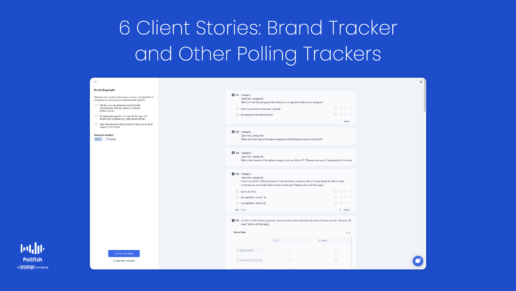
How Pollfish Clients Use Our Brand Tracker and Polling Trackers to Meet Business Goals
How Pollfish Clients Use Our Brand Tracker and Polling Trackers to Meet Business Goals

Running a brand tracker and other polling trackers is essential to keeping a constant oversight of the perceptions of your company. Understanding the views of your target market will help you both conceive and execute a variety of business campaigns.
Pollfish clients run trackers throughout the year to track everything from their brand awareness to consumer loyalty and a variety of other matters.
That’s because when it comes conducting market research, understanding your customers is one of the most important benefits, as it helps drive the success of a variety of business goals. Aside from understanding their needs and habits, it is just as crucial to understand how your customers view your brand in particular.
That’s where brand and other polling trackers are especially useful, as they allow you to discover how your target market views various aspects and news of your brand, along with unearthing whether they know about its existence in the first place.
This article provides firsthand information on how clients of the online market research platform Pollfish use brand trackers and other polling trackers to meet their business goals.
Brand Awareness and Usage of a Streaming Platform
One of Pollfish’s major clients is a global audio streaming and media services provider. This platform used Pollfish brand trackers to conduct global market research. The client's intent was to track brand awareness and usage of their platform in five countries.
Specifically, this client sought to uncover trends throughout different days, months and even years and then use those trends to compare with the ads that were being run in specific regions.
The streaming platform used the Pollfish brand trackers on a daily basis, seeking to uncover how well residents of the five countries were aware of the streaming platform and how often they used it.
The company has been running the tracker for half a year as the main instrument in assessing brand awareness and usage.
Brand Awareness and Physical Visitation of an Immersive Arts Production Company
An art production company that creates immersive, multimedia experiences for audiences of all ages, relied on the Pollfish brand tracker to trace both brand awareness and the visitation of its physical exhibitions in different states across the US.
The client has continuously used this tracker to see trends across months, using this information to compare to ad expenditure. As of today, they have run the tracker for one year.
The outcome of using this tracker involved leveraging data on brand awareness to understand how ad expenditure is working in certain locations.
Consumer Behavior and Purchasing Decisions of the Condiment Company Kalsec
Kalsec, a US-based food manufacturer that produces condiments, has been running global trackers on Pollfish since 2019. The company has used polling trackers to observe customer behavior, with a particular analysis on purchasing decisions, as they sought to understand their consumers’ decision-making on the purchase of spices and other flavorings.
Kalsec used our trackers to review year-over-year trends to understand their consumers and aid in their own decision-making processes.

Running the trackers in 14 countries, Kalsec investigated the awareness of its brand, along with consumer preferences of their products through a global lens. In doing so, the condiment company was able to compare how awareness and preferences panned out across various countries.
The insights that Kalsec derived allowed the business to make key decisions, specifically those that solidify its stance in the industry as experts and leaders on the topic of hot and spicy flavors.
In addition, the company chose to leverage the insights for content creation and lead generation. Furthermore, the brand tracker aided Kalsec in internal business decisions on product ideation and development.
Brand Loyalty of an E-commerce Marketing Brand
An ecommerce marketing platform sought to examine the brand loyalty of various brands using the platform. As such, it utilized the Pollfish brand tracker to do just that. Specifically, the platform conducted a consumer behavior study to unlock market trends and steer content initiatives.
Beginning in 2020, the ecommerce company has been analyzing trends relating to consumer spending, along with brand loyalty to specific brands that use the platform year-over-year.
Running trackers on a yearly basis, the company sought different opportunities to reach its consumers, while it simultaneously measured their loyalty to the platform.
The tracker also provided the ecommerce platform with insights on consumer behavior, in addition to measuring key metrics to align with internal efforts.
The Quorum Leverages The Pollfish Platform To Surface Key Audience Insights Into The Film Business
In late 2020, The Quorum, a film industry research firm, turned to Pollfish to create a survey tracker for the purpose of measuring awareness and interest in upcoming film releases. Key to this research has been measuring changes over time through longitudinal surveys.
The Quorum has been fielding these studies three times a week for the past 18 months. Results of the surveys are available for all to see on The Quorum's website.

Primarily created as a resource for movie fans, the resulting data has become a valuable resources for the studios and streamers as a way of measuring the health of a film's marketing campaign.
"We are in the field five days a week. In deciding on a data partner, we were looking for a platform that would allow us to maintain complete control over the writing, programming, and fielding of our studies in a frictionless environment. We were immediatley sold once we saw the robust and intuitive Pollfish interface. Eighteen months and hundreds of surveys later, we have no regrets about the decision to work with Pollfish.”
- David Herrin, Founder, The Quorum
This research has resulted in numerous insights into consumer behavior and attitudes about individual films and the theatrical business as a whole. This has proven to be especially valuable in understanding an industry that has seen immense disruption from the pandemic.
The Quorum’s specific objectives with their tracker usage centered on assessing movie awareness over time and determining how the industry has been changing. In addition, the company has been striving to eventually monetize its website by selling its data to studios.
This data is available to the general public, though a market has emerged in licensing the data to studios and streamers. This has become one unexpected monetization model for the tracker.
Brand Awareness and Health of a Condiment Company
Another condiment company has been using the Pollfish brand tracker to keep track of brand health and awareness. Starting in early 2020, the consumer packaged goods company has run a quarterly tracker to track condiment awareness and usage of the products in different cities.
This company has continued relying on the Pollfish tracker, as it allows them to track brand usage and awareness over time in specific, local markets.
Running quarterly, the goals of this tracker include being able to:
- Understand how the company’s brand image stacks up against its competition in its key markets
- Decipher whether its awareness and usage is increasing or decreasing
The tracker has allowed the condiment company to understand the trajectory of its brand perception within its target market and determine how it aligns with other marketing efforts.
Keeping Constant Track of Your Brand
Brand perception shifts with the seasons and the times. What remains constant is the need to satisfy your customers, maintain a healthy brand reputation and grow your brand equity.
As such, you need to keep track of your brand, whether it's for gauging your awareness, reputation, demand or other concerns.
To do so, you’ll need to opt for an online research platform that makes it easy to run polling trackers. This way, you will be able to collect all your necessary data from the right respondents in a short window of time.
As such, choose a survey platform that features artificial intelligence and machine learning to remove low-quality data and offer a broad range of survey and question types.
It should include advanced skip logic to route respondents to relevant follow-up questions based on their previous answers.
Most importantly, it should allow you to survey anyone. As such, you’ll need a platform with a reach to millions of individuals, along with one that offers the Distribution Link feature.
This feature will allow you to send your survey to specific respondents, rather than simply deploying surveys across a network.
With a market research platform that offers all of these capabilities, you’ll be able to survey your audience and run quality trackers whenever you wish.
How to Benefit from Pollfish A/B Test Results & Exports
How to Benefit from Pollfish A/B Test Results & Exports

There are various ways researchers can benefit from Pollfish A/B test results and exports, as the Pollfish platform supports different A/B testing capabilities. These include both monadic A/B testing and sequential A/B testing.
At Pollfish, we’re thrilled to offer product features that exist outside the span of surveys alone, allowing our platform to deliver a truly all-encompassing market research experience. As you know, there are all kinds of market research techniques, which include both primary and secondary market research.
You can form primary market research campaigns via surveying your target market, or by creating A/B tests on any topic of your choice, whether it is for an ad campaign or product development.
It is therefore no surprise that 77% of companies use A/B testing on their website and 71% of companies do so monthly.
This article explains how to use and benefit from A/B testing results and exports on the Pollfish platform.
A/B Testing Results Dashboard
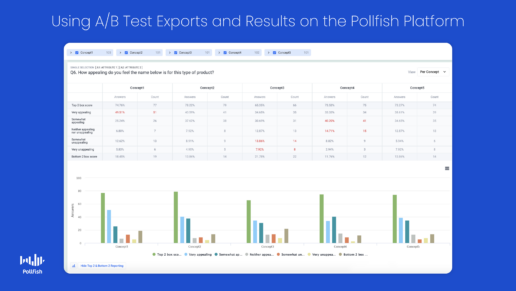
Both the Monadic and Sequential A/B testing results are displayed in separate blocks in the Pollfish dashboard. There, researchers can preview the contents of each A/B testing campaign.
You can use concept shortcuts to filter the results page, isolating the concepts’ audience, along with the question information you seek. While navigating down the questions included in the A/B test, the concept shortcuts remain sticky so that you can access their content easily.

Each question included in a Monadic or Sequential A/B test is presented with concept attributes that accompany the question. You can switch the view of the question results, between concept-focused or answer-focused tables, wherever applicable.
To assist you in simplifying the results of Likert scale questions, our report comes from the Top 2 Box score and Bottom 2 Box scores, which are at the Single selection and Matrix Single selection questions. These are in both the tables and the charts.
The Top 2 Box score is the sum of the number of responses that originate from the first two answers, whereas the Bottom 2 Box score is the sum of the number of responses that are derived from the last 2 answers.

Slider and numeric open-ended questions are presented with a box plot diagram, per concept.
A boxplot is a standardized way of displaying the distribution of data based on a five-number summary (“minimum”, first quartile (Q1), median, third quartile (Q3), and “maximum”). It shows you about your outliers and what their values are.
It can also reveal if your data is symmetrical, how tightly your data is grouped, along with if and how your data is skewed.

A/B Testing Exports
All A/B test exports come through with concepts’ information.
Concept information is included in the form of PDF, Excel, CSV and SPSS exports. In the near future, Pollfish will include concepts in an export of Crosstabs.
Recently, Pollfish has added a new type of Excel export, the Comparison export, in which you can view and compare statistics on different questions for all the concepts side by side. This file is available once the A/B test gets completed, and is offered with post stratified data if applicable.
The Top 2 Box score is also available in the exports section for Single and Matrix Single selection questions.

If you have an Elite plan and use a BQ integration, you will receive the concepts’ information for each response, from the data you export.
Driving the Best A/B Testing Campaigns
A/B testing campaigns help drive the success of all kinds of business campaigns, whether they are product, ad, or topically focused. In order to reap the benefits of A/B tests, you’ll need a platform that offers optimal A/B test exports and results.
You’ll also need to refer to other considerations when choosing a strong online market research platform. These include selecting a top-tier mobile-first platform, as the mobile space continues to dominate and no one wants to participate in research campaigns on a poorly constructed mobile environment.
Your market research platform should also offer artificial intelligence and machine learning to disqualify low-quality data and offer a broad range of survey and question types.
Additionally, it should also allow you to reach anyone. As such, you’ll need a platform with a reach to millions of consumers, along with one that offers the Distribution Link feature. This feature will allow you to send your survey to specific consumers, instead of solely deploying them across a vast network.
With a market research platform that offers all of these offerings, you’ll be able to continuously measure and improve on a wide variety of business campaigns, including sales and marketing and beyond.
Managing and Improving Brand Experience with Surveys
Managing and Improving Brand Experience with Surveys

At the heart of every brand lies its brand experience, which not only helps a business obtain its key differentiating factor(s), but is largely responsible for customers’ associations and feelings towards a brand.
This concept also plays a crucial role in brand visibility and brand equity, as it is the experience that shapes visibility and defines a brand’s value for its customers. Experience-driven businesses see a 1.5 times higher YoY growth than other companies.
In addition, brand experience dictates the way customers share their experiences with others. This is important, as customers make both their good and bad experiences publicly known, such as on social media, forums, review sites and via word-of-mouth.
72% of customers will share a positive experience with 6 or more people. Unsatisfied customers, on the other hand, will share their experience with 15 or more people. To satisfy customers, brands must create consistent brand experiences in an omnichannel setting.
This article explains brand experience, its importance, several examples, how it differs from user experience (UX) and how to manage it and improve it with surveys.
Understanding Brand Experience
This concept is defined by the sum of all thoughts, feelings, reactions and sensations that consumers undergo in response to a brand. Brand experience is not exclusive to a particular channel or media type.
Rather, this is the result or the lasting impression that remains with customers after they’ve either encountered or engaged with a brand in any capacity.
Brand experience is a holistic set of conditions that a company creates to influence how customers perceive a particular product or the brand itself. Given that this involves interacting with customers to influence their feelings, it is also considered a kind of experiential marketing.
Companies form their brand experience through a combination of interactions with customers, whether they are digital, physical (such as with products) or in-person (in-store shopping, events, etc). Through different modes of communication, brands can create a positive atmosphere, so that customers establish a tie between the brand and an emotion or need.
As such, brand experience involves creating sensory user experiences so that they can long resonate with customers. This tactic of engagement facilitates brands to convert their brand awareness into brand loyalty.
The Importance of Brand Experience
Brand experience carries plenty of importance for businesses of all sizes and there they're startups or long-established companies. Firstly, this concept deals heavily with creating positive experiences, the kinds that make all members of a target market remain interested in a company, impressed by how it made them feel.
Since brands are competing on experience, a good product or service alone is not enough to retain customers anymore. Thus, brands need to hone in on their brand experience to truly set themselves apart from competitors. This involves forming experiences that can reasonably be seen as superior to competitors’.

Given that a brand is often expressed as a network of associations living within customers’ minds, brands must foster strong brand experiences so that their consumers continuously view them in a positive light. These associations help businesses and market researchers assess customer perceptions, the relevance of their brand, preferences and whether their marketing campaigns are working.
The notion of brand experience also helps brands forge connections with customers, as experiences can humanize a company, show customers that it is more than just a money-making machine and encourage companies to spend more time with their customers. It therefore makes a brand far more present in the lives of its customers than it would have been had it not involved brand experience in its strategy.
A positive brand experience can inspire customers to make changes to their lifestyle and habits, the kinds that involve buying products from a particular brand. A brand experience can inspire customers to create their own content based on their use of a brand’s product or their experience with one. This creates testimonial-like assets for brands, which they can use in their marketing collateral and social media campaigns.
When businesses provide a positive brand experience, this can be the ultimate deciding factor for customers to choose one brand over another. In fact, brands with superior experiences yield 5.7 times more revenue than companies lagging in brand experience.
This should come as no surprise, given that a strong brand experience spurs repeat purchases, one of the underlying aspects of customer retention. When brands retain their customers, those customers in turn, increase their customer lifetime value by bringing more continuous value to a business.
As such, this concept largely affects customer buying behavior, having the power to steer it in one way or another.
Examples of Brand Experience
There are several factors that form brand experience in its entirety. That’s because various aspects of a customer buying journey influence the way customers view a brand.
The following presents common examples of brand experience aspects:
- Customer service can give customers a positive view of their brand experience and make them likely to purchase or return to a brand.
- A strong digital experience allows companies to create their brand’s online presence through their websites, social media, blogs and mobile apps.
- Promotions such as discounts, coupons and customer loyalty programs bring in new customers and create positive experiences.
- Advertisements that target specific customer personas or a broader audience are an extension of a brand’s personality and feelings associated with it.
- Branding aspects like logos, store layouts and signage designed to involve emotions, via emotional marketing like trust, excitement, or dependability.
- Slogans and jingles that are unique to a brand.
- Community participation, such as physical stores, expressing certain views, addressing regional holidays, etc.
- Content marketing campaigns such as blogs, newsletters, resources, infographics, mobile experiences to mold perceptions of a brand.
- Design aspects such as color schemes for ads, web content, and other marketing collateral to stir up desired feelings in customers.
- Product placement and influencer marketing that disseminates products through different media outlets such as social media, film, commercials, etc., to encourage customers to use their brand.
Brand Experience Vs User Experience
Although these terms may be used interchangeably, they are different concepts that therefore have many differences despite their similarities. While both of these concepts entail the sensory, cognitive and behavioral responses that customers face in response to an experience with a company, there are several distinctions between them.
User experience specifically deals with a customer’s takeaway from their interaction with a brand’s products, services, workers, digital experience or other offerings. For example, a good UX occurs when customers have a positive user experience in the following scenarios:
- Receiving fast and effective customer service
- An easy to navigate website
- A smooth checkout process
- A workable product
Brand experience, on the other hand, is all about communicating a vision and feelings to users, which includes catering to them even before they become a user. Therefore, it heavily relies on design and messaging to communicate specific things that make users feel a particular way about a brand.
User experience deals with the experiences that users have already undergone. It also involves the customer journeys that customers must go through to reach their ultimate destination with a brand.
Although these concepts are different and involve using different methods to uphold, you can’t have one without the other. A positive UX helps foster positive brand experiences. Consider this: when a customer has a positive user experience with a brand’s website or app, this experience influences the way they’ll view the brand behind it.
As such, a user experience should implement a consistent brand voice and other branding elements throughout. If it doesn’t, it will be difficult for customers to recognize the brand behind the experience.
Managing and Improving Brand Experience with Surveys
With the diverse makeup of brand experience, it can appear to be difficult to manage, let alone optimize. Surveys are critical tools to use for various market research purposes, along with marketing purposes such as brand experience.
Brands can manage their BX (brand experience) by first being pointedly aware of their customers, which includes a wide swath of considerations, such as: user experience, customer preferences, expectations, desires, aversions, needs, behaviors, opinions and more.
 This is because surveys can be used to examine virtually any subject by strategically setting up the questionnaire with the 6 main types of survey questions, depending on the capabilities of the online survey platform they use. They can also incorporate different elements into the questions to maximize respondent engagement, such as videos, GIFs, images and more.
Surveys should therefore be used as a data-driven tool to plan and execute brand experience campaigns. However, they provide even more utility than simply understanding customers to improve BX campaigns.
This is because, when a brand explicitly mentions itself in a survey, this tactic creates a brand experience on its own, raising brand awareness and granting respondents a chance to interact with the brand in a unique way. As such, a brand can improve its brand experience with surveys as another avenue for doing so. To this end, brands can also use multiple question types, add multimedia to questions, personalize the questions, as marketing personalization is key to BX, incentivize the survey and more — all while associating the survey and its positive attributes with a brand.
Going Above and Beyond for Your Brand
Making headway in any branding activity requires being prepared and using a data-driven approach that justifies strategies and a plan of action. After all, no business wants to see their time, resources and efforts go to waste.
That’s why all brands need to conduct market research; survey research in particular, is crucial to implement, as it equips brands with the most relevant and granular insights on their niche and target market. This is because market researchers can set up their surveys in their manner of choice and ask any questions they seek. Best of all, they can acquire answers from the respondents that matter the most — their customers.
Equally important to using surveys if not more so, is choosing the correct online survey platform to create and deploy the surveys. Businesses should choose an online survey platform that allows them to hyper-target their survey respondents, set quotas and use advanced skip logic to route users to the proper follow-up questions.
Additionally, a strong online survey tool allows brands to create quality data checks via artificial intelligence and machine learning, use a wide range of filtering data options, engage respondents in their natural digital environments via random device engagement (RDE) sampling and much more.
A business that uses such survey software is well-adjusted and prepared to tackle a wide range of marketing and market research campaigns, including improving its brand experience.

How to Survey Your Audience with a Market Research Platform
How to Survey Your Audience with a Market Research Platform
 Any research endeavor will leave you wondering how to survey your audience properly so that you can collect quality data from the correct survey subjects.
While surveying your audience shouldn't be a daunting chore, it should also not be brushed aside as something requiring little to no thought or structure. Instead, a quality survey campaign requires taking certain actions to ensure you’re studying the survey audience you need, with the correct questions and more.
Online surveys provide the strongest conduit to your target market, a must when conducting market research. In fact, one of the top reasons businesses fail is because they don’t invest in their target market.
This article explains how to survey your audience, including the major aspects to pay attention to and advice on how to achieve your survey campaign goals.
The Major Aspects to Observe When You Survey Your Audience
There are a few chief considerations to consider when surveying your audience. A few of them were mentioned in the intro of this article. But there are several others that are key to work towards when setting up any survey campaign.
The following major aspects show how to survey your audience:
- Targeting the correct survey audience
- Setting the purpose of the survey campaign
- The best time to send a survey
- How to set up your questionnaire
- How to incentivize your respondents
The following section will explain how to survey your audience while keeping these considerations in mind and working towards a campaign that includes all of them.
How to Survey Your Audience
Let’s take an in-depth look at how to survey your audience via the five major aspects identified above. These provide the makeup of any survey campaign.
Reaching Out to the Correct Survey Audience
First, you’ll need to reach out to the correct survey audience. You’ll need to understand who your target market is, and for this, you ought to conduct secondary research. Refer to all the available information on your industry, your specific niche, its customers, its peak sales periods and more.
There is a vast amount of information available online. You can learn more about the different market research techniques and how to perform them.
To understand your target market, you should also consolidate your secondary market research with your own internal documentation. Do you have any customer audits or documents on customer personas?
If not, you should consider creating them by conducting survey research. Surveys allow you to understand the makeup of your customers via market segmentation. The right online survey platform will allow you to target your customers in a granular way, as it will enable you to filter your survey audience through a variety of demographics and add screening questions.
Setting the Purpose of the Survey Campaign
Next, you’ll need to set the purpose of the campaign, if you haven’t done so already when you’ve decided on running a survey campaign. In the realm of market research, it is best to tie your campaign to a particular business goal.

For example, do you need survey insights to strengthen your content marketing strategy? Or, do you need more insights onto who your target market consists of? You may also need to run a campaign to A/B test your advertising. The insights surveys derive are virtually limitless, so you’ll be able to use them for a variety of business matters.
Whatever the case may be, you’ll need to have an overarching campaign or particular goal under which you’ll set up your survey research. This will help you form a well-organized survey and help you put together your questionnaire.
To do so, ask yourself, what is it that you’re looking to gain from the survey and how can it help immediate business needs. Use the following characterization of survey insights to form the basis of your survey campaign:
- Validation of an idea, product or campaign
- New ideas
- Feedback
- User insights
The Best Time to Send a Survey
After you’ve targetted your survey audience, contemplate when you would like to send it.
But first, in order to determine the right time to deploy your survey across a wide network, or by sending the link via specific digital channels, you’ll need to consider the following:
- The point of your survey campaign
- Whether it is tied to other sub-campaigns
- The target audience of the campaign and their habits
- For example, you would target different times to send a survey to the unemployed younger generation, than you would to parents who work a full-time job.
After you’ve consolidated all of these matters, you ought to infer when the best time to send your survey is for different demographics of people. If you seek to send your survey abroad, consider the difference in time.
For example, Monday at 6: 30 PM may be a good time to send surveys to younger, unemployed individuals who enjoy playing video games. But Monday, at 6:30 PM in New York, isn’t the same time in other parts of the world, and even the country.
If you need more help on deciding the best time to send your survey, click on the link to the best time to send a survey, which you’ll find in the “Major Aspects to Observe” section above.
How to Set up Your Questionnaire
There are various routes you can take when it comes to setting up your questionnaire. First, consider the larger campaign or purpose of your survey. Then, consider the curiosities you have and the insights you’ll need.

If there are too many, it is apt to separate the survey into two or more surveys. This is a general best practice for surveys, as no one enjoys filling out long questionnaires.
Then, choose from the following approaches for creating your questionnaire:
- Coming up with your own preliminary questions
- Using survey templates
- Using survey templates, then customizing them to your liking
- Conducting secondary research on survey questions
- Considering using the 6 main types of survey questions
Make sure to personalize your questionnaire, especially if you intend on sending your survey to specific individuals. Even if you’re going to deploy the survey to a massive network, it is best to personalize the contents of it to your target market and customer personas.
Did you know that a whopping 90% of consumers in the US find the idea of personalization appealing? This makes sense, given that no one likes to feel marketed to; nobody wants to see generic content or the kind that does not appeal to their interests or sensitivities at all.
How to Incentivize Your Respondents
Incentivizing your respondents will depend on how you’ll send your survey. If you’re going to distribute it through a massive network of digital channels, opt for a survey platform that partners with publishers that offer survey incentives. These may take many forms, including mobile game incentives.
If you’re going to send your survey to specific individuals, such as via email, or to a slightly broader audience — although not as broad as via a publishers’ network — you’ll need to offer your own incentives. These can be monetary or non-monetary.
Often, they’ll involve your products, services or unique promotions. In this way, survey incentives are a potent marketing initiative, as they bring more exposure to your offerings. Moreover, if you incentivize your respondents with your products or services, you can then send a follow-up survey asking them to rate their experience via a product satisfaction survey.
All in all, survey incentives are useful, as they motivate your target market to take your survey, and to do so quickly. After all, the sooner they’ll complete your survey, the sooner they can get their reward.
Successful Survey Campaigns
All business and non-business entities ought toa conduct their own research via a potent DIY market research platform. How to survey your audience ceases to become an intimidating task when you have a strong survey platform powering the entire process.
You should opt for an online research platform that makes buying survey respondents a quick and simple affair. This way, you’ll collect all your necessary data from the right respondents in a short space of time.
Opt for a platform that features artificial intelligence and machine learning to remove low-quality data and offer a broad range of survey and question types.
It should include advanced skip logic to route respondents to relevant follow-up questions based on their previous answers.
Most importantly, it should allow you to survey anyone. As such, you’ll need a platform with a reach to millions of individuals, along with one that offers the Distribution Link feature.
This feature will allow you to send your survey to specific customers, instead of just deploying them across a network.
With a market research platform that grants you all of these capabilities, you’ll be able to survey your audience and run quality research campaigns.
Gauging and Improving Your Brand Reputation with Market Research
Gauging and Improving Your Brand Reputation with Market Research

Brands must constantly track and work towards improving their brand reputation, whether it is a fledgling business or one with a high degree of brand equity, that is, name recognition and notability.
That is because your brand reputation can make or break your business, given that it is made up of the collective viewpoints of not just your stakeholders, but your customers — the lifeblood of your business.
You should therefore steer clear of any harmful agents towards your reputation — from negative reviews to word-of-mouth and all else. A company risks losing 22% of business when potential customers find a negative article on their first page of search results. This increases to 44% of lost business with two negative articles and 59% with three.
Conversely, 75% of customers will trust a company with a good reputation more, such as in the form of good reviews, for example. You should therefore constantly monitor and attempt to improve your reputation.
This guide expounds on brand reputation, its importance and how to use market research, specifically survey research to gauge and augment that of your own.
Understanding Brand Reputation
Brand reputation is the idea relating to the public's perception of a company or an organization.
This perception is formed by all the actors and agents of a market, which include:
- Stakeholders
- Investors
- Existing customers
- Potential customers and your target market
- Competitors
- The media
- Virtually all spectators who are aware of your brand
How the market and all of its actors view a certain brand is determined by their personal direct or indirect experience with a brand. This means that all kinds of interactions with your brand factor into your reputation.
These include direct interactions with your brand, hearsay, advertisements, secondhand communication from the media and word-of-mouth and much more.
Direct interaction doesn’t merely encompass customers who use a band’s products. Instead, these interactions can include: browsing your website, signing up for a newsletter, viewing your social media, buying a product, experiences with customer support and observing how your business treats its customers and employees.
The public can discover how your business traits its customers and employees personally, or indirectly. This means they can also form their perceptions of your brand based on what they hear or read about from others.
When it comes to the latter, there are various external means that form your reputation, that is, those that come from indirect interactions with your brand. You ought to monitor these factors to avoid any negative feedback, which tarnishes your brand reputation.
The following lists the external factors and means that can harm your brand reputation:
- Bad reviews on review sites
- Poor feedback on forums
- Negative social media mentions
- Negative comments on your social media channels
- Complaints on a major platform such as the Better Business Bureau
- Bad press via articles, blog posts, editorials, press releases, news sites, videos and podcasts
- Negative ads targeting your business
- Adverse word-of-mouth mentions
- Comparisons with competitors that paint them in a better light
On the contrary, when businesses have an excellent brand reputation, it is a marker of a high degree of brand trust. This points to your target market’s willingness to do business with your brand, thereby sustaining it.
Aside from producing a good product or service, your customer experience plays a major role in your brand reputation. In addition, your employees also help build your reputation. That’s why you need to properly train your employees so that they can develop and maintain a good reputation.
It is primarily through different customers’ experiences that other members of your target market — namely those still deciding — base their decision-making process.
This experience can involve any stage of the customer buying journey, as customers can form their opinions from both their personal experiences, along with those that come from hearsay, the media and various other sources.
When it comes to their firsthand experiences, some customers value the post-sales service organizations offer, viewing it as an essential factor in ranking your brand.
The Importance of Brand Reputation
Your brand reputation is crucial for a wide range of reasons.
First off, it is important for customers to do their research on a business, before patronizing it. They would therefore need to study a brand that already has a reputation. This is why startups and newly established businesses must work towards their brand image as soon as possible after launching.
This is especially true for those who intend to spend a considerable amount of money, use a business for a major milestone (think a wedding, a birthday, etc.), or use it for a key aspect of their health (think weight loss, avoiding inflammation, etc).
As such, patronizing new businesses, or any at all ties into customer trust. Customers are far more willing to do business with a company that they trust, as opposed to one with a poor reputation or one without enough information for customers to decide whether it is worth buying from.
When you gain customer trust, your target market will favor your brand over others, giving you a strong market advantage over your rivals. With it, a domino effect has the potential to take place, driving demand for your business.
With a surge in demand, naturally, your business will have a boost in sales and monetary returns. There are various self-evident reasons as to why this is important for your business, along with less obvious, yet equally important, such as increasing your market share.

Your business’s financial value will rise, as it correlates with higher demand and sales, both of which are the benefits of a strong reputation.
Furthermore, it is key to build a healthy brand reputation, as positive brand impressions will lure in more potential customers. This is the by-product of reaping a higher demand for your products and business. As such, a good reputation helps you acquire more customers.
Aside from acquiring new customers, your brand reputation can also help you increase your consumer loyalty. This ties into the idea of customer trust. When customers trust you, not only will they patronize your business once; instead, they’ll be inclined to make repeat purchases.
These are the core of customer retention, the concept that maintains lasting business relationships. When your customers stay with your business for a long time, they grant you a high customer lifetime value, which is the total monetary value a customer brings to a business across their lifetime. This is one of the main benefits of customer retention, which you can establish by maintaining and improving your brand reputation.
It is key to maintain a good reputation, as it also affects the employees of your business. Businesses with poor reputations will suffer higher turnover rates. When businesses have a terrible reputation, they are far less adept at recovering from losing their talent. This is because a bad reputation costs a company at least 10% more per hire.
All in all, it is in the best interest of all businesses to build, track and maintain a healthy brand reputation.
How to Use Surveys to Measure and Improve Brand Reputation
Building a strong brand reputation is highly bent on satisfying your customers. In order to satisfy them, you’ll need to conduct certain market research techniques, as market research is primarily focused on studying your customers.
Surveys, in particular, give you quick and easy access into the minds of your customers, allowing you to understand their consumer preferences, needs, desires, aversions and virtually all else.
As such, you can use surveys to obtain customer feedback on the way your customers perceive your brand. In doing so, you can evaluate your brand reputation directly from the customers themselves.
But even more important is that by using survey research, you will gain the intelligence necessary to correct any issues that trouble your customers, along with optimizing your products, services and customer experience.
By removing bugs and improving your entire customer experience, you’ll delight your customers and maintain a solid brand reputation, the kind that will allow you to reap all of the benefits of it. You’ll just need to track it.

The following explains how to measure and improve your brand reputation through market research, including survey usage:
- Do an internet search of your business.
- Read review sites, forums, social mentions and all other places that mention your brand.
- Check for long-form content if you operate a major brand, such as blog posts, articles and new pieces.
- Conduct secondary market research on your customers.
- Pay attention to what your target market responds well to, along with what they dislike and object to.
- It’s key to study scandals within your industry so that you can avoid them.
- Example: lawsuits, tales of unhappy customers.
- Conduct secondary market research on your competitors.
- Make sure to study how your competitors have handled scandals.
- Pay heed to companies that fell from grace and how they bounced back, along with those that didn’t improve their reputation.
- Learning from your direct and indirect competitors will help you avoid running afoul your customers, industry and media.
- Speak to your customers.
- Conduct one-on-one interviews, phone interviews or focus groups to learn more about your customers’ pet peeves, triggers, etc.
- In addition, ask them about how they feel about your brand and ask for comparisons with other brands.
- Conduct a survey to assess your own reputation.
- Based on your prior research, conduct a survey asking customers to reveal their perceptions about your company.
- Alternatively, you can begin your research by using a survey alone.
- Use a brand perception survey to do so.
- Make sure to ask customers about familiarity with your brand first if you’re deploying your survey to a massive network.
- Survey existing customers. In this case, you don’t need to ask about their familiarity with your brand.
- Analyze your market research.
- This includes your earlier secondary findings, your direct talks with customers and your survey data.
- Run more surveys if you need more information.
- You ought to create follow-up questions and send them to specific people.
- Alternatively. You can call customers to discuss their survey results if this is their preferred method of communicating their perceptions.
- Take action.
- Take action after you consolidate all of your dings, including those of follow-up/additional surveys.
- If you find your reputation to be in good standing, don’t make any changes.
- Rather continue doing as you were before.
- You should also consider creating similar marketing campaigns if your customers put in a good word about them.
- Don’t stop. Continuously track the standing of your brand.
- Use the brand tracking survey to assure good brand health.
- Additionally, run surveys that track brand visibility, so that your brand has not fallen by the wayside, that is, become forgotten about.
Creating a Reputable Brand
Building a reputable brand is a must for your business to survive and remain competitive.
Sustaining a strong reputation goes beyond avoiding scandals and bad press. You’ll need to constantly satisfy your customers and stay relevant in order to sustain a healthy brand reputation.
Conducting market research with surveys helps you achieve these goals. You’ll need a strong online survey platform in order to carry out all of your research.
Use an online survey platform that makes it easy to create and deploy surveys to your target market. You should also use a mobile-first platform since mobile dominates the digital space and no one wants to take surveys in a poorly constructed mobile environment.
Your online survey platform should also offer artificial intelligence and machine learning to disqualify low-quality data and offer a broad range of survey and question types.
Additionally, it should also allow you to survey anyone. As such, you’ll need a platform with a reach to millions of consumers, along with one that offers the Distribution Link feature. This feature will allow you to send your survey to specific consumers, instead of deploying them across a vast network.
With an online survey platform that offers all of these capabilities, you’ll be able to continuously measure and improve your brand reputation, allowing your business to satisfy your customers and remain competitive.
Buy Survey Responses With a DIY Market Research Platform
Buy Survey Responses With a DIY Market Research Platform

Rather than relying on survey panels or syndicated research, you can buy survey responses and access highly sought insights yourself when you use a DIY market research platform.
Such a platform evades many issues present within the aforementioned research methods, such as panel fatigue, which is found in survey panels and exerting less control over a research project, which occurs in syndicated research.
Additionally, in keeping with the idea that any team member can perform quality market research — very much in tune with data democratization — you can buy a set amount of survey responses for your market research needs. You can do so without breaking your budget.
On the contrary, research firms and various market research platforms don’t offer the ease of performing and sharing market research as does a DIY market research platform. What’s more is that many research projects are expensive and time-consuming. As a matter of fact, brands spend $60,000 and more on market research, with an estimated 6 weeks or more to complete a market research project.
With a DIY research tool, you can buy responses, which is far more cost-effective and quicker.
This article explains what it means to buy survey responses and how to do so on the Pollfish online survey platform.
What it Means to Buy Survey Responses
Relatively speaking, buying survey responses is much like buying a survey sample, which is an exclusive pool of all the respondents that make up your survey. As such, it does not mean you’ll need to reach out to individual respondents or send your survey via an online portal yourself.
So what does buying survey respondents entail? In the context of a DIY market research platform, it means you buy the participation of your target audience based on a particular number of individuals.
Given that you and your team are at the helm of market research study, it is up to your team to decide the number of respondents you would like to partake in your survey. It is key to note that you are not buying for participation in an entire campaign. Rather, you pay for individual respondents’ participation in a specific survey.
By buying survey respondents, you’re allocating all the data you need for any survey; at times, one survey is all you’ll need for a market research campaign, unless you’re seeking out other market research techniques.
Thus, when you pay for individual survey respondents, you’re building the entirety of the subjects that make up a DIY survey.
As such, when you buy responses in a DIY market research platform, you’re hastening the speed to insights and reducing the span of the research project. This is one of the many benefits of buying your responses.
Benefits of Buying Survey Responses

When you buy survey responses on a DIY market research platform, you’re doing more than just opting in research participants. A strong DIY market research platform offers various benefits. These include the following:
- Reaching the exact number of respondents you need
- Obtaining respondents where they naturally exist online
- via RDE sampling or random device engagement
- Market segmentation and targetting
- Quicker insights
- Reaching your particular target market
- Dictating the demographics, psychographics and geolocation of respondents
- All the data you reap is proprietary to you (not the DIY survey platform)
- Being equipped with key data for decision making
- Insights for business decisions
- Steering the direction of a research campaign
How to Buy Survey Responses on Pollfish
Buying respondents is easy and hassle-free — with the right DIY research platform. You can buy individual survey responses on Pollfish.
All respondents are pre-screened and pre-qualified to take part in a survey study. This means, only the respondents you target can take your survey. They will need to tick off all your requirements, from location to demographics and more, depending on how you set up your screener.
To buy responses on Pollfish, you’ll first need to choose a pricing plan. On this page, you have the option of choosing a basic or elite plan. In the basic plan, you can buy survey responses at an individual basis.

Each completed survey, aka, individual survey respondents starts at $0.95. Prices range from $0.95 to $1.25 based on the number of questions in your survey.
Once you choose a pricing plan best suited for you, you can then begin your market research endeavors. The Pollfish dashboard is easy to access and allows you to make your own survey in just 3 steps.
Then, commence targeting your respondents by setting up various qualifications in the screener section of your survey. In Pollfish, this interface is referred to as the Audience section. Here you can also set the exact number of survey completes in your survey. Each complete is done by an individual survey respondent. As such, a survey with 800 survey completes = 800 survey respondents.
You can also create custom quotas to narrow down specific people and see how different groups answer questions. For example, you can create quotas such as: 300 middle-aged men with a salary between $100,000-$250,000.
Constant Access to Any Target Population
All business and non-business entities can conduct their own research via a potent DIY market research platform. Even individuals who seek data on a specific target population can do so at speed when they buy survey respondents.
You should opt for an online research platform that makes buying survey respondents a quick and simple process. This way, you’ll collect all your necessary data from the right respondents in a short space of time.
Opt for a platform that features artificial intelligence and machine learning to remove low-quality data and offer a broad range of survey and question types.
It should include advanced skip logic to route respondents to relevant follow-up questions based on their previous answers.
Most importantly, it should allow you to survey anyone. As such, you’ll need a platform with a reach to millions of individuals, along with one that offers the Distribution Link feature.
This feature will allow you to send your survey to specific customers, instead of just deploying them across a network.
With all of these capabilities, you’ll be able to reach any target audience and run quality research campaigns.