
How to Collect Customer Feedback with Surveys
How to Collect Customer Feedback with Surveys

You won’t be able to understand your target market and cater to its needs without collecting customer feedback. Relying solely on secondary market research is a thing of the past, with the accessibility and speed to insights that many online market research tools provide.
It’s now more important than ever to gather customer feedback, as there are so many digital outlets for customers to voice their opinions, be they frustrations or satisfaction.
72% of customers will share a positive experience with a business with 6 or more people. However, 13% of unhappy customers will share their experience with 15 or even more people.
At face value, this disparity may not seem so caustic, when you compare 72% with 13%. However, the challenge lies in the fact that, in most cases, customers don’t share their dissatisfaction with businesses. In fact, only 1 in 26 unhappy customers will complain.
As such, it is up to businesses to extract customer feedback from their customers.
This article provides an in-depth glance into customer feedback and how to collect it with survey research, using the correct methods and the correct tool.
Understanding Customer Feedback
Customer feedback refers to all the information that customers provide about their experience with a business, whether it is in regards to a product, a service, a specific experience and virtually everything else in their customer buying journey.
Customer feedback can be either verbal or written communication from your customers, expressing how they feel when dealing with your business in any capacity. As such, aside from giving feedback on the main issues listed above, customers can sound off on other matters concerning your business, such as advertisements, sensory influences (think taste and smell) and your brand in its entirety.
The purpose of customer feedback is to reveal customers’ degree of satisfaction or dissatisfaction with a business across touchpoints and offerings. This kind of feedback is used to help product, marketing, customer service, customer success and sales teams understand how to improve, ultimately to make their customers happy.
Companies can collect customer feedback through a variety of means, such as interviewing customers over the phone, using VoC programs, asking for reviews, speaking with them in-store and through other means.
You can also passively collect feedback for your team by providing your customers with a place in the product where they can make comments, complaints, or compliments. This is usually facilitated via SaaS and other cloud-based services.
The most potent way of obtaining customer feedback is through polling software, which allows companies to survey the masses belonging to their target market. It can also target specific individuals by sending surveys to them via the Distribution Link feature.
The Importance of Obtaining and Studying Customer Feedback
All businesses, whether they are B2C or B2B, must work towards collecting and studying their customer feedback. This is because, in order to improve your product, service and overall customer experience, you’ll need to understand how your customers feel towards all of these matters.
Customer feedback essentially serves as a guiding source for your business’s growth. It allows customers to express exactly what they appreciate and dislike about your company; this is invaluable information for improving your business and taking any action. After all, you wouldn’t want to launch campaigns that drain your funds while yielding little to no ROI.
In addition, feedback is powerful, as it grants your leadership team insights from the customers themselves, which allows your team to forge a path forward in every part of your business — from product to marketing, through UX and customer support. These insights are especially critical for building and maintaining customer satisfaction.
By gaining customer feedback, your business will be able to sustain a customer-first model that prompts customers to buy from you continuously. As such, using customer feedback is also a key towards building customer retention.

Additionally, customers tend to favor marketing personalization, as no one likes to be sent generic and stagnant messaging and offers. Marketing personalization, as its name suggests, allows businesses to communicate in a hyper-personalized way to customers. But without collecting their feedback, it is nearly impossible to create personalized experiences for them.
Moreover, without customer feedback, your company will never know if customers are reaping value out of your offerings. This presents a major lack for product and go-to-market teams, since without feedback, they’re wasting time and resources on offerings that customers may draw little value from. Remember, as per the intro, only 1 in 26 unhappy customers complain.
When customers draw little to no value from a product, or are unhappy with other business-related interactions and issues, they will leave, increasing a company’s customer attrition rate, while lowering its customer lifetime value.
Needless to say, your business will see an exodus of customers and plummeting sales if it lacks customer feedback.
Despite the importance of gaining customer feedback, customers themselves don’t believe that companies are using this feedback to make any improvements, as 53% of shoppers believe their customer feedback doesn't go to anyone who can actually take action on it.
As such, the three main concerns for your business are to properly obtain feedback from customers, especially the segments on which you seek to run a campaign, to collect feedback at the most appropriate times and to analyze it correctly.
When to Collect Customer Feedback
The pertinent question to ask now is: when should you collect customer feedback? In order to answer this question, you must first mull over WHY you need to collect feedback. There are a few opportune times to collect feedback from your customers. Sending them surveys during this time will be beneficial for your campaigns.
 The following lists the most apt times to gather customer feedback:
- Immediately after customers interact with your content, no matter what stage in the funnel they are in.
- Before you begin working on any marketing, branding or advertising campaign.
- There is a slew of sub-campaigns for each three of these major categories. You ought to survey your target market on their feedback before working, let alone, launching any of them.
- These insights will let you know how to form a campaign, what to include and what to avoid.
- Customer feedback in the pre-campaign stage allows you to avoid snafus and faux pas, including in relation to cultural trends.
- After customers encounter obstacles in their customer journey.
- Whether they have difficulty finding what they need on your website, checking out or signing up for something, you should ask for their feedback to unearth exactly what’s troubling them so you can fix any obstacles quickly.
- After customers checked out (successfully).
- Even if customers were able to check out without issues, you should still get their feedback as a means of checking up on them and your digital experience/ how well your site functions.
- After customers received their order.
- You can obtain product satisfaction feedback after your customers have received their orders and used them. This is usually a few days to a week after customers have received their order, depending on what it is.
- Long-term follow-up.
- This is especially useful if you offer a subscription service or sell a long-term product, such
- When you need to ask them to make a recommendation.
- The most apt time to do this is a considerably long time following a purchase, or several purchases.
- The most common way to test customers whether they would make a recommendation is with the NPS survey.
How to Gather Customer Feedback with Surveys
You’ll need to be strategic when it comes to gaining customer feedback in order to gain valuable data. Surveys provide many formats for obtaining customer feedback.
Once you have determined why you need to collect customer feedback, as the previous section examined and have an end goal, proceed to the next step by asking yourself how you will collect feedback.
An online survey platform offers the most efficient method of gaining customer feedback, as you can survey any demographic group you wish. Surveys grant you insights on all of the situations highlighted in the section that covers when to collect feedback.
To gather customer feedback, first choose the main campaign for the feedback. For example, let’s say your customers signed up for your newsletter.
You can send them a consumer survey to ask how they discovered your brand, why they signed up, what they’re looking for and what they like about your brand. This kind of survey will largely be based on customers’ first impressions and brand awareness.
If you’d like to understand how your customers viewed a recent event you held, whether it is digital, such as a webinar, or physical, such as a grand opening of a store or after they shopped during a promotional sale, conduct an event evaluation survey.
This survey is specifically designed to gauge the CX of your events and can help you see how you excelled, fell short and what to change/prepare fr for your next events.
If you’re dealing with long-time customers, you can send them the aforementioned NPS (Net Promoter Score) survey to determine if your consumers are detractors, promoters or passive customers for your brand. You can ask follow-up questions on how you can improve and take action from there. This way, you can master catering to their consumer preferences.
Connecting with All Your Customers
Customer feedback enables you to connect with customers on things that matter the most to them, allowing you to prioritize all the most necessary actions for improving your business.
The feedback you derive from customers will inform your company on crucial matters as it grows and evolves. This, in turn, helps your business thrive.
You should keep in mind that gathering customer knowledge is a continuous and important practice for any customer success manager or marketer. As such, it is important to choose a robust online survey platform to carry out all of your feedback campaigns.
A strong online survey provider operates via random device engagement (RDE) sampling, which enables you to reach respondents in their natural digital environments, as opposed to pre-recruiting them. This stamps out social pressures to answer in a particular way and cuts back on biases.
You should also use a mobile-first platform, as mobile dominates the digital space, so ideally, you would need a survey tool with the best mobile experience.
The platform should also offer artificial intelligence and machine learning to remove low-quality data, offer a broad range of survey and question types and disqualify low-quality data.
Most importantly, it should allow you to survey anyone. As such, you’ll need a platform with a reach to millions of consumers, along with one that offers the Distribution Link feature.
This feature will allow you to send your survey to specific customers, aside from deploying them across a network. This is especially important for gathering feedback during the specific times mentioned in the section on when to collect feedback.
When you use an online survey platform with all of these capabilities, you’ll be getting all the quality customer feedback you need.


How to Implement an Advanced Design with Survey Logic
How to Implement an Advanced Design with Survey Logic

The Pollfish online survey platform is feature-rich, offering various methods of using survey logic in your surveys. Logic directs respondents to relevant questions, assuring you ask the correct follow-up questions based on their answers.
While the Pollfish online survey platform is intuitive, it can be overwhelming to maneuver between the different survey logic options at times.
This article explains the three main types of survey logic functions available on the Pollfish platform and how to use them to remove any ambiguity.
Understanding Survey Logic
Many providers of automated surveys offer the functionality of survey logic to augment the survey experience by routing respondents to the proper questions.
This is necessary, as not all respondents will respond with the same answers; as such, not all follow-up questions will be relevant to all respondents. Instead, they’ll need to be sent to questions that are logically next in line with the answers that your respondents provided.
That’s where survey logic comes into play.
The term “survey logic” denotes the mechanisms that change survey behavior, appearance and content based on the answers that respondents give.
Logic instills changes by way of automation, so the researchers don’t need to take action in order for the survey to make a set of certain functions. Instead, it saves the researchers manual labor by automating the survey functions.
Survey logic is mainly concerned with routing respondents to the relevant questions after they answer a question. It works by directing respondents to specific questions based on their answers.
How to Apply Survey Logic to Single-Selection and Matrix Questions
Understand survey logic by beginning with single-selection and single selection Matrix questions.
- Go to the Questionnaire section of the survey.

- Have your set of preliminary questions ready so that you are ready to apply logic.

- Choose the Single Select or Matrix Single Select question type(s).

- Go to the left-side menu panel and select “Apply logic” at the bottom.
- This is next to the tree branch icon, which also exists at the top left of the panel.
- Hence, this is why survey logic is sometimes referred to as “branching.”

- Add in the rules that will appear in the next interface.
- They will appear as such: “If the answer at Q1 (Question 1) is A, go to” “...”
- There, you can add where you want to direct the respondents.
- You have the option of seeing the logic path on the right side, showing you the flow of questions the respondents will undergo.

How to Apply Survey Logic to Multi-Selection Questions
In multi-selection questions, you cannot apply logic to just one question. Instead, you’ll need to do so in all the questions. This is because each answer is routed to a specific question, and since respondents can select multiple answers, they’ll be led to banks of questions.
- Have your set of questions ready, with rules established on how respondents are to be routed based on their answers.
- At each question, go to the left-side panel and click on “Apply logic.”
- This is the tree branch icon, situated right below the pencil icon and to the left of the “Multiple Selection” question type.

- This is the tree branch icon, situated right below the pencil icon and to the left of the “Multiple Selection” question type.
- Add in the rules to your logic based on each answer respondents can provide.
- For example, if in Q1 (Question 1), the answer choices are A, B, and C and D and each answer has 2 follow up questions that pertain to that answer choice, you must route the respondents to the proper follow-up questions based on the selections they make in Q1.
- Another example, the logic at Q1 is: if the answer is A go to Q2, if B, go to Q4, if C, go to Q6, if D, go to Q8. Those who answer A will answer Qs 2 and 3, B Qs 4 and 5, C Qs 6 and 7, and 8 and 9.
- But since it is a multi-select question, you must also apply logic at Q3 that states if B, go to Q4, if C, go to Q6, if D, go to Q8.
- Then at Q5, the order will be, if C, go to Q6, if D, go to Q8.
- Finally at Q7 should state, if D go to Q8.

- Apply the logic until the last question.
- This will create a ladder of logic, with layers in each question.

- This will create a ladder of logic, with layers in each question.
How to Apply Survey Logic to Reference an Answer from a Previous Question
You can refer back to an earlier question to determine the path the respondent will take in the survey by applying logic.
As such, you can use a scenario in which all of your respondents will be directed to a set of questions, for example, questions 1-7. But, you seek to apply logic to only questions 8-11. You can do so when you apply logic.
- Have your set of questions ready, with rules established on how respondents are to be routed based on their answers.
- At each question, go to the left-side panel and click on “Apply logic.”
- This is the tree branch icon, situated right below the pencil icon and to the left of the question type.
- You may not need to apply logic to every question.
- Take the following example to insert an answer from a previous question.
- There is a survey that asks in Q1: “What is your favorite baseball team?”
- Qs 2-5 are universal questions that all respondents can answer and are about baseball in general.
 On Q’s 6-10, let’s say you want to ask questions specific to those who selected the Yankees in Q1.
- As such, in Q5 you would insert logic that dictates the following: if the answer at Q1 was Yankees go to Q6, in any other case, end the survey so only those who chose the Yankees will answer only Qs 6-10.

- As such, in Q5 you would insert logic that dictates the following: if the answer at Q1 was Yankees go to Q6, in any other case, end the survey so only those who chose the Yankees will answer only Qs 6-10.
Designing the Perfect Survey
To design a strong survey, you’ll need to apply survey logic to different kinds of questions. This advanced feature is invaluable but can create roadblocks when applying it to different types of questions.
You should therefore know how the three main survey logic scenarios differ and how to use this function in all three.
In addition, to adequately run this kind of survey function, you’ll need to use a quality online survey platform, the kind that makes it easy to create and deploy surveys.
You should also use a mobile-first platform since mobile dominates the digital space and no one wants to take surveys in a mobile environment that’s not adept for mobile devices.
Your online survey platform should also offer artificial intelligence and machine learning to remove low-quality data, disqualify low-quality data and offer a broad range of survey and question types.
Additionally, it should also allow you to survey anyone. As such, you’ll need a platform with a reach to millions of consumers, along with one that offers the Distribution Link feature.
With an online survey platform with all of these capabilities, you’ll be able to set up survey logic for all your campaign survey needs.
The Complete Guide on Market Research vs Market Analysis
The Complete Guide on Market Research vs Market Analysis

Market research versus market analysis. This is a topic of contention for many in the business and research worlds. Both of these concepts yield critical data and intelligence for businesses and both of them are necessary to sustain a business.
Both market research and market analysis empower businesses to analyze areas of their industry, predict future trends, hone their business practices and lead organizations effectively. They both deal with big data problems from time to time. Both of these concepts also allow businesses to assess industry expectations and meet them.
However, although these terms are used interchangeably and offer similar business benefits, they are not the same thing, as each represents different key factors, processes, objectives and methodologies.
We’ve taught you about the differences in market research vs. user research. This guide lays out market research vs. market analysis, allowing you to understand all of their key facets and differences, so that you can understand when and how to apply both.
Understanding Market Research
Market research refers to a process that is far more specialized than market analysis, as it entails examining a specific market and its corresponding customers. It is usually bent on answering distinct questions regarding customer behavior along with all else that pertains to a target market, which is the group of consumers most likely to buy from a business.
Market research involves studying customers at an in-depth level, which therefore includes segmenting them into distinct groups and designating them with individual customer personas. This involves the practice of performing market segmentation, along with conducting secondary and primary market research techniques prior, during and after administering market segmentation.
Aside from referring to and implementing primary and secondary resources, market research encompasses both quantitative market research and qualitative market research methods.
Given that this kind of research is centered around customers, it examines a variety of customer traits and characteristics. They include the following:
- Customer buying behavior
- Customer preferences
- Desires and needs
- Customer aversions
- Opinions and sentiments in regards to
- Values
- Products
- Cultural trends
- Current events
- The industry at large
- Prices
- Lifestyles
- Behaviors
- Customer experience (CX)
- Views on the industry at large
- General feedback
Market research is a practice undertaken by business owners, researchers, analysts, marketing departments and even individuals. Essentially, market research is used to gather feedback and data directly from the customers, mainly to assess the viability of particular business decisions.
The Importance of Market Research

Market research carries a great deal of importance, as it empowers all businesses with critical data that steers them towards making the right business decisions.
Firstly, it’s important for startups and new businesses to conduct market research before launching their business or even innovating on a product. Although it is tempting to push a product to market, a lack of market research has grave consequences.
It is difficult to acquire new customers for established businesses, as it costs five times more to acquire a customer than it does to retain an existing one. Additionally, selling to a new customer has a low success rate of 5-20%, while selling to an existing customer has a success rate of 60-70%.
This environment exists for existing businesses. It is even more arduous for startups and yet-to-be registered businesses to gain a customer base. As such, these businesses must conduct market research. It grants them valuable knowledge about the particulars in their industry and most importantly, their target market.
Only when you understand your customers can you serve them properly. After all, you're not just selling a product or service. Businesses of the present can only survive if they provide a strong experience for their customers. 73% of U.S. customers say that CX is a very important factor in their purchasing decision. 1 in 3 custumers will leave a company after just one bad experience.
Clearly, customer experience is vastly important and in order to create positive experiences that not only draw in but retain customers, you’ll need to understand your customers at a deep level.
Market research makes this possible, as it allows you to learn everything about your target market, segment them into smaller, more distinct groups that you can dedicate to different campaigns and satisfy them continuously.
Understanding Market Analysis
Market analysis is the process of examining a particular market, industry, niche or segment. It is carried out by way of quantitative and qualitative assessments of a market.
This analysis relies on raw data that predominantly focuses on a market's size and potential. As such, it involves studying a market by observing various factors that involve these two concepts.
A market analysis involves observing the following aspects: market volume, value, its different customer segments and their customer buying behavior, economic conditions, regulations, the competition, barriers to entry and political, social and cultural trends, as they relate to the market.
A market analysis uses current and historical data to forecast future market events and outcomes. This data includes information on the above topics of observation. Businesses use market analyses so that they can understand how their products and experiences may exist under a certain environment.
This kind of analysis allows companies to plan ahead for the future in a strategic way, using data for decision-making. This is because it allows companies to get a plain understanding of the most important factors of their market.
A market analysis is an all-encompassing practice of examining a market, therefore, it uses a wide range of sources. This involves using market research to provide key information on customers and other aspects of the market. By relying on a vast number of sources, a market analysis can assess and predict all of a business’s growth options, as well as its possible stumbling blocks and limitations.
In short, a market analysis gives businesses a broader understanding of their market by relying on multiple means and sources of data that pertain to various aspects of the industry.
The Importance of Market Analysis
 Market analysis is important for a variety of reasons. Almost every successful product or service of the present involves having conducted a thorough market analysis. This analysis is often the first and the most significant stage in the development of a marketing and business plan.
The process of a market analysis is important, as it allows business owners to evaluate whether their product or service will satisfy their customers’ needs. This way, they don't waste time on producing products, product updates and features that will perform poorly and generate few sales.
A market analysis helps gain insights into the shifts occurring in the economy. This can include changes in regulations that directly or indirectly affect your business. It also helps you stay aware of market trends, which puts supply and demand in perspective.
This helps you set reasonable prices that are commensurate with demand. It allows you to understand the desirable products and services along with those that drive little demand. These key aspects enable your business to become fully acquainted with the economy, along with the particular one of their industry.
In addition, this kind of analysis is important in that it provides insights into your target market, the segment of the market most likely to be your customers. It does so, as it involves studying your demographics along with their behaviors, traits and expenditures. In this sense, market analysis is critical as it implements market research.
Furthermore, a market analysis will help you plan the most promising strategy to market your product or service product. This is because when analyzing the key facts of your market, many marketing messages will come your way.
Even by casually browsing your competitors’ sites and social channels, you’ll discover various marketing techniques, from ads, to landing pages, webinars, promotions and much more. This will give you critical information on the kinds of marketing methods to test and try.
Given that a market analysis touches on so many components of a market, it equips businesses with essential knowledge for making auspicious business decisions. This kind of knowledge allows you to complete a business plan, as it has its own section, showing prospective and plausible investors that you understand your market.
The results that your market analysis draws enables your company to identify both the opportunities and risks of your particular market. All in all, this kind of analysis sheds light on all the foundational aspects of a business, along with its main ongoing concerns. This kind of knowledge will inform and bolster all kinds of business endeavors.
The Key Differences Between Market Research and Market Analysis
There is considerable overlap between market research and market analysis, given that some market research projects may include a market analysis and especially since market analysis encompasses market research.
Additionally, you can complete both a market analysis and market research for a business plan. You can use both of these insights-rich methods to support a wide array of different documents and reports. Both of these can point you to the appropriate action based on the data you collect.
However, these two terms are not the same and should, therefore, not be confused with one another.
The main differentiating factor between them is that market research is inclined on gathering customer-specific intelligence. Market analysis, on the other hand, seeks a far more expansive perspective of a market, thereby relying on more resources, to execute all the possible business forecasts and examine all growth options.
Whereas market analysis is broad, market research is much more specific and fine-tuned. Market research is therefore restricted by the population of studies, emotions and time, as well as different kinds of human interaction.
In contrast with market research, market analysis works by depositing large quantities of data into a large storage framework. Market research works by collecting specific data points necessary for answering certain research concerns.
Market analysis often yields results that last in the long-term, while the results of market research tend to be valid for several months to years, depending on the population and theme of the study, given that public opinion can change quickly.
In conclusion, market analysis strives to render a clear picture of the majority of a market, while market research is focused on understanding its customer base and those possible prospects.
Reinforcing All Your Research and Analysis Needs
Market analysis and market research are two exceedingly important processes of gaining information to bolster your business. Despite their similar nature and often conflation, they are two distinct practices and should not be mistaken for one another.
However, in order to conduct market research and even garner intelligence for market analysis, your business ought to use a strong online survey platform. It can be used to study your customers on a deep level, along with what people perceive in your market. You can also send surveys to specific people with Link Distribution, allowing you to better understand your market by surveying key players.
To do so, you ought to look into a strong online survey platform, the kind that operates via random device engagement (RDE) sampling, which reaches respondents in their natural digital environments, scaling back on survey bias.
You should also opt for an online survey platform that implements artificial intelligence and machine learning to disqualify survey fraud and poor-quality data and offer a mobile-first design.
Such a platform will ensure you gain the most quality insights on your market and customers in a timely way.
Creating the Ultimate Brand Advocate through Survey Research
Creating the Ultimate Brand Advocate through Survey Research

All businesses should strive to create the ultimate brand advocate, or at least attempt to form some degree of brand advocacy.
This is because brand advocates play a major role in strengthening a business; they raise brand awareness, help brands acquire new customers, reinforce brand trust with existing customers and even vitalize brand equity.
Brand advocates influence 50% of purchasing decisions. In addition, a heaping 92% of online customers trust recommendations from their social circle; clearly, brand advocates are integral players when it comes to helping businesses achieve success, as they make word-of-mouth marketing possible.
This article explains what a brand advocate is, along with describing the importance of brand advocacy, what makes a strong advocate and how surveys help brands obtain a loyal brand advocate.
Understanding Brand Advocacy
A brand advocate is a person who shares positive feedback about their experience and patronage with a company across their network and through various means and media.
Unlike a partnership or an endorsement, brand advocacy doesn’t rely on influencers, though they too can become brand advocates. A brand advocate works without any incentive other than their appreciation for a brand. This means, they do all of their advocacy for free.
Although typically associated with word-of-mouth marketing, a brand advocate can support a company via social media channels, online reviews, forums, chat rooms, emails, and other electronic and non-electronic means.
A brand advocate can also express their satisfaction with a company through their own content, whether it is a blog post, images or videos of their using a product or interacting with a company.
This kind of advocate acts as a representative of a brand community, showing others how a brand and its offerings are valuable. Their support for a company is entirely voluntary, thus, they want to take part in advocacy but don’t have to, as they aren’t getting paid for it.
Brand advocates are usually enthusiastic, and outspoken ambassadors, that rank as promoters in an NPS survey. When businesses identify and leverage ambassadors to drive new business opportunities, they are using brand advocacy.
Examples of Brand Advocacy
Brand advocacy can include various actions. It works best when advocates do it authentically because, although brand advocacy can include influencers, this kind of marketing is unpaid and completely organic.
A few examples of the work that brand advocates can provide include:
- Personal (word-of-mouth) recommendations to friends, family and colleagues
- Social media posts
- User-generated content (UGC)
- Customer referrals
- Reviews
- Participating in (or building) customer communities
- Mentions in forums
- Link-dropping
What Makes a Good Brand Advocate
In addition to recommending a brand privately, a good brand advocate is anyone who doesn’t shy away from publicly supporting and praising a brand and its products and services.
A valuable brand advocate is one who proactively promotes your business through various outlets and media. Such an advocate is typically a customer but they can virtually be anyone, such as employees, executives, partners and influencers who are genuinely satisfied with your brand and are happy to publicly show their support for it.
The more ideal brand advocates are loyal, have a high customer lifetime value (CLV), have an online reach and closely represent your company’s values and personality.
As aforementioned, a brand advocate works best when they act authentically; no one likes being marketed to under the guise of genuineness. That’s why most advertisements and the like are marked as such. Ex: “paid partnership with…”
When your advocates’ values align with your brand, their advocacy appears to be far more authentic than it would otherwise. This also means that these advocates are in a better position for reaching your target market, as they typically have a network full of people with like-minded interests and views.
For example, if you are an activewear company, a strong brand advocate will have a fitness background, such as that of a worker in the space or someone who takes their fitness routine seriously.
It is especially important for your brand advocates to be real users of your product, service or experiences, as this kind of authenticity carries the core strength beyond brand advocacy: that of brand trust.
This concept makes a brand advocate much more useful and impactful than an influencer, as paid influencers promote products they wouldn’t normally use, making it easy to label their efforts as product placement.
When your brand advocate isn’t affiliated with your company, their support is seen as more genuine and influential to potential customers.
Finally, engaged employees can also be ideal brand advocates, as they are loyal to a company and share their workplace experiences and culture as employee brand advocates. They share these experiences on their social media and other outlets.
The Importance of Brand Advocacy
Brand advocacy is not merely an added benefit for marketing departments and their corresponding businesses at large. It carries major importance for businesses on several fronts.
First off, a successful brand relies on positive public perception, as this is the core of a business’s reputation. Brand advocacy contributes to this with positive messaging and other content that reinforces a brand’s strengths to the masses.
Secondly, customers who share their positive reviews and experiences about a brand on social media and other digital spaces can reel in new customers. As such, a brand advocate helps increase customer acquisition, which is often more expensive than customer retention.
In this way, a brand advocate positively influences your sales. In fact, as the intro mentioned, brand advocates influence a hefty 50% of all purchase decisions — that’s a significant amount of revenue brought in via free marketing efforts.

Brand advocacy is a must, as it renders a company to stand out in a crowd of competitors. This makes a brand seem more trustworthy than its competitors with few or no advocates. Brand advocacy operates as a powerful publicity machine beneficial for all types of organizations, from B2C retailers to B2B companies and even charities.
Brand advocacy also encourages consumer loyalty. This is crucial, given that customer retention costs companies less than acquisition and yields more profits than acquisition. Retention drives 52% of revenue, whereas acquisition drives about 45%.
Brand advocacy and customer loyalty have a symbiotic relationship, in that brand advocates influence existing consumers to remain loyal, while loyal customers can be so committed to a company that they too become brand advocates.
Brand advocacy also builds trust. When consumers trust a company, whether it is in its service, product promises or delivery of values, it will patronize it instead of its competitors. It will also remain in their minds as opposed to other companies in the same niche.
Why? Consider this: a brand with brand trust is valuable, desirable and therefore memorable, whereas a brand without it is seen as just another fish in the sea, another filler or placeholder for the main player. In this case, the evident key player is the brand with brand trust.
Brand advocacy is also important for content marketing strategy, as it boosts content creation. Whenever a brand advocate includes a brand in their social media, video or blog content, they’re providing free marketing. This becomes useful for SEO, when they include links to the brand, which can drive their readers and followers to your website.
You can also ask your brand advocates to contribute to your blog or other content assets, such as a testimonial. Content is king for a reason, as it keeps your website from becoming stagnant. A high content volume also contributes to brand awareness.
Finally, brand advocates can help expand a business’s target market. This is because advocates help convert members of audiences that are not part of a business’s target market. For example, a local gym may notice that most of its clientele are people ages 18-40. However, a brand advocate may encourage and convince a 60-year-old to frequent this gym.
How Surveys Allow Brands To Obtain Brand Advocates
Rome wasn’t built in a day and neither are brand advocates; rather they are cultivated personas that have to be assured of a brand’s excellence in products, services and experiences.
Brand advocacy is also built through connections. When customers experience strong connections, they connect with brands. Whether it is through brand messaging, values or their CX, when customers form a connection with a brand, they trust it, and brand trust is the gateway to brand advocacy.
But to build this trust, businesses need to first have a strong grip on their target market. As such, they need to study their consumers through easy and practical means. That’s where survey research comes into play as the key practice in primary market research.

Surveys are the most potent tools when it comes to studying a customer base, as they provide firsthand insights from the customers themselves. These insights include information on their customer buying behavior, their likes, hobbies, aversions, opinions, desires, needs, behaviors and virtually all else.
Surveys can be deployed to the masses, across a wide geographic area and tinkered so that only the respondent with the desired demographics, localities and even behavioral qualities are qualified to take part in the study.
That way, businesses only observe the most relevant respondents and gain answers to their most pressing inquiries.
Surveys provide brands with a window into the minds of their target market, allowing them to better market to them, serve them, and most importantly, understand them to cater to them properly and make them feel seen and heard.
Best of all, they are quick to complete, both in terms of deployment and completion of the surveys themselves, should you use the correct online survey platform, that is.
Forming Meaningful Connections with Consumers
Brand advocates are key players for businesses, as they not only posit them in a positive light, but sing their praises to their network of family, friends, colleagues and peers, along with third parties. All companies can therefore benefit from brand advocates.
Surveys are the go-to tools for learning about and fully understanding your customers. While there are many online survey providers, they are not all built with the same capabilities and functionalities. Businesses should therefore choose wisely by opting for a potent online survey platform.
This kind of survey provider should offer an agile platform, one that can easily allow brands to take part in an agile research strategy. It should be a mobile-first platform, as mobile use dominates the digital space.
It should also include advanced skip logic to route respondents to relevant follow-up questions, use artificial intelligence and machine learning to skout out low-quality data, have a wide range of filtering data options and engage respondents in their natural digital environments via random device engagement (RDE) sampling.
When brands use such an online survey platform, they are on the right track towards studying all their consumer segments and building the ultimate brand advocate.
How to Create a Customer Journey Survey for All of its Stages
How to Create a Customer Journey Survey for All of its Stages

Brands ought to create a customer journey survey to observe how their consumers traverse throughout their buying journey.
After all, 76% of customers expect companies to understand their needs and expectations, and It is the customer-centric companies that reap more profits, typically yielding 60% higher profits than companies that aren’t.
Understanding customers’ needs and expectations largely involves understanding their customer buying journey to properly cater to them, as no customer journey is exactly equivalent.
Some customers may undergo long customer journeys before converting. Other customers may detour and head straight to the checkout, while others may leave mid-journey without making a purchase or converting whatsoever.
This article explains the customer journey survey, why it’s useful and important, how to create one and the questions to use for all of its key stages.
Understanding the Customer Journey Survey
The customer journey survey is a kind of survey that examines consumers in relation to their customer buying journey, as its name suggests. It probes customers on the common things they experience and feel throughout their journey, including specific parts of it.
The customer buying journey is a path of all customers’ digital (and sometimes physical) visitations, behaviors and actions before they make a purchase.
This journey is a kind of process in which customers become aware of, examine and evaluate and make the decision to purchase a new product or service. In the digital space, these journeys do not always conclude with a purchase, as sometimes, they are cut short when a consumer decides to purchase elsewhere or not all.
The customer journey survey can be holistic, covering all parts of a customer journey that businesses either perceive or discover by previously surveying their customers or getting feedback via a voice of customer (VoC) program. This survey can also focus on a key aspect of the buying journey, such as one of its three main stages.
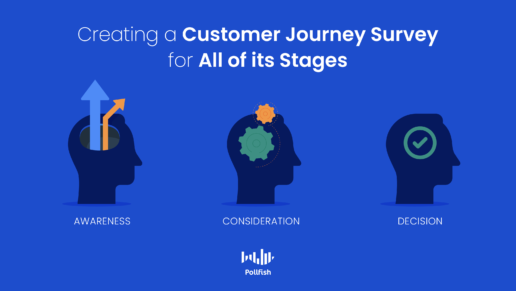
The three main stages of a customer journey are the awareness stage, the consideration stage and the decision stage. Businesses ought to deploy different tactics in their content marketing strategy, along with their ecommerce strategy so that customers stay engaged in each of these stages and are prompted to the next one, until they finally make a purchase.
The Importance of the Customer Journey Survey
This kind of survey is important in several ways. Firstly, it helps form the journey itself at a high level, serving as a tactic for customer journey mapping. This practice entails establishing a visual depiction of customer processes, needs & perceptions during their interactions and relationship with a business.
Customer journey mapping is as significant for small and medium-sized businesses as it is for larger enterprises.
Essentially, the customer journey survey allows businesses to map out the customer journey itself. Rather than forming one through assumptions or online templates, this kind of survey shows businesses exactly what customers are doing, thinking and feeling in their journey.
As such, the insights from this survey enable businesses to form their own customer journey maps which they can use for future marketing campaigns or for their strategic planning process.
By understanding the journey of your customers when they engage with your company, this survey type allows businesses to understand the steps customers take – which includes the steps that are easily accessible for brands and the ones that aren’t.
These steps are important for a number of reasons; they include triggers that incite customers to take some kind of action, whether that is clicking through an ad to its landing page, going further into their journey or finally making a purchase.
For example, these steps can include online review, in which 95% of customers read online reviews before visiting a business. 54% of shoppers comparison shop when they browse online, another crucial step in their final purchasing decision.
As such, it is important for businesses to understand the steps of a customer journey, as they shine a light on key customer insights, allowing brands to not simply map out their customer buying journeys, but optimize them.
In addition, being able to map out and improve the customer journey involves taking the proper steps towards making an impact. In this case, the customer journey survey is effective for configuring and optimizing budgets. This is because it shows businesses how customers are reacting to certain messaging, images, offers and other aspects of their customer experience.
In doing so, the customer journey survey is critical to improving your customer experience (CX), as it dictates how customers feel about a business and plays a major role in customers’ purchasing decisions. This survey helps improve CX, as it allows researchers to diagnose existing issues in their journeys, in turn, allowing businesses to tend to those issues, fix them and innovate more on their customer journey, products and CX as a whole.
Creating a Customer Journey Survey
Creating this kind of survey requires taking several key considerations.
First off, if it is your first customer journey survey, you may need to first form a high-level customer journey map that lays out your expected customer journeys. In order to map out this preliminary customer journey, use an analytics source, such as Google Analytics, or a specialized one, such as one that offers session replay.
These tools allow you to access key analytics on your digital traffic, allowing you to see how a customer made their way to a webpage — whether they clicked on an ad or arrived organically — the duration of their visit, how they traversed a site, how they engaged and more.
These insights will help you design your customer journey map and allow you to categorize your journey into the three aforementioned stages of awareness, consideration and decision. It won’t give you much insight into the kinds of customer personas and segments that are taking these journeys. That’s where the customer journey survey becomes incredibly useful.
Not only does this survey let you examine customers' stages and mindsets throughout their journeys, but to identify the kinds of journeys typical among your customer segments and personas.
After you parse through your analytics and other digital traffic tools, refer to your customer segments and their habits. If you do not have access to this, you should conduct market segmentation, another practice made possible thanks to consumer surveys.
Once you have studied your customer segments, consider the segments and personas whose journeys you intend to survey. It is possible that you may need to survey them all to get a clear picture of your customer journeys across personas.
Either way, begin your customer journey survey by organizing each sub-campaign by each persona type. You can also group sub-campaign based on journeys in a certain marketing campaign, such as a particular offer or landing page. The most important thing is to pin down the purpose of your survey campaign so that you have a central point of study.
Next, consider which stages you need to survey; having observed your analytics helps you determine this. If you need to study all stages, consider creating surveys in chronological order. Come up with some key inquiries you need to be answered.
Then, choose from the question examples to use in each step of the journey from the examples in the following sections.
Survey Questions for Awareness

- What is the biggest problem you have with [something pertaining to your niche/products]?
- Answer type: Multiple-choice, multiple-selection, with an open-ended field option
- What bothers you the most about [completing an action, buying a product in your niche, etc.]
- Answer type: Multiple-choice, with an open-ended field option
- How do you usually go about fixing this problem?
- Answer type: Multiple-choice, with an open-ended field option
- What have you considered to fix/ tackle this problem?
- Answer type: Multiple-choice, with an open-ended field option
- Have you considered using [your brand] for this problem?
- Answer type: Yes or no, followed by a follow-up question on whether they’ve tried competitors’ products/services and another question on what they like/ dislike about them.
- Apply skip advanced logic to route your respondents to follow-up questions.
Survey Questions for Consideration
- What are your biggest concerns about [the problem]?
- Answer type: Multiple-choice, multiple-selection, with an open-ended field option
- What is the easiest way for you to solve this issue?
- Answer type: Multiple-choice, with an open-ended field option
- What would make you choose to try [your brand] if you haven’t already?
- Answer type: Multiple-choice, multiple-selection, with an open-ended field option
- What do you think of this selection? [Mid-funnel journey question for users of product pages, site menus, etc]
- Answer type: Multiple-choice, multiple-selection
- How would you rate our services based on the following? [Use image of an ad with a list of strengths relating to buying from your brand]
- Answer type: Rating scale, stars, etc.
Survey Questions for the Decision Stage

- When thinking about other companies that provide product X, which brands come to mind?
- Answer type: Multiple-choice, with an open-ended field option
- If all of the brands that can fix the problem had different prices, which would you purchase from?
- Answer type: Multiple-choice, Matrix question with options that mention price, capabilities and quality
- Which company are you most likely to buy from to fix your problem?
- Answer type: Multiple-choice, multiple-selection,
- Have you considered switching brands for this problem?
- Answer type: Yes or no, followed by a follow-up question on what would make them switch brands or try yours.
- Does this ad make you want to buy from us? [Use a multimedia file, such as an image or video that features your brand’s strongest capabilities to fix the customers’ problem.]
- Answer type: Yes or no, with an open-ended field option
- Answer type:
Optimizing the Customer Journey Survey
Being attuned to the customer journey is important, as it lets market researchers and businesses understand what their customers go through before finally making a purchase, or cutting their journey short before converting.
The customer journey survey assures that businesses can both map out their customer journey and understand their customers’ decisions throughout it. This kind of approach is strategic to better understanding customer expectations and is therefore crucial for optimizing the customer experience.
Aside from setting up this survey, market researchers need to use a strong online survey platform to carry out this survey campaign.
The most potent online survey platform makes it easy to make your own survey in three easy steps, offers advanced skip logic to route certain respondents to the correct follow-up questions, uses random device engagement (RDE) sampling to engage respondents in their natural digital environments, as opposed to pre-recruiting them, implements artificial intelligence and machine learning to disqualify poor-quality survey data and much more.
Businesses who use an online survey tool with these capabilities and more are well-equipped to create customer journey surveys, deploy them, map out their customer journeys and become well-adapted to their customers.
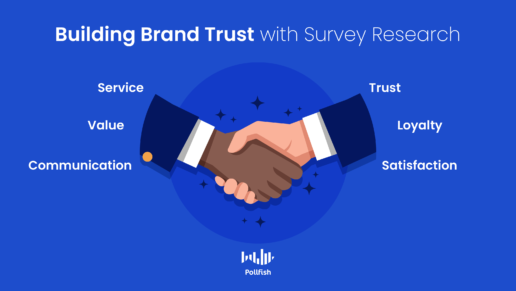
How to Build Brand Trust With Surveys
How to Build Brand Trust With Surveys

Businesses must reach a sense of brand trust, as it reflects customers’ expectations of a brand being able to fulfill its promises about its products, services and experiences.
As such, all businesses must work towards securing a strong sense of brand trust, as no business is immune to customers who don’t trust it.
Although large companies carry high brand equity and therefore seem to be at an advantage when it comes to brand trust, 76% of consumers trust small businesses more than large.
However, this doesn’t mean that small companies automatically have more brand trust and can reap all of its benefits. All brands have to establish this concept for themselves, as lacking it has dire consequences. 81% of customers say that they will only buy from a brand they trust, which leaves the brands that they don’t trust at a major disadvantage, one that will undoubtedly harm their revenue.
This article explores the notion of brand trust, its importance, benefits, how to achieve it through five common ways and how survey research helps brands attain this consumer confidence.
Understanding Brand Trust
Brand trust gauges how much confidence a target market has in a business. Customers exhibit their trust in a brand as a kind of willingness to rely on the ability of a brand to perform its key functions and the other promises a brand makes, whether they are in the form of advertisements, social media, their website, their marketing content or otherwise.
Brand trust typically arises after customers evaluate companies' offerings. However, there is much more involved in trust-building. Customers, therefore, don't merely assess offers; rather, they weigh a company’s promises against their products, services and experiences.
This involves CX (customer experience), the total of all the feelings that customers undergo throughout their customer buying journey.
The concept of brand trust is rooted in a brand’s reputation, as such, it carries all the important aspects of maintaining a good reputation with customers and the general public. It should thus come as no surprise that brands with poor reputations struggle, while brands with good reputations strive.
It may take longer for brands to establish a healthy level of brand trust when it is new, virtually unknown or untested, or in times of reputational crises. As for the latter, it can emerge during scandals, significant bad reviews, poor social mentions and more.
The Importance of Brand Trust
This business concept is important for various reasons, most prominently because the way consumers, especially a target market, feels about business matters. Trust is important, as it is one of the most positive feelings that customers can have towards a brand.
Brand trust brings value to a target market. While some situations may prompt customers to buy from a brand they don’t trust, these are nothing but one-off instances of need and lack of other options. Trust, on the other hand, fosters consumer loyalty, the bedrock of repeat sales, aka customer retention. It is no wonder that an increase in brand trust correlates with a higher customer retention rate.
As such, when brands build trust, customers reward them with ongoing loyalty, a long-lasting relationship in which customers don’t merely buy from the same brand, but choose it over competitors time and again. In this way, the continuous support brands attain with brand trust yields a higher CLV, or customer lifetime value.
CLV denotes the total monetary value a customer will bring to a business during their relationship with the business across their lifetime. Given that brand trust incites customers to continuously purchase from the same brand, it positively ties in with customers’ CLV. Thus, the longer relationships present in retention spur more monetarily valuable customers.
Aside from valuable customers, brand trust is crucial to a company's livelihood, as it softens the blow of a reputational crisis. This is because customers who are loyal will continue to engage and purchase with a company they trust, as opposed to a company they have little or no trust in. As such, brand trust serves as a kind of security blanket, enabling companies to take more risks.
Brand trust also forges brand advocacy. When a happy customer becomes a recurring customer, they tend to speak out about their positive CX, therefore becoming a customer advocate. Customer advocates help brands obtain brand awareness and augment their brand visibility, reputation and overall branding efforts.
They do this by spreading rave mentions about the brand they trust on social media, forums, review sites, brand websites’ comment and review sections, along with via word of mouth. This is tremendously important for a business, as customer advocates do many of the things that salaried marketing and PR employees do, but for free.
Finally, when a brand reaches high levels of brand trust, it is not only setting itself up for a better reputation and higher sales, but it is growing in its potential to be a key player in the cultural trends of an industry. Sometimes, this potential may carry over to greater cultural relevance, such as being a household name of a product that represents an entire country.
The Benefits of Brand Trust

There are several benefits to brand trust, which complement its importance, as laid out above. These benefits also bring new ideas that support the need to establish and maintain brand trust. The following lists the key benefits of securing a strong sense of brand trust within your business:
- Brand trust drives new business, making customer acquisition more feasible.
- It makes consumers more receptive to marketing campaigns.
- It fosters connections with consumers and drives loyalty.
- It allows brands to innovate more, since consumers trust what they.
- It makes those who write or speak negatively about a company lose credibility.
- It helps brands achieve cultural relevance when strong enough.
- Key benefits such as brand loyalty, advocacy and goodwill allow businesses to overcome various challenges and obstacles.
10 Ways to Build Brand Trust
There is far more to building brand trust than simply executing a strong product experience. Consumers have growing concerns about the customer experience (CX) that brands promise, along with other promises brands make in their marketing messages, such as their impact on society.
As such, businesses need to pay attention to other key facets to work towards strengthening, solidifying, and in some cases, establishing brand trust. The following lists include 10 pieces of advice for brands to build trust among their target market and the general public.
- Create quality products and services.
- Establish optimal omnichannel CX, including digital experience, in-person, over the phone, etc.
- Charges reasonable prices.
- Offer promotions, sales and customer rewards programs.
- Include a generous return policy.
- Treat customers well, whether on a chat, on phone support, etc.
- Handle customer service issues quickly.
- Keep up your end of promises.
- Establish clear communication with customers.
- Create consistent content; content is king for many reasons.
How to Forge Brand Trust Through Surveys
Survey research is a proven method of accurately measuring consumer sentiment through customer feedback — when used with the correct online survey platform, that is. Surveys allow businesses to probe as deeply as they wish into virtually any business matter, from product satisfaction to customer effort. When it comes to building trust, surveys allow market researchers and business owners to understand their target market’s needs, desires, expectations and aversions, which essentially tells them all they need to know to build trust.
Researchers can set up surveys with questions that are as granular as they need, allowing them to zero in on a topic, so that they can identify and apply the proper course of action, whether that entails correcting something, creating a new product feature, changing an existing experience and much more.

Additionally, researchers can make their sampling pool as granular as possible in the screening section of a survey. In this section, researchers can filter respondents as precisely as they need, setting eligibility requirements on demographics, psychographics, device used and more.
Researchers can even set restrictions based on how respondents answer additional screening questions, permitting only those who answer in a certain way to take part in the survey. That way, only the qualified respondents will be able to take the survey.
By providing precise information and quality data, surveys enable businesses to extract only the information that they need to build brand trust. Businesses can deploy as many surveys as they deem necessary. By iterating surveys, brands can gather as many perspectives as possible from their target market, paving the way for new ideas to build and improve trust and maintain statistical accuracy in the findings.
Heightening Your Brand for the Long Term
Brand trust is critical for the survival of any business. Whether you seek to increase sales or customer loyalty, remain relevant or simply to stay afloat, you need to build brand trust for your business.
When your brand consistently delivers on quality, reliability and credibility, it will yield significant benefits, as customers will go to your brand first and repeatedly when they look for products and services in your niche.
To build brand trust, you must understand your customers as precisely as possible, cater to their needs and form marketing campaigns and promises to begin with. Survey research has transformed businesses' access to consumers, allowing them to reach a wide swath of their target market and extract their feedback and other necessary customer data.
However, not all online survey platforms are built the same, therefore, they don’t all offer the same capabilities and reap the same benefits. To gain the most quality customer data, businesses must use a strong online survey platform, the kind that offers random device engagement (RDE) sampling to engage respondents in their natural digital environments, uses
You should also use a platform that offers advanced skip logic to route respondents to relevant follow-up questions, one that implements quality data checks via artificial intelligence and machine learning and much more.
When an online survey platform offers these capabilities, businesses gain the most relevant and high-quality consumer data, the kind that allows them to accurately understand their customers’ preferences, expectations and virtually all else. In turn, it allows businesses to feasibly build and improve their brand trust.

Diving into the Concept Testing Survey for Marketing and Product Development
Diving into the Concept Testing Survey for Marketing and Product Development

Using a concept testing survey to inform marketing and product development is like giving your target audience a seat at the table.
Concept testing refers to the market research practice you should perform early in the marketing and product development process. It helps you find out how your products will resonate with your customers.
While traditional market research requires respondents to choose from pre-existing criteria, concept testing requires them to provide unique feedback.
With a concept testing survey, your business can assure that it is putting out products that your customers will be fond of. Use this article as a guide to get started.
Defining a Concept Test Survey
 A concept test is a research method wherein your business accrues customer feedback about a new product before it launches.
A concept test survey, as its name implies, is a survey that utilizes a concept test.
Surveys are tools with questionnaires designed to elicit unique responses from your target audience in reference to your business’s new product or product feature idea.
Concept surveys differ from other surveys, in that they help your business to evaluate concepts before they go to market to understand how your customers will react. The concepts include anything that can be tested for marketing purposes, such as an advertisement, a slogan, imagery, emails, a particular service, and more.
Surveys act as a safety net for new products, helping your company predict whether they will succeed or fail.
Why Your Business Needs a Concept Testing Survey
A concept testing survey is important, as it provides insight into how products will be received. With proper concept testing, your business can avoid investing in concepts that won’t succeed (saving you a lot of money). On the flip side, you can increase investment in concepts where testing predicts success.
Basically, a good concept testing survey system can help your business save money and resources, while earning money at the same time.
Concept Testing Survey Methods
The first step to a successful concept test is choosing the right method. Here are the most common methods:
- Single Concept Evaluation (Monadic testing) – a full evaluation is given on one concept. Participants are made aware of features and prompted to discuss whether they approve or disapprove as their survey response.
- Multiple Concept Evaluation (Sequential Monadic) – full evaluations are completed for multiple concepts.
- Concept Selection (Comparative) – Respondents choose their most preferred concept.
- Concept Selection and Evaluation (Comparative Monadic) – Respondents choose their most preferred concept and provide a full evaluation of that concept.
Each product testing method has its advantages and setbacks. As a business, you should choose the one that best fits your specific needs, based on the concepts you want to test and the results you seek.
You should use survey software to ask questions about your products. Survey software is also helpful in pushing your surveys to your target audience.
The survey questions should include the following:
- What do you like most about this product?
- What do you like least about this product?
- How likely is it that you’d buy this product?
You can use more specific questions, just make sure they are relevant to your products for the most useful feedback.
Concept Testing Survey Use Cases
Concept testing can be used at almost every stage of the marketing and product development process. Here are some common use cases:
Logo Testing
A concept testing survey is an asset when conducting branding market research. For example, logo testing is a great way to see how your customers will perceive your business’s new logo.
You can use concept testing surveys to identify what your logo communicates to customers. Ultimately, logo testing is the best way to discover the logo that best embodies your brand.
Website Design
Concept testing surveys also come in handy when you redesign a site or launch a new one. Through concept testing, your brand can see how its design concepts will be perceived by a selection of people who will one day interact with your website. This gives you an inside look at how the sample of your target population thinks, guiding their design decisions for the best possible outcome.
Ads, Landing Pages, and Conversions
Split-testing is a popular way to test headers, images, and other website content to see which resonates most with an audience. Also called A/B testing, split testing is a random experiment where two versions of a piece of content are shown to your target audience. Whether customers see version A or version B occurs completely at random.
Through analytics, this method helps you identify which ad, landing page, or other pieces of content is most compelling for their audience. You can see which customers convert.
Concept testing takes this method to the next level by allowing your business to hear from your audience directly. As such, you won’t simply obtain numbers, as concept testing gives you qualitative feedback about the “why” behind the numbers.
Beyond just validating the numbers, this inside look into the minds of your audience could lead businesses in new directions and even spark new ideas.
Pricing and Upgrades
Concept testing is also a great way to project how upgrading products and services or altering your pricing system will be perceived. The best way to do this is by using migration path tests to gauge your customers’ initial thoughts and see what features and benefits they crave. Migration path tests compare migrated data with original data. Your business can create upgrade tests to predict how the new product will affect your sales.
Name Testing
Deciding on a name can be rather difficult when forming a new company or creating a new product. The impact a name has on overall success can be paralyzing, especially since it’s usually composed of only a few words.
Those few words have to convey what your business offers, its benefits, and how your brand should make customers feel to your audience.
By using concept testing surveys, your business will be able to test potential names and request evaluations on what your customers believe the names convey. This feedback will guide you on the correct track to choosing the perfect name for your business.
Price Testing
Have you ever considered how your customers feel about the value of your products? You can use concept testing to find out whether or not your customers are satisfied. You can also use price testing when you alter the prices of your products. This is an effective way to find out how your customers will receive any new redesigns or product innovations.
Package Testing
Packaging matters more than many a business may think. Do you know what your customers think about your current packaging? Using a concept testing survey for package testing is a strong method to discover if your customers are impressed or irritated by your business’s packaging.
Messaging
When your business is unsure about how its target audience will perceive your messaging, you can apply a concept testing survey to learn more. This shows them if your messaging resonates with your audience. As such, you can gather how it communicates the value of what you offer. You can use the insights from concept testing to create a style guide that informs future messaging.
Product and Concept Development
This might be the most obvious use case of them all. A concept testing survey is an essential part of transferring products and concepts from ideas to reality. Concept testing can reveal missing product features as well as features that offer no benefit and can be removed entirely. Your business can discover what its customers think about your new product’s quality and usability. Overall, product concept and usability tests are the ultimate way to make sure every product your business releases is up to par.
Step Up Your Product Development with Concept Testing Surveys

All businesses should use a concept testing survey at virtually any level of the marketing and product development process. Listening to direct customer feedback gives you an edge over your competition by equipping your business with key information about the specific wants, needs, aversions, and sentiments of your target audience.
[wp-faq-schema accordion=1]

How Relentless Quality in Market Research Perfects the Strategic Planning Process
How Relentless Quality in Market Research Perfects the Strategic Planning Process

Surviving in business depends on a well-established strategic planning process — and not just for new businesses. This ensures that a business establishes its priorities and correctly focuses its efforts and resources in order to obtain them.
Despite the importance of this process, up to 67% of strategic planning fails.
You can build an effective strategic planning process with market research, but you’ll need to use the proper market research tool.
That’s because in the demanding world of business today, market research tools must provide relentless quality in order to sustain a strategic plan.
This article explains the strategic planning process and how a market research platform that provides relentless quality can support this effort.
Understanding the Strategic Planning Process
This process involves all the activities that your business performs as part of strategic planning, the organizational management activity used to identify priorities, set goals, map out a direction, produce strategies, allocate resources, and make decisions to accomplish the goals.
This process plans the fundamental course that your business should take, along with its actions, while layings out what your business seeks to do, who it will serve, and why it will do so. It is built with a focus on the long-term.
In the strategic planning process, your business must cover as many bases surrounding itself as possible, including where it currently stands, where it is going, where it seeks to go, and what it’s striving to achieve. Additionally, the strategic plan must include all the actions required to accomplish its goals based on this evaluation.
The strategic planning process also includes measuring the effect of its activities and whether your business has achieved the kind of results it sought., It is therefore an exhaustive process that involves strategy, exchanging ideas, testing and implementation.
Essentially, the strategic planning process centers on a catalog of steps that managers must follow to form and implement a strategy within a company. This process aligns the entire company around its main goals and how to execute them. As such, it is also meant to create transparency, so that no employees are left wondering about the objectives of a company and how to incorporate them into their daily work.
The Importance of a Well-Executed Strategic Planning Process

It is critical to establish a solid strategic planning process for a number of reasons. Without clearly established goals and plans, your business would be navigating in the completely uncharted and unaided territory.
As for the process itself, your business must understand the steps it will need to take to tackle its goals, especially since many of them are mid-to-long-term goals. The following lists the various benefits of a well-executed strategic planning process:
- It sets a clear set of goals and an honest assessment of an organization’s strengths and weaknesses.
- It reveals what is most important, relevant, and actionable in business, removing the guesswork.
- It offers plans on how to achieve its goals, with different ideas that businesses can smartly put to the test.
- It helps companies understand how they can improve their performance.
- It shows businesses where their biggest challenges lie, whether it is in your business itself or external factors (laws, changing trends, customer behaviors, etc).
- It prevents businesses from performing tasks that will yield little to no growth or benefits.
- It enables businesses to respond to a change or an issue with preparation, lowering stress and the difficulty of handling the unknown.
- It fosters and upgrades the technical abilities of your workforce or product.
- It aligns employees and shareholders with business objectives and visions.
- It determines KPIs so that businesses can track progress based on data.
When to Use the Strategic Planning Process
Strategic planning is an ongoing activity, therefore its process should not be applied just once. Although mainly used by new companies and startups, strategic planning should be involved at various stages, especially those that are bent on making change.
As for scheduling the process, this will vary based on the needs and experiences of your business and its external settings, such as its niche, target market, or competitors.
The strategic planning process should be regularly carried out in a business that operates in a frequently changing industry, such as the SaaS industry, for example. In this case, this kind of process should take place 1-2 times a year.
If your business has existed for a long time and is in a slow-moving market, it can carry out a lesser frequency of one strategic planning process a year. This should involve updating in which only certain parts of the process.
Aside from new businesses, all businesses should perform strategic planning when taking on any new venture, whether it is an acquisition, a new department, product, or branding change.
Businesses that are in an unstable or semi-stable marketplace should conduct the strategic planning process at least once a year in preparation for the coming fiscal year. By doing so, they can identify the organizational goals to accomplish in the coming fiscal year, along with finding the resources to obtain the goals.
In this way, this process is a must for budget planning. However, businesses will not need to complete every step of the process each year, as the full strategic planning process should be conducted at least once every three years. As mentioned previously, it should be conducted every year when businesses or their external environments undergo a massive change.
Although longtime businesses in stable marketplaces don’t need to conduct this process yearly, they must review it once a year to determine any new action items and to determine whether anything should be removed.
How Market Research Supports the Strategic Planning Process
Market research is invaluable to the strategic planning process, as it provides a stable foundation for virtually every step of the process.
This form of research provides insights on your business’s target market and industry at large, the kind of crucial data that supports a vast array of decision-making.
That is because creating objectives and planning activities around them based on intuition is dangerous and costly. Unfortunately, many businesses do not pay enough attention to their market research data, or any sort of data, as over half of the data businesses obtain goes unused.
This is a major misstep as market research offers relevant information on the heart of your business: its consumer base. A strong market research tool can help your business reap the most updated data on its target market, along with specific market segments.
In this way, using a primary source of research is superior to conducting secondary research alone, as secondary research may not be fully updated, relevant to your business’s specific needs, or involve using questions that a particular business needs to address.
Market research provides the key insights that a strategic planning process needs, as it sets concrete objectives and lays out concrete processes, all of which require time and resources. By gathering and analyzing market research, your business can gain a competitive advantage, one that yields 10 percent in sales growth and higher margins.
A market research survey in particular is a potent way of extracting the kinds of insights that set a strategic planning process in motion. Surveys are versatile and can take various forms, from customer satisfaction surveys like the NPS to employee feedback surveys, to B2B surveys, and many more.
They are devised to help your business understand a number of issues, such as product satisfaction, product needs, opinions, aversions, user experience, and much more. You can create them with any sort of questions, depending on the market research platform they use.
In order to create a strong strategic planning process, businesses should turn to a market research tool that offers relentless quality.
How a Platform Offering Relentless Quality Perfects the Strategic Planning Process

Obtaining a market research platform that is built on relentless quality is difficult to come by. While this may be a tall order, given that there are so many tools marketed in this way(but not verbatim), only a few deliver on this promise.
The Pollfish market research tool, on the other hand, delivers relentless quality, the kind designed to provide a 360-degree assessment of all the factors involved in a strategic planning process.
Whether your business needs to determine its specific market segments through market segmentation or weed out survey fraud and faulty responses with artificial intelligence, Pollfish offers both and much more.
It also uses a viable sampling method to gain timely responses in a randomized way to limit survey bias. This method is known as random device engagement (RDE) and it is extremely effective at gaining responses from a target market the natural way, by deploying surveys across a vast network of digital properties that users visit voluntarily, meaning that they are not forced to take a survey or are pre-recruited.
It helps your business gain intelligence at virtually every aspect of the business relating to its customers and employees, which helps hammer out reasonable objectives and a market research budget for a strategic planning process.
Additionally, businesses can use the Pollfish platform for the following aspects of their strategic planning process:
- Finding funding priorities
- Gauging customer-service satisfaction
- Discovering new customer needs that can help set off new product launches
- Identifying the backbone of strategic goals
- Discovering whether a business needs to change its branding direction
The Pollfish platform allows businesses to gain access to all of these factors and more in a friction-free way, as the platform is user-friendly; there are only three main steps to make your own survey.
The platform uses quality checks to remove any below-par data, such as repetitive answers (flatlining), gibberish answers, VPN use, and more. It does so through a machine learning system that cancels out the need for manual quality checks.
It also offers 24-hour support from a dedicated team of market researcher experts. As such it is possible to perfect a strategic planning process, as long as it is done with the proper market research tool. Because the Pollfish online survey platform offers proven relentless quality, your business should look no further and use Pollfish for all their strategic planning needs.
How to Conduct a Market Trend Analysis for Sublime Market Research
How to Conduct a Market Trend Analysis for Sublime Market Research

Conducting a market trend analysis is critical for a market research campaign, as it uncovers trends in both an industry and within a target market — the group of customers most likely to purchase from a company.
Market trend analysis is valuable for data-driven decision-making, as it consolidates trends extracted from data and puts them and their key aspects, such as customer behavior, for example, into perspective. In turn, this helps businesses recognize patterns and make predictions on various strategies and campaigns, along with discovering future trends.
Additionally, although trend analysis is chiefly used in the financial sector, its concept is also essential to market research, as it is used to make sense of survey data analysis, allowing researchers to understand their findings, thereby improving the market research process.
This article explores market trend analysis, why businesses must conduct it, how to conduct it for efficient market research and more.
Understanding Market Trend Analysis
A market trend analysis is a kind of trend analysis, except rather than focusing on the financial aspects of a sector or business, it refers to analyzing trends in a market or industry at large.
Specifically, a market trend analysis is a method of analysis on past and current market behavior, along with dominant patterns of the market and its consumers. This kind of analysis relies on examining statistical data and recorded market behavior over a defined period of time.
This kind of analysis covers a wide range of topics, as trends can appear within different aspects of a market.
Businesses, therefore, use this kind of analysis to extract necessary information in order to map out and support the strategic planning process and forecast future trends within customers, campaigns and other business plans.
Identifying the prominent traits of an industry and its target market, this kind of analysis acquaints businesses with key occurrences in the market, thus it is a vital practice in market research.
The Importance of Market Trend Analysis

Market trend analysis carries significant weight in market research, for a number of reasons, including the ones aforementioned.
First off, one of the greatest concerns in a business and virtually any entity is that of performance. A market trend analysis grants insights on performance, identifying areas of sufficient business performance, along with those that aren’t faring well.
Thus, it helps businesses on the decision-making front, providing insights that boost long-term strategy and helping businesses avoid future setbacks.
Given that in market research, trend analysis is used to better understand consumers, this kind of analysis provides insights into customer behavior trends, allowing businesses to cater to customers with data backing all of their decisions. This way, customers are more likely to engage with brand campaigns and make purchases.
Moreover, market trend analysis can obtain valuable insights into the overall scenario of a market. For example, a SaaS company can discover the products, services and startups within a particular niche of their industry.
Alternatively, a shoe brand can discover the latest trends in shoe designs and fashions by running various market research campaigns that capture customer sentiment, opinions, preferences and recognition of shoe brands and styles.
Market trend analysis also helps businesses gain an understanding of their market’s macro-environment, the holistic condition existing in an economy, rather than a specific sector of it.
Conducting trend analysis helps businesses find and display long-term data in summary form. The data can be used to investigate changes across different points in time and find how both customers and markets respond to them.
These variations can involve changes in demand levels in the market, allowing businesses to take appropriate action, as periods of high demand and low demand require different strategies.
What Businesses Can Learn with Trend Analysis
Businesses can gain the various insights laid out above. In terms of market research, these insights provide information about three key aspects: customer preferences, the macroeconomic environment (market’s economy at large) and changes in the industry.
With the trend analysis report, you can compare historical data and get answers to questions like:
In market trend analysis report, businesses can understand the following:
- Changes in their NPS score over a period of time
- Levels of employee engagement and turnover
- Sales fluctuations and forecasts
- Change in customer experience in the past year
There are various other market aspects that businesses can examine with this kind of analysis. In addition, businesses can plan their actions in response to long-time or emerging trends and any changes in their market. As such, trend analysis prepares businesses for the long term.
The Different Types of Market Trend Analyses

There are four main types of market trend analyses that businesses and market researchers should acquaint themselves with. The following explains the four kinds, so that businesses can aptly conduct a market trend analysis and analyze it based on the categories.
- Consumer Trend Analysis:
- This focuses on trends among a target market, its segments and customer personas.
- It involves gathering key customer data such as customer satisfaction, customer aversions, needs, opinions, preferences, customer buying behavior and more.
- This involves studying product trends in relation to customers' reception and opinions of them.
- Historical Trends Analysis:
- This is an investigation into past industry trends in a market or niche.
- It shows researchers how such trends developed, how they affect the present and how they will affect the future.
- Historical trends concern historical data, which can date back years, along with data from the near past, such as the past few days, weeks and months.
- In this kind of trend analysis, there is typically a comparison between the current market with others, such as year-by-year or period-by-period analysis.
- Seasonal and Temporal Trend Analysis:
- This is an analysis of market shifts relating to seasonal events, such as holidays, the weather, natural disasters, etc.
- Many of these are recurrent, such as the holiday season, which starts around late November and lasts through most of December. For businesses, strategizing for this season occurs many months in advance, thus the data they use tends to be historical trends analysis.
- Geographic Analysis:
- This entails studying trend changes based on geographic location.
- These analyses can include comparisons between different regional areas within a country, or on an international basis, studying trends from different countries and even continents.
- It involves conducting global market research, should the trend analysis delve into international markets.
- This analysis seeks to discover how trends develop in geographies of various sizes and places.
How to Conduct Market Trend Analysis to Excel in Market Research
There are various means to run such an analysis and businesses can complete this with a process for collecting, comparing and analyzing data.
The following explains how to conduct market trend analysis in a step-by-step process.
- Determine the trends you seek to study for your trend analysis. To do so, refer to the above section on the major different kinds of market trend analyses. You can also perform a social media and desktop versus mobile analysis, should your business require it.
- Create a focus on your trend analysis within the main topic you chose. For example, if you choose to analyze consumer trends, consider the major aspects of consumers that you ought to focus on for your study. This will differ from business to business.
- For example, you can study their reactions to your ads and marketing messages, their purchasing behaviors, their preferences, etc.
- Pinpoint your target population of study. You can also begin broadly, by targeting the entirety of your target market.
- Conduct secondary research in regards to your target market and the focus of the study.
- There are various online sources to consult, such as trade publications, news sites, sites dedicated to your niche, statistics websites, etc.
- Stay up to date with industry research and trends reports. There are various online sources offering these reports, such as IBISWorld.
- Study your competition. Observing your competitors gives you a good picture of their market positioning and how they react to an emerging trend.
- Conduct primary research around the focus of your trend analysis. There are various methods and digital tools that can be used to extract primary data. Survey research is among the strongest, as it powers its users to inquire into any topic, form and ask any question, along with distributing the survey to its intended audience.
- Find the correct online survey platform to conduct your primary trend analysis research. A strong tool is user-friendly, offers deployment on a vast network of popular websites and apps, offers global support, uses random device engagement (RDE) sampling and more.
- Analyze all of your findings by studying both primary and secondary resources. Specifically, look for patterns and repeated actions, opinions, etc.
- Based on your analysis, identify all possible trends, both minor and major. Create a document based on these findings.
- Put your analysis into action. If you are able to successfully discover trends, create a plan of action based on them. Your plan of action can include new campaigns or changes to current campaigns, changes to your strategy or changes to how you engage your topic of study, in this case, the customers.
- You ought to conduct more survey research should your analysis appear to be lacking, if it leads to further questions or if you simply need to understand your trends at a more granular level.
Powering Each Market Research and Trends Project
Conducting a market trend analysis is a crucial factor in maintaining strong market research campaigns. Aside from uncovering trends among customers, market segments and the market at large, this kind of analysis complements any market research endeavor, with key, organized data.
While there are various means of performing market trend analysis, survey research helps carry this kind of analysis, as it empowers researchers to inquire into virtually every business subject, from purchases, to buying habits, to brand recognition and much more.
As such, the proper online survey platform will unlock various trends, but businesses must choose one wisely, as they are not all built the same. A strong online survey platform will enable businesses to deploy a massive volume of surveys across a multitude of digital websites and apps, hyper-target customers and take a few days at most to complete.
The Pollfish online survey platform offers all of these capabilities, including an RDE (random device engagement) method to draw responses from digital users voluntarily, bias-free and in their natural environments.
Performing a Customer Behavior Analysis for a Deep Read
Performing a Customer Behavior Analysis for a Deep Read

In order to access customers, businesses must conduct a customer behavior analysis. Given that customers are the lifeblood of any business, it is critical to analyze their behavior, as doing so will support any business strategy.
A customer behavior analysis is a kind of analysis that provides a granular evaluation of customer behavior. Specifically, it examines customer behavior in relation to a particular business.
It is especially important to run this analysis, given that customer expectations and needs constantly shift; nevertheless, 76% of customers expect companies to understand their needs. When businesses understand customer behavior, they have a context to their customers’ needs, making them more practical to fulfill.
This article explores customer behavior analysis, its importance, how to conduct it and how the role of survey research in conducting this analysis.
Understanding Customer Behavior Analysis
A customer behavior analysis is a kind of analysis that melds qualitative and quantitative observations of how customers interact with a particular company. It involves studying how customers interact in-store, on a website, social media, apps and other places, both physical and digital.
This analysis examines what influences their customer buying behavior, which includes studying the triggers, motivations and reasons behind their buying choices.
In this behavior analysis, customers are first segmented into customer personas based on their shared characteristics. Then, researchers observe each segment throughout the different stages of their customer journey map. This stage serves as the heart of the analysis, as it requires scrutinizing how the personas interact with a company.
This analysis grants insight into the various variables that may influence a customer segment and customer persona. It allows businesses to understand how customers feel about a company, thus it is a crucial component of brand tracking.
The Importance of Customer Behavior Analysis

It is important to conduct customer behavior analysis for a number of reasons.
A behavior analysis is a proven method for understanding customers and connecting them to the business. It allows businesses to understand their customers’ priorities, motives and rationalizations behind their decisions.
Given that customers exhibit these thoughts and actions as part of the customer journey, conducting this kind of analysis helps businesses understand how customers feel about their company.
Additionally, a customer behavior analysis allows companies to understand customer habits and motivations. This includes how customers behave in different settings, whether it is digitally or physically.
Without it, market researchers and online store web developers would only have a scant idea of how their customers shop, whether it is on or offline. Conducting it can reveal these multi-environmental habits, also revealing unique or latent patterns.
Businesses can also offer a better shopping experience by nailing down where and how customers face issues. These can involve non-virtual problems, such as poor customer support, along with technical problems, such as slow web pages and functionality problems.
When it comes to the latter, a poor check-out experience may lead customers to abandon their carts prior to purchasing. Additionally, an improper search may deter shoppers from finding their products. These instances lead to site leaves and lack of conversions, therefore casting a blow to revenue. Businesses can avoid these issues and missed opportunities by performing a customer behavior analysis.
Furthermore, businesses can improve their existing marketing campaigns and form new ones from analyzing customer behavior. This will improve both customer retention and acquisition, as brands can tweak campaigns based on studying existing target market members, therefore creating more fitting campaigns for future potential customers.
This analysis reveals recurring patterns on shopping transaction timing, location of purchase, device used for purchases, frequency of buying, favorite products and other behavioral aspects. As such, marketers can better understand customers’ actions and use this information to target their audience more precisely.
Moreover, marketers can use this data to optimize various customer experiences, create more personalized content from the intelligence they gained, create more enticing advertising campaigns and determine the value of different customer segments and personas.
All in all, customer behavior analysis offers a myriad of benefits that can help solve various business needs.
The Use of Surveys in Customer Behavior Analysis

Given the scope of customer behavior, there are various methods and tools to analyze it, from one-on-one calls with customers, to in-store experiences, to digital tools such as experience analytics.
Online surveys are the most potent tool for studying customer behavior, as they allow businesses to study virtually any aspect of customer behavior and ask all of their desired questions.
Surveys offer value in various aspects of performing a customer behavior analysis, such as segmenting customers via market segmentation. This allows businesses to understand the key groups making up their target market and how to serve them more effectively. Additionally, as aforementioned, surveys help businesses form their customer personas, another key practice for targeting an audience.
Surveys allow market researchers to inquire into any customer behavior topic. This way, researchers can detect the presence of certain common behaviors, along with patterns in preferences, actions and inclinations, all of which are crucial factors in a behavioral analysis.
Surveys can provide both qualitative and quantitative market research data for researchers, granting them a holistic view of customer behavior. Thus, surveys do not merely provide a means of analysis but are complementary to various market research campaigns.
A strong survey platform makes it possible and practical to study a vast pool of customer behavior via deployment across thousands of high-traffic websites and apps. Additionally, a platform that offers filtering data for survey results makes it easy to perform an analysis of all the collected data.
How to Conduct a Customer Behavior Analysis
There are several ways to perform such an analysis, including through the use of surveys. The following explains how to conduct a customer behavior analysis through a multi-step approach:
- Segment your target audience. This involves dividing your customers into various groups, or segments, based on shared demographic and psychographic characteristics.
- There is also a wide range of other characteristics to use for segmenting, involving behavioral characteristics such as:
- Web and app activity, preferred media channels and online and offline shopping habits.
- Consider the most valuable segments to your business. You can find them when you calculate customers’ CLV or customer lifetime value, or by performing an RFM analysis.
- There is also a wide range of other characteristics to use for segmenting, involving behavioral characteristics such as:
- Pinpoint the benefits of each segment. Each customer group and persona will choose a particular business in their own unique way. Market researchers should identify what triggers these segments to choose a particular company over another.
- Refer to products, services and experiences, along with external factors that influence buying decisions.
- Consider the different effects on purchasing, such as: did customers buy a product due to its brand? Did they make a convenience purchase? How much did the customer seek to spend? How urgent was their purchase decision?
- Always consider the context of a customer’s behavior and needs during the analysis.
- Conduct survey research. This involves using both the qualitative survey and quantitative survey for a holistic read of your customers' behaviors.
- Additionally, it is critical to perform secondary market research, using external sources of already published data. While this provides useful information, not all or any secondary resource will provide relevant information to your niche and specifically, your customer base.
- After you conduct qualitative and quantitative research, compare the two sets against each other as you discover patterns, habits and other key components of customer behavior.
- Use your analysis findings on a campaign. You can apply your analysis to various campaigns, from content optimization to advertising.
- Use the best delivery channel for each persona.
- Provide personalization to different segments and personas whenever possible.
- Fix any hindrances in the CX (customer experience).
- Nurture the customers throughout their CX.
- Assure any changes won’t adversely affect your customers, as not all will be receptive to change. Conducting surveys can help you determine which customers are less fond of it.
- Analyze the results of any changes you’ve applied to your campaigns. Marketers should always test their results and the same applies to changes made after running a customer behavior analysis.
- Test the effects of your changes with different metrics such as traffic to websites. Advertising spend versus revenue, conversion rates, CLV, customer acquisition cost (CAC) and more.
- Analyzing results ought to be a continual process, giving the vast external influences on customers, such as politics, technology, new products in a niche, etc.
Staying Attuned to Customers
Performing a customer behavior analysis is a crucial task in obtaining a deep understanding of how customers behave in relation to your offerings, experiences and business as a whole. Such an analysis should therefore be ongoing, as even the most loyal customers change from various influences.
Surveys provide a powerful yet practical means for performing a behavioral analysis, given that they can be deployed to the masses, are highly targeted and allow market researchers to delve into any behavioral topic through questions of their choice.
The key is to use an online survey platform that offers these capabilities and more.
Although conducting such an analysis is likely to require several tools and methods, surveys allow researchers to capture insights into all customer behaviors, along with their needs and opinions, as surveys allow researchers to explore any topic and ask about it explicitly and in a custom way.
A strong online survey platform offers capabilities that put survey bias, survey fraud and other low-quality data at bay. Such a platform makes it easy to study customer behavior by extracting data based on precise demographics and psychographics, adding randomization to the sampling process via RDE (random device engagement) and offering several data visualization formats.
Businesses should therefore choose their online survey platform wisely.