
What to Expect and Look for in Survey Data Collection
What to Expect and Look for in Survey Data Collection

There’s far more involved in survey data collection than you may think. That’s because this data contains factors that go beyond mere questions and geographies.
But all survey data collection methods and their resultant data aren’t the same. They will differ based on the method you use to gather the data, along with your market research service provider.
There are lots of ways to go about this and thus, various types of survey data you can collect, depending on your approach.
93.4% of respondents will not give out their personal details in the surveys they take. While this may sound concerning, there are solutions to get around this, which, in turn, allows you to gain key details without violating respondents’ privacy.
This article delves into survey data collection, including its importance, popular collection methods and the actual data you should expect and look for in your research campaigns.
Understanding Survey Data Collection
Survey data collection refers to the practice of collecting various information about your target population through the use of survey research.
Survey data collection involves obtaining various kind of information from your target group: their opinions, sentiments, behaviors, needs, aversions and knowledge. In market research specifically, this data largely comes from your customers, or your target market — those most likely to buy from your business.
Survey data is defined as the resultant data you gather from a sample of respondents that took a survey. This respondent pool is called a survey sample. This data must exist as a fair representation of the opinions and perceptions of your audience.
This is possible to achieve if you use the proper method of collecting survey data. There are different methods and approaches to gathering this data.
You should opt for the method and provider that grants you the most timely and accurate results. Price and provider capabilities are also important considerations.
Survey data collection ought to be as comprehensive as possible about your target audience and also must be specific to the topics related to your research campaign.
Survey data collection can be applied in a vast number of industries and applications. It can be used within the following industries and for different purposes:
- Scientific research
- This includes performing experimental research.
- It also involves all fields of medicine.
- Politics and political polling
- Sports and sporting events
- Socioeconomic research
- Demographics research
- This includes censuses.
- Real estate research
This list is not exhaustive, as collecting survey data is useful for anyone who seeks answers from a target audience. However, survey data is most commonly used in market research and its various sub-practices.
Thus, any business can and should conduct market research and this is feasible using the market research survey and the myriads of other surveys.
Methods of Survey Data Collection
There are many methods used for survey data collection and its various ensuing analyses. Consider the efficacy and drawbacks of each method before you decide on the best for your research needs.
Some researchers prefer using multiple sources to gather their data collection.
While doing so may help you research certain demographics (e.g., elderly respondents who are more prone to responding to snail mail), it is best to opt for one robust survey data collection method.
That’s because survey data should not just be exhaustive, it should also be well-organized so you can draw accurate conclusions without referring to various sources and trying to make sense of them all.
Data collection involves the following methods:
- In-person interviews
- Businesses and other organizations can conduct in-person interviews with their target market to obtain the data they need. This often involves a pre-agreement to partake.
- Telephone surveys
- Like other surveys, telephone interviews can be conducted with the masses, but they have a major vulnerability: most people don’t want to spend their time taking a phone survey.
- These are also not ideal as they don’t provide as much anonymity as do other surveys, as the respondents’ voices, names and contact information is known.
- Mailed questionnaires
- These take the most time out of any method to get results.
- However, older demographics who spend less time digitally may be optimal for this kind of survey method.
- Focus groups
- A focus group is a small group of people selected based on shared characteristics to take part in a group discussion for market research.
- Syndicated research
- This kind of survey research involves relying on a research firm that conducts the surveys.
- The firm owns all the data and sells it to interested parties.
- Online surveys
- These can take many forms and have different methods of deployment.
- For example, in the Random Device Engagement (RDE) method, surveys are sent to a massive network of over 250 million+ websites and apps, prompting users that exist in their natural digital environments to take the surveys.
- You can also send surveys to specific people and through specific digital channels, like your homepage, landing pages, emails, newsletters, etc. This requires using the Distribution link feature.
The Importance of Survey Data Collection
A collection of survey data is extremely important for businesses that want to not merely survive, but remain competitive.

That’s because the data from surveys is used to form the basis of informed decision-making in different contexts. Everything from product development to product satisfaction, consumer needs and post-serivce sentiments about your brand can be studied through surveys.
This means you form a survey data collection at any part of your customers’ customer buying journey.
Whether your customers are just getting acquainted with your brand, have just made a purchase or are longtime buyers, gathering survey data will fortify all of your marketing and business campaigns.
As such, survey data won’t merely inform you on post-campaign activities. For example, you can conduct surveys for more than just asking respondents about their thoughts about a already launched product or an advertising campaign that’s already in effect.
Instead, you can survey your target market on their needs, problems and frustrations before you innovate your products or come up with an ad or marketing campaign. You can also survey them on current products in your industry and discover their weaknesses, allowing you to better innovate your own.
Because of this, a strong survey data collection will help you form or consolidate a marketing strategy or product idea. This essentially means that surveys help you throughout any stage of your business and, to reiterate, any point in the customer lifecycle.
Thus, surveys thoroughly serve your market research needs and can be used as the final (or beginning) touch to using any sort of behavioral data analytics. In fact, some of the most reknown companies of the world like Apple adn Verizon rely on a survey data collection.
Having a solid survey data collection is also important when it comes to making decisions — particularly, looking for answers. That’s why your collection should be well-organized. No matter how adept of a researcher you are, surely you won’t want to parse through mountains of onorganized or loosely related data.
That’s why we suggest forming your data collection via one source. This source should allow you to target anyone and gain granular insights.
A potent online survey platform can provide this, as it uses technology such as artificial intelligence and machine learning to remove low-quality data, provide a broad range of survey and question types and can fully customize your surveys.
The Actual Data You Should Expect and Look for
Collecting survey data is far more than just creating questionnaires and gathering them. Instead, there is particular data you ought to expect from your survey provider.
Here is what you should keep your eyes peeled for to create a well-built survey data collection:
- The ability to opt-in only the respondents you need for your survey campaign.
- This should include a screening section, allowing you to ask screening questions and target respondents as granularly as possible.
- Set quotas so that your survey gets the number of respondents you desire.
- This is not just for preferential reasons, but to reduce biases like the margin of error and sampling errors from your research.
- Create multiple audiences per survey or survey campaign.
- Some providers, like Pollfish, allow you to create separate audiences in one survey and achieve any targeting combination you like.
- This feature allows researchers to create quotas within quotas and set multiple conditions for granular targeting.
- Having various types of survey questions on hand to enrich your campaign and data collection.
- Have a wide range of survey templates as you prepare a survey.
- Route respondents to certain questions based on their answer to a previous question.
- This can be done via advanced skip logic, which automatically directs respondents to relevant follow-up questions based on a previous answer tey provided.
- The ability to filter data.

- This includes data at the questionnaire level and results section (a dashboard in a survey platform).
- On the survey results dashboard, you should be able to filter data based on demographic and location information. For example, you should be able to filter data by gender, age, location, and any other targetting you set to understand how each demographic group answers your questions.
- Various ways to view and organize your data:
- The ability to see and analyze your survey data as you please is crucial to you and your team, as no one works in the same way.
- As such, you should be able to view your survey data collection in various formats:
- Charts
- Graphs
- Tables
- This involves having access to different visualizations of both the questionnaire (survey answer) data and the respondent data.
- Various access points to your data via exports:
- PDF: A visual document that can easily be shared with stakeholders and saved as reference docs. A Pollfish PDF is laid out similarly to a PowerPoint presentation.
- Excel Spreadsheet: Recognizable to most businesses, with a Pollfish spreadsheet export, researchers have full access to all Pollfish survey results. They can add pivot tables, graphs and get deeper insights.
- Crosstabs Report: Crosstabs are a matrix-style data visualization format for analyzing data. This report allows researchers to look into individual insights and organize their data in different ways, opening different consumer insights that wouldn’t be readily available from the initial results.
- SPSS Report: This allows you to add your Pollfish results to various kinds of complex data analyses. Ideal for combining varied, complex data sets, researchers use it to make connections, find correlations and graph results from various data exports at once.
- CSV file: A Comma Separated Values file is a plain text file containing a list of data. This kind of file is often used to exchange data between different applications.
- Pause, stop and change your survey while it is still running.
- This can only be done via a digital means, such as an online survey platform.
- You should be able to alter your survey to get only the most relevant and necessary information.
- A strong platform will allow you to pause and alter your survey before it reaches all quotas. This way, you can modify the targeting or the questionnaire itself.
Build the Best Market Research Campaigns
The Pollfish team is constantly making upgrades to our online survey platform to provide you with a comprehensive market research experience.
Our survey software allows you to establish a thorough survey data collection, one you can customize to your liking, view however you please and organize to the max.
In addition, with our vast array of question types, you can create any survey type to aid any research campaign.
Our survey platform is optimized for both the respondent and the researcher. Thus, it is a win for all parties involved.
Researchers can reap a wide breadth of information on their respondents and access a wide pool of insights in their survey results dashboard.
In addition, there’s the advanced skip logic feature, which routes respondents to relevant follow-up questions based on their previous answers.
With a research platform containing all of these capabilities, you’ll constantly have a strong survey data collection on hand, there for you for all your business ventures.

Fully Understanding Your Consumers with a Target Market Analysis
Fully Understanding Your Consumers with a Target Market Analysis

Conducting a target market analysis is central to market research, as it enables you to understand your consumers in-depth and in relation to the viability of your products and services.
A vague or unproven idea of your target market — the group of customers most likely to patronize your business — will have damaging consequences for your business. This is because you can’t be all things to all people; even your competitors’ target market isn’t the exact same as yours.
Analyzing your consumers will help your business reach the right audience, along with a slew of other benefits. In fact, by segmenting your consumers through a target market analysis, you can increase profits by 80%.
This article examines the practice of the target market analysis, its importance, when to use it and how to create it using market research software.
Understanding the Target Market Analysis
A target market analysis is more than simply a study of your potential customers.
A target market analysis is a comprehensive assessment of your target market, the core base of customers most inclined to buy your product or service. One of several market research techniques, this kind of analysis is exhaustive in that it doesn’t merely examine customers.
Instead, this method involves assessing how your offerings will fit with a specific market and how they will achieve the most traction with your target customers. As such, a target market analysis defines where and how your product belongs in the real-life market.
Given that a target market analysis grants a high-level perspective of your market, you can use it to outline the opportunities and restraining factors that exist in your market.
Being able to create a market analysis will enable you to comprehend who to market and sell to along with how to satisfy your consumer preferences. As such, a target market analysis will help you reach your customers and provide them with a solution tailored to their specific needs or concerns.
When you conduct your target market analysis, you’ll need to consolidate your previously conducted demographic analysis with a psychographic analysis. These two kinds of analyses provide detailed information on the makeup of your target market, from their quantitative information, such as their age, gender, location, education and other such categories, to the psychological underpinnings of their buying habits and needs.
As such, this analysis requires merging both analyses, along with analyzing your own offerings and the problems they can solve for your target market.
The Importance of a Target Market Analysis
A target market analysis is critical to your organization for a number of reasons.
First off, businesses don't have the time or resources to serve or reach everyone with a product offering and message. By analyzing a target market, you can focus on the correct audience, the kind most likely to need, want and purchase your product or service.
As such, you can work on campaigns directed at customers with the highest profit potential, or at least those who will purchase from you every now and again.
Furthermore, this analysis also helps you determine the least valuable target markets, so you can know which customers are worth pursuing and which are worth avoiding.

As such, this intelligence permits you to limit the populations you market to and serve. By limiting those populations, you will improve how you allocate funds to your market research budget and other business budgets. Thus, a target market analysis saves you time, money and other resources by informing you of the most beneficial means of funneling them.
Conducting a target market analysis also enables you to develop customer personas. These are highly defined and granular representations of particular individuals in your target market. They offer a hyper-specific form of the groups in your target market, which you would identify via market segmentation.
Understanding your customer personas allows you to understand your ideal customers more accurately and how to forge marketing personalization for them more effectively. Personalization is a crucial marketing strategy, as no one wants to feel marketed to, especially with mundane and generic messaging. In fact, 99% of marketers say personalization advances customer relationships and 80% of consumers are more likely to buy when brands offer personalized experiences.
In addition, a target market analysis helps you understand the viability of your products and services in relation to your target market. As such, you can use it to discover gaps in the market that your organization can fill. In this way, this analysis helps you work on product innovation and augmenting your customer experience.
This is because feedback from your target market helps you evaluate how successful your existing or new products will be, along with other insights on your CX.
This kind of analysis also unearths new target customers that are interested in your offerings, groups you previously may have been unaware of.
Finally, you can leverage your target market analysis to find the best marketing channels to use. This is important as various market segments use and respond differently to social media platforms. Some may forgo using a certain platform entirely, while others may get all their information from one social media platform.
All in all, analyzing your target market brings various benefits for your business, whether you’re a startup or a long-standing business.
When to Use a Target Market Analysis
There are several key times you should conduct and parse through a target market analysis. These will vary depending on the duration of your business, the particular campaign you set to work on, or one that is in the works, along with various other factors unique to your business.
The following lists some of the most opportune times to complete a target market analysis:
- When venturing into how to do market research for a business plan.
- During the early stages of a business.
- During certain stages of the strategic planning process that require more consumer insights.
- Before beginning a marketing, advertising, branding or other business campaigns.
- This is especially important, as money, time and creativity are often spent on these undertakings.
- During any major campaign, it is critical to be targeting the correct audience.
- If you seek to discover other customer segments and personas that may be interested in your product or service.
- When you need ideas on how to make product improvements and updates.
- This involves getting rid of bugs and glitches, along with optimizing the user experience of your products.
- If you seek to improve your digital experience or obtain feedback on it from all your market segments.
- This helps inform your content marketing strategy.
- During concept testing and A/B testing, to put customer opinions into perspective by understanding the preferences of all market segments.
How to Create a Target Market Analysis
You’ll need to consolidate several documents to run a comprehensive target market analysis. This will ensure you’re not missing any key insights about your customers and your product or service’s use to them.

The following provides step-by-step instructions for creating a target market analysis:
-
- First, decide the purpose of your analysis by using the previous section to guide you.
- There are various other instances that may require putting together this analysis, regardless of whether its purpose is mentioned in the prior section or not.
- Next, consolidate your demographic and psychographic analyses of your target market.
- These analyses have critical customer information that you’ll need to use in your target market analysis.
- Combine your findings by adding the psychographic information to the demographical information.
- For example, let’s say one of your segments is men and women in their mid-forties to early fifties. Add their behavioral, lifestyle and psychological factors you’ve uncovered in your psychographic analysis.
- Should you require more information, conduct secondary market research by observing resources relevant to your industry, such as:
- news sites
- blogs
- trade magazines
- Google Trends
- public resources, such as the US Census Bureau.
- Next, conduct primary market research with a market research platform.
- Use an online survey platform, ideally one that allows you to conduct quantitative market research and qualitative market research.
- Use this step to fill in the gaps from your existing analyses, or to start from scratch if need be.
- Come up with preliminary questions relevant to the purpose of your target market analysis.
- For example, if you seek to launch a new ad campaign, consider creating questions that relate to it.
- Then, create questions specific to customers’ problems and needs, especially ones that your product or service is made for.
- Consider asking questions about your competitors to gain an understanding of what is missing in your market, along with what your customers find favorable.
- Also, consider running a brand tracking survey to gain intelligence about how your brand is perceived and whether or not your potential customers know about it to begin with.
- Continue creating surveys and iterating as needed.
- Don’t stop until your customer profiles are complete.
- Also, continue studying your target market until you understand its demand and the reputation of your business and competitors.
- Put together all your findings and analyze them.
- Use the dashboard of the online survey platform to visualize your data in various ways.
- Share your analysis with your team members.
- You’ll need to use a platform that makes it easy for anyone to use the platform; your online survey platform should offer data democratization.
- This way, it can easily be shared, reviewed and analyzed across teams.
- Take action.
- Now that you understand your target market, including its members and their customer behavior, habits and more, along with the viability of your products, you can plan on how to move forward.
- Use the insights you’ve gained to plan your campaigns.
- First, decide the purpose of your analysis by using the previous section to guide you.
Targeting Your Most Valuable Consumers
A target market analysis is a deep-dive investigation into your customers’ statistical makeup, problems, needs, behaviors and preferences. By forming this analysis, you’ll have a deep understanding of what makes your customers tick and how your business can appeal to them.
To conduct this analysis, you’ll need a strong online survey platform to carry out your market research and present it in a way that’s most convenient for you.
You should therefore use an online survey platform that makes it easy to create and deploy consumer surveys. It should offer random device engagement (RDE) sampling to reach customers in their natural digital environments, as opposed to pre-recruiting them.
You should also use a mobile-first platform since mobile dominates the digital space and no one wants to take surveys in a mobile environment that’s not adept for mobile devices.
Your online survey platform should also offer artificial intelligence and machine learning to disqualify low-quality data and offer a broad range of survey and question types.
The survey platform should offer advanced skip logic to route respondents to relevant follow-up questions based on their previous answers. It should also make it easy to form a customer journey survey to survey your respondents across their customer journeys.
Additionally, it should also allow you to survey anyone. As such, you’ll need a platform with a reach to millions of consumers, along with one that offers the Distribution Link feature. This feature will allow you to send your survey to specific customers, instead of only deploying them across a vast network.
With an online survey platform that offers all of these capabilities, you’ll be able to carry out a quick and useful target market analysis.
Create an Advanced Research Experience with Passthrough Parameters & Other URL Parameters
Create an Advanced Research Experience with Passthrough Parameters & Other URL Parameters

Learn how to pass and capture more information by using parameters - or “params” for sort - on our DIY survey platform
Our URL feature allows you to add passthrough parameters, also called URL parameters, along with offering redirect parameters to your survey.
These help you to append information to your respondents, as you can use params to track them and then lead them to a particular response. As such, this technical feature helps you better acquaint yourself with your target market.
This article explains these parameters, their use cases and how they work in the Pollfish online survey platform; it also provides examples.
Understanding Passthrough Parameters
Pass-through parameters are specific tags that are placed at the end of a URL. They send data to a server and creating them is optional.
These parameters are part of a URL’s query string and thus are part of the URL-forming process. They can be seen by respondents, as they appear in the URL.
You can append as many parameters as you want to your survey link.
How Passthrough Parameters are Used
They are predominantly used to track and match a respondent with a certain response. In Pollfish, you append the user ID at the entry URL and retrieve it at the redirect URL.
By doing so, you can match a respondent profile from the Pollfish respondent pool with a response on a Distribution Link survey. This is the opposite of what you would do with third-party surveys, which are the surveys that get deployed through our massive networks via our Random Device Engagement method (RDE).
Other Uses of URL Parameters
This new offering has various other use cases for your market research needs. These include technical uses and research-based ones, that is, those that focus on understanding your respondents.
Here are other uses of passthrough/URL parameters:
- Passing along demographic data, storing it and later analyzing the results with ease..
- Passing, tracking and monitoring campaign IDs.
- Inviting and tracking respondents via email
- Segmenting your audience for market segmentation
Examples of Passthrough Parameters
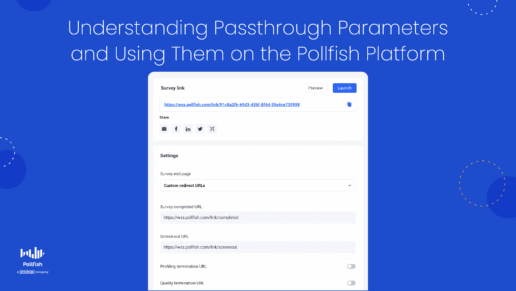
The following shows you how passthrough parameters appear on your Pollfish surveys. Take a look to see their components and properties and how to add them to your own survey link.

Add some more:

Add even more:

Retrieve them with redirect params:

Redirect Parameters
You can retrieve your passthrough parameters through redirect parameters, which are also part of a URL. The value in your destination URL affects where and how the URL is redirected.
Building Passthrough Parameters on Pollfish
Params order and letters case doesn’t matter! You can define a parameter at the end of an entry URL by adding first the ? and then the parameter. For example:
Entry URL:
https://wss.pollfish.com/link/12345678-1234-1234-abc123456?userid=%userid%
You can append another parameter by tying them with the “&” sign. For example:
https://wss.pollfish.com/link/12345678-1234-1234-abc123456?userid=%userid%&campaign_id=%campaign_id%
Retrieving parameters through redirect URLs
In case you want to pass through the information with redirect URLs then you have to include the same parameters at the redirect URLs. For example:
Survey with a completed URL:
https://thirdpartyswlink.com?user=%userid%&campaign=%campaign_id%
An easy way to check the validity of your parameters is that the parameter name in entry url is the same with the value between the % symbols at the redirect URLs. For example:
Entry URL: https://wss.pollfish.com/link/12345678-1234-1234-abc123456?user_id=%respondentid%
Survey with completed URL:
https://thirdpartyswlink.com?respondent=%user_id%
Export the stored data.
All parameters and their saved values for each respondent are available at XLS export, sheet individuals.
Will the following work?
A third party software defines parameters $param$ or [param] or [[param]].
It will not. Try to replace all other symbols with the percentage symbol (%).
Creating the Best Survey Experience
While this topic hinges on the technical side of the market research process, the Pollfish platform is otherwise extremely user-friendly and easy to navigate.
You should therefore opt for a research platform like Pollfish, which also grants artificial intelligence and machine learning to remove low-quality data and a broad range of survey and question types to customize your surveys.
It also features advanced skip logic to route respondents to relevant follow-up questions based on their previous answers.
Pollfish puts you in full control of your survey campaign — from targeting, to deployment method, to the questionnaire and how your post-survey data is presented.
With a research platform containing all of these capabilities, you’ll be able to set up research campaigns your way and retrieve quality data.
Implementing a Psychographic Analysis to Fully Understand Your Customers
Implementing a Psychographic Analysis to Fully Understand Your Customers

In order to understand your target market, you’ll need to conduct a psychographic analysis, a critical kind of consumer analysis that logically follows a demographic analysis. Consolidating both of these forms of analyses allows you to paint an accurate picture of the customers most likely to buy from you — aka, your target market.
76% of customers expect companies to understand their needs. It is therefore critical to analyze your customers’ psychographics, as psychographics aims to understand the cognitive factors that drive consumer behaviors. As such, this kind of analysis allows you to understand the core of your customers’ psyche, making it easier to serve them and meet their needs.
To further prove the importance of understanding your customers, consider this: customer-centric companies are 60% more profitable compared to companies that aren’t. All businesses should study their customers' psychographics.
This article explains the psychographic analysis in full detail, including its importance, makeup, how to collect psychographic data and how to conduct this kind of analysis.
Understanding the Psychographic Analysis
A psychographic analysis is a kind of customer analysis that involves examining psychological and emotional motivations in order to provide more relevant offers and messaging to the customers.
This kind of analysis is performed to complete a target market analysis, which is a comprehensive analysis of the consumers most likely to buy from you.
A psychographic analysis must follow a demographic analysis, which organizes customers via basic, quantitative information, such as age, gender, occupation, etc. Studying psychographics allows you to understand how demographics relevant to your brand think and behave.
While demographics deal with a specific segment of the population, thereby answering the “who” and “what,” psychographics deal with the motivational factors that influence customer buying behavior. As such, a psychographic analysis provides the “why” behind purchasing behaviors.
The following lists all the factors involved in a psychographic analysis:
- Consumer activities
- Interests
- Goals
- Values
- Belief systems
- Attitudes
- Opinions
- Aversions
- Emotional responses
- Morals and ethics
- Biases and prejudices
- Tendencies and habits
- Hopes
- Thoughts
- Fears
- Lifestyles
Given that psychological and behavioral factors tend to intertwine, this kind of analysis includes both. Additionally, they both hold sway on how, what and how many times customers buy.
As such, this kind of analysis also supports the RFM analysis. An abbreviation for recency, frequency and monetary value, this analysis is used to estimate the value of a customer based on the three data points in its abbreviated title.
Finally, a psychographic analysis allows you to create detailed customer profiles. As such, aside from learning the demographic makeup of your customers, you’ll begin to understand why they buy and behave in certain ways.
How to Collect Psychographic Information
There are various means you can use to collect psychographic information. These involve taking part in secondary and primary research.
The following lays out the different ways you can collect psychographic information:
- One-on-one interviews
- The most traditional route.
- This often involves pre-recruiting participants.
- It can also consist of random cold calling.
- Focus group
- A small group of people selected based on shared characteristics to take part in a discussion for the purposes of market research.
- A moderator conducts a discussion where every member participates at their own will.
- This can be biased, as submissive participants will keep quiet, while extroverted, dominant participants will offer more.
- Website analytics
- This includes internal site analytics.
- Examples include those involved from a web host, such as WordPress.
- It can also include Google Analytics, which displays various site activities.
- Third-party analytics providers
- UX analytics providers
- They often provide capabilities beyond traditional metrics such as traffic and bounce rate.
- Ex: Adobe Analytics
- Psycholinguistic
- This refers to investigating the psychological processes involved in the use of language.
- In market research, it involves understanding customer jargon and slang.
- It deals with the perception, production, and acquisition of language.
- Browsing Data
- This involves examining how customers browse your site.
- It includes studying the time spent on a page, etc.
- It often involves using site cookies, which allow you to monitor customers and remember certain information about them.
- Social media behavior
- This includes likes, shares, clicks, tweets, posts.
- It also involves using social listening to understand when customers mention your brand, niche or competitors.
- Reviews on social media sites provide insight into customers’ attitudes and opinions.
- Syndicated research
- This research is conducted independently, published and sold by a market research firm.
- The firm is industry-specific and funded by several companies in a particular industry.
- It doesn’t allow you to gain full control of your market research study, as the firm dictates the study and owns the data.
- Survey panels
- This research method collects data from a group of pre-recruited and pre-screened respondents.
- A group of panelists takes part in research sessions over a given period of time.
- This is ideal for longitudinal studies, as you can work with the same set of panelists continuously.
- Online survey tools
- This involves market research platforms that allow you to create, distribute and analyze surveys online.
- They put you in full control of your survey study.
- They eliminate bias via quality checks, such as banning VPN users, removing gibberish answers, etc.
The Importance of a Psychographic Analysis
This kind of analysis is essential for various reasons.
A psychographic analysis allows you to complete the customer profile you’ve begun compiling during a demographic analysis. It scopes out the psychological and behavioral factors behind the demographics.
As such, you won’t merely understand who is in your target market, but their mindsets, what they do and why they act in particular manners, putting their customer behavior into perspective.
Through this analysis, you’ll be able to unearth who would be most receptive to your company’s offering.

By understanding why a consumer might buy your product or service, you’ll be able to efficiently create marketing campaigns that appeal to them specifically. For example, some consumers may find it difficult to make healthier lifestyle choices. Through a psychographic analysis, you can discover the psychological nuances that drive this difficulty.
You can then use those insights to appeal to these consumers, by positioning your brand as one that understands the hardships of living a healthy lifestyle and offers simple solutions, ie, your products and services.
With the correct psychographic information in tow, you can then create marketing campaigns with the most relevant customer testimonials, content and messaging. You can also use the insights you gathered from this kind of analysis to adjust sales campaigns, such as creating the correct promotions and incentives that spur customers into buying from you.
Aside from setting up the proper campaigns and serving your customers in their favor, a psychographic analysis allows you to influence consumer behavior. This involves being able to tap into your consumers’ values and what they hold important, along with using effective emotional marketing.
For example, some customers value green initiatives and sustainability. They are thus most inclined to buy from green, sustainable brands. Other customers may have an emotional connection with a particular charity, and thus will be more willing to buy from a business that supports this charity, a similar one or champions its cause.
All in all, all businesses need to understand what motivates their consumers. A psychographic analysis will humanize the raw and statistical data that brands derive from a demographic analysis.
That’s because psychographics refines dry data by painting a picture of who your shoppers are aside from their quantitative traits, allowing brands to know them on a far more personal and intimate level.
How to Form a Psychographic Analysis
Creating a psychographic analysis requires conducting both primary and secondary market research. Unlike in a demographic analysis, studying customers’ psychographics requires conducting qualitative market research.
You’ll need to apply this approach to every step in the process, including when you contextualize your demographic analysis — this is a major part of forming a psychographic analysis, as the psychographic portion is meant to delve into the psychological factors of a company’s key demographic targets.

The following lays out how to conduct a psychographic analysis:
-
- Begin by drawing up your findings from your demographic analysis.
- Consult the different segments you’ve discovered from the secondary and primary research you conducted in your demographic analysis.
- Next, perform secondary research; use the current market segment insights you have and dig further by using all kinds of secondary sources. These include:
- Government websites
- Market research sites with publicly available data.
- Trade magazines
- Blogs
- News sites
- Websites dedicated to CX and consumers
- Niche sites that discuss consumers in your industry
- Add the information you’ve discovered in the demographic profiles you’ve created.
- For example: do men between the ages of 20-35 tend to make hasty purchases? Or perhaps they’re more likely to buy the latest version of electronics?
- Run a primary market research campaign.
- Use the profiles you created in the previous step to brainstorm your most pressing psychographic questions.
- To better understand each demographic segment you highlighted, conduct a survey with multiple audiences. Alternatively, conduct several surveys on each demographic group. (The former is more efficient; you’ll need an online survey platform that provides this).
- Consider dividing your surveys and question types by the following broad topics, which include corresponding sub-topics. Since it is best to keep surveys short as a best practice, it is ideal to create multiple surveys. First, divide them into the following:
- Emotional response
- To understand consumer: feelings, aversions, desires, fears, emotional connections and sensitivities
- Consumer activities
- To understand consumer: habits, spending patterns, purchasing pains, frequency of purchases, lifestyles
- Interests
- To understand consumer: lifestyles, habits, curiosities, needs, biases, likes, tendencies
- Goals
- To understand consumer: needs, aspirations, how they seek to remove pain points
- Values
- To understand consumer: belief systems, moral and ethics, biases and prejudices,
- Opinions
- To understand consumer: attitudes, hopes, perceptions of your brand and others and lastly, their thought
- Emotional response
- Conduct follow-up surveys and/or questions, if need be.
- Use a survey platform that offers advanced skip logic, if you opt for the latter. This is because this functionality routes users to specific follow-up questions, based on how they answered a previous question.
- Analyze your findings.
- Use your market research platform’s dashboard to visualize and make sense of your data.
- Form concrete customer segments and personas from your psychographic survey findings and analysis.
- Take action.
- Use the findings from your psychographic analysis to take a wide range of actions, such as establishing new marketing campaigns, tweaking existing campaigns, innovating on products, improving customer service and more.
- Conduct regular surveys of your target market sample to continuously stay in the know about their feelings, opinions and all else that their psychographics include.
Delving into the Minds of Your Customers
A psychographic profile enables you to know how your ideal customers think, feel, behave, value and much more. This kind of customer intelligence is vital, as it not only paints a clear picture of your target market, but it also allows you to understand your customers’ buying decisions and behaviors.
This could mean the difference between earning, retaining or losing customers. As such, you should conduct a psychogrpahic analysis of your customers to understand what makes them tick, how they respond emotionally, how their values shape their buying behavior and much more.
To do so, you’ll need to use a quality online survey platform. You should use an online survey platform that makes it easy to create and deploy all kinds of surveys.
It should extend random device engagement (RDE) sampling so that you can reach customers in their natural digital environments, as opposed to pre-recruiting them.
Your online survey platform should also offer artificial intelligence and machine learning to remove low-quality data and offer a broad range of survey and question types.
Additionally, it should also allow you to survey anyone. As such, you’ll need a platform with a reach to millions of consumers, along with one that offers the Distribution Link feature. This feature will allow you to send your survey to specific customers, instead of only deploying them across a vast network.
With an online survey platform with all of these capabilities, you’ll be able to properly conduct an informative psychographic analysis.
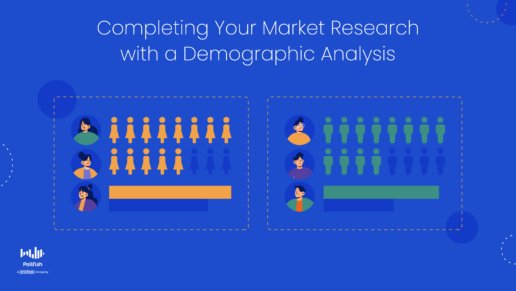
Forming a Demographic Analysis to Complete Your Market Research
Forming a Demographic Analysis to Complete Your Market Research

Conducting a demographic analysis is a critical component of your market research and consumer analysis efforts.
In today’s hyper-competitive age, you need to understand your market precisely, including its key players, namely your target market — the group of customers most likely to buy from you.
To market successfully, your target market can’t be anyone. Instead, you’ll need to narrow down the targets of all your marketing campaigns by identifying them and running an analysis on them in relation to your products and services.
There are many characteristics making up a target market, with demographics being at the forefront. As such, it is key to begin your target market analysis by running a demographic analysis.
This article expounds on the demographic analysis, including its importance, makeup and how to properly conduct one to complete your market research.
Understanding the Demographic Analysis
Also called a demographic market analysis, a demographic analysis refers to the collection and examination of a specified list of characteristics pertaining to groups of people and populations. These characteristics differ from those used in a psychographic or lifestyle analysis.
A demographic analysis is a kind of technique that identifies and analyzes the demographics of a population. It then uses this data to develop an estimate of the population. This technique allows market researchers to understand key demographic aspects of its target market. Demographic data includes the following factors:
- Age
- Gender
- Race
- Ethnicity
- Socioeconomic information including:
- Employment
- Education
- Income
- Marital status rates
- Location data including:
- Country of residence
- State, territory, county, zip code, etc.
- Device usage
- Which device
A demographic analysis involves learning about the amount of each kind of demographic group present in a target market. This is because a target market is not one set of demographics; rather it is a multitude of demographic groups consolidating into the broad group that comprises all your target customers.
As such, a demographic analysis is used in market segmentation, along with when you construct customer personas. These market research techniques involve classifying and breaking down your target market into smaller, more defined groups that are easier to target than the overall target market.
Aside from studying the composition of a target market, a demographic analysis is also used to develop an understanding of how a population has changed over time. This involves evaluating birth, death, and migration.
In addition, you can further analyze how demographics have changed by conducting longitudinal studies via longitudinal surveys. These allow you to study a population over a period of time.
All in all, a demographic analysis includes all the aspects that allow researchers to measure the dimensions and dynamics of populations.
The Importance of a Demographic Analysis
A demographic analysis is critical to market research for a number of reasons.
First off, it is the chief method of identifying and classifying your target market, which represents those who are most likely to patronize your niche and products and most importantly, your business.
Before you can study your customer behavior, consumer preferences and how to create your marketing campaigns accordingly, you’ll need to know the core aspects of your target market, which is its demographics. This is because you wouldn’t be able to scope out the habits and lifestyles of your customers, if you don’t even know who they are.

Next, this kind of analysis can assist you with two other key objectives. These include the following:
- Discovering the sectors and subgroups making up the population
- Generating a comprehensive portrait of the traits that a typical member of each of these sectors possesses.
These two methods allow you to get a comprehensive understanding of the statistical information of all those in your target market. With this information in tow, you can move forward by studying your target population more closely, by conducting a psychographic analysis.
This analysis is also useful in that it allows you to form a specific demographic profile. Also called a customer persona, this profile presents information about a typical member of a certain customer segment. It assists in creating a visual representation of a hypothetical target market. For example, a market researcher may focus on the following persona: single men between the ages of 18 and 34, and are college-educated.
A demographic analysis is particularly valuable if it is used to compare demographics residing in different places. This is not just useful for those operating brick-and-mortar shops, as digital businesses must understand all of their customers and how to appeal to them.
And since it is unlikely for all customers to live in one area, it is key to study demographics across geographies. As such, it is also useful for local SEO, in which digital users are targeted by their location.
It is useful to provide two comparison sets of data: comparable communities and the state or United States as a whole.
Demographics are important to analyze, as they allow marketers and market researchers to comprehend how their target market searches for information online, along with how it purchases products.
In this way, demographic data is particularly useful for businesses, as it enables them to understand how to market to their consumers, which helps raise sales and revenue. In addition, understanding your demographics allows you to plan strategically for future campaigns.
All in all, demographics are critical for market research, given that demographics encompass human populations and how they impact the market.
How to Form a Demographic Analysis for Market Research
To create a demographic analysis, particularly for market research, you’ll need to understand who makes up your target market.
As such, you’ll need to gather this info by eliciting information on who buys products and services in your niche. You can also do so by discovering your demographic makeup from customers who have already purchased from you.

This requires conducting both secondary and primary research. The following steps provide a walkthrough on how to create a demographic analysis:
- Begin by conducting secondary research. Start at the general level by scouting for articles and other resources on the demographics in your niche.
- Use demographic data on particular locations from government websites.
- For example, the US Census Neighborhood Explorer.
- Based on your secondary research, put together your findings into preliminary customer segments.
- Then, use market research software to conduct primary research.
- You can opt for syndicated research, but you won’t control the study, should you take this route, as it will be proprietary to the market research firm you use, along with its partnering companies.
- Create surveys with screeners that require the demographics you’ve discovered from your secondary research.
- It is optimal to create a single survey with multiple audiences — whether you’ve conducted secondary research or have obtained little to no secondary demographical data.
- This way, you can ask multiple audiences for their thoughts on your niche and whether they would buy your products or services.
- You can segment your demographics more accurately this way, as your survey results may not perfectly align with your secondary research.
- Be sure to send your surveys to specific people, such as previous customers or those on an email list, aside from only deploying your surveys via your online survey platform.
- It is crucial to send follow-up surveys, or at least follow-up questions that ask for more clarification on preceding questions.
- Your market research platform should offer advanced skip logic to do this, as it routes respondents to relevant follow-up questions based on their answers to previous questions.
- Make sure you iterate your survey research by covering all demographics, as you may have some demographics in your target market that you are completely unaware of.
- Analyze your findings.
- Put together a document with various segments based on their demographics.
- You may use them to build preliminary customer personas.
- Start coming up with questions for a psychographic analysis, which covers lifestyles and behaviors.
Understanding the Makeup of All Your Customers
A target market analysis is of the utmost importance before you tackle any marketing campaign. It begins with conducting a demographic analysis, which informs you of the statistical makeup of various characteristics of your consumers.
In order to carry out an accurate and timely demographic analysis, you’ll need a quality online survey platform.
You should use an online survey platform that makes it easy to create, deploy and analyze all kinds of surveys. It should offer random device engagement (RDE) sampling to reach customers in their natural digital environments, as opposed to pre-recruiting them.
Your online survey platform should also offer artificial intelligence and machine learning to remove low-quality data, disqualify low-quality data and offer a broad range of survey and question types.
Additionally, it should also allow you to survey anyone. As such, you’ll need a platform with a reach to millions of consumers, along with one that offers the Distribution Link feature. This feature will allow you to send your survey to specific customers, instead of only deploying them across a vast network.
With an online survey platform with all of these capabilities, you’ll be able to quickly gain insights into your customer demographics and analyze them at speed.

Buy a Survey Audience and Survey Respondents Straight from the Source
Buy a Survey Audience and Survey Respondents Straight from the Source

As market research professionals, we urge you to buy a survey audience to access a wealth of survey respondents at your fingertips.
While it may be tempting to opt for a market research panel, buying survey respondents straight from the source is a much more effective method for conducting research and having constant access to the correct survey respondents.
You wouldn't want to survey the wrong audience; it should be precise to both your target market segments, along with to the respondent qualifications of a particular research campaign or survey.
Both the former and the latter are going to vary; as such, there is no such thing as a single survey target audience.
Thus, the makeup of your survey audience will differ based on the shifts in your target market and the different subjects and objectives of distinct research campaigns.
As such, you’ll need to reach out to several populations based on your various research campaigns and needs. To do so, you’ll need to identify, target and buy the correct survey audience.
This article explores how to buy a survey audience, the importance of reaching the right survey respondents, how the Pollfish platform does so with random organic sampling and much more.
Table of Contents: Buy a Survey Audience and Survey Respondents Straight from the Source
- Target the right survey audience
- Removing fraud incentives
- Our audience operates differently
- Audience size and source matter
- Selecting the right consumer
- The right audience makeup
- Our expansive reach means we can do what no other market research provider can
- The Importance of Buying a Survey Audience
- The Proper Target Survey Audience is Not the Same as Market Segments
- Identifying and Reaching the Poper Respondents
- Studying Your Target Audience in Greater Depth
- Being Able to Detect and Observe a Bad Customer Experience
- Having Constant Access to the Correct Survey Audience Population
- Using Random Device Engagement and Organic Sampling
- Market research panels are flawed
- How to Buy a Survey Audience
- Buying a Survey Audience as Part of the Survey Process
- The Two Pollfish Plans
- Accessing Market Research Data to Buy Survey Audience
- Two Main Ways to Buy a Survey Audience
- How to Buy Survey Respondents
- The Pollfish Platform Has Your Back
Target the right survey audience
You ought to target the right survey audience without being bogged down by survey fraud and a host of other issues that non-organic probability sampling methods bring.
We identified data-quality issues - such as panel fatigue and unconsciously biased responses that are unavoidable with career panelists early on. To stamp out low-quality data, our platform is designed to avoid career panelists with narrow targeting and a system of quality checks.
We’ve also created our own distributed audience network to be the first wholly-owned and operated network made up of real consumers around the world.

Whether it’s cracking down on low-quality survey data or accessing real customers, the Pollfish organic sampling method (see the section called Using Random Device Engagement and Organic Sampling) executes a meaningful market research campaign.
Our platform targets the correct survey audience, one that can be exclusively defined and hyper-targeted to ensure that only the most relevant respondents partake in your survey campaigns.
Removing fraud incentives
Most traditional market research panelists are survey respondents who sign up in exchange for cash or airline points.
Because these incentives are static and cumulative, they often become “professional survey-takers” — they understand how, and are motivated to bypass screening questions to ensure they can take as many surveys as possible, without providing quality responses.
Our platform mandates a screening section, which you can customize to be as granular as possible, thereby allowing you to avoid poor-quality respondents. Just use our screener to qualify respondents on a wide range of demographics and psychographic qualities.
We even offer screening questions in addition to inputting survey respondent qualifications in the screener section.
Our audience operates differently
Because we partner directly with app developers, the developer defines appropriate and specific non-cash survey incentives in exchange for completed surveys. These incentives benefit real consumers without motivating them to become career panelists.
Instead, respondents are motivated to complete a survey truthfully and are rewarded with a pleasant survey experience (and an incentive after they complete the survey).
With so many mobile apps in existence, there is a wide breadth of non-monetary survey incentives to reward your respondents, draw them to your survey and provide accurate data.
For example, in the case of a news app, the survey incentive might be a premium article, or in a fitness app, access to a free yoga lesson.
In a mobile game, the incentive can take the form of in-game tokens, lives, access to higher levels and more. You can get creative with how you offer these incentives, and our app partners always are.
Audience size and source matter
Since we operate the largest global audience of survey takers, our vast network enables us to reach very narrow consumer segments, meaning we can reach very specific target audiences, the kinds you wouldn’t be able to target otherwise.
That’s because our survey audiences are hyper-targeted.
The screening questions we mentioned earlier (Removing fraud incentives section), allow you to do just that.

With the screening questions, you can permit or disqualify potential respondents based on how they answer your screening questions. In other words, it allows you to fine-tune your survey audience targeting even more distinctly.
However, what truly makes us stand out against the crowd of other survey sample providers is our relationships with our partner apps that ensure high-quality responses from those targeted segments.
Because of this relationship, our surveys and incentives are never boring or lackluster. Instead, the respondents have an engaging survey environment where they’re prompted to complete entire surveys. Thus, it’s a win-win situation for researchers and survey respondents alike.
Selecting the right consumer
Our more than 120K+ app partners are manually vetted and only get paid when they deliver a response from a qualified individual that fits the targeting criteria request and meets our strict quality controls.

This differs from the traditional approach that requires “impaneling” respondents, making it prohibitively expensive to throw out questionable responses.
But on the Pollfish platform, our AI-powered system automatically disqualifies respondents who don’t fit the entire targeting criteria, along with those who provide faulty answers and low-quality data.
That’s because our wide range of quality checks weed out gibberish answers, respondents who don’t pay attention, VPN users who would otherwise taint geographic targeting and other sources of low-quality data.
The right audience makeup
New respondents are joining our consumer network every day. Our network of app providers and survey respondents is now in over 160+ countries - and growing - as our app-based partnerships give us a fast and efficient way to reach and expand our market research audience.
We use a rolling profiling model to keep our audience information up-to-date and collect a wealth of data upfront including demographic, location, gender, carrier and mobile usage data (a first in the space).
This makes it easy for you to create surveys using already-collected demographic data and spend time seeking answers for your business, not drafting questions to define your audience makeup.
Our expansive reach means we can do what no other market research provider can
We narrowly target consumer populations and send surveys to the exact respondents you want to reach, apply AI fraud detection to remove responses that don’t meet our quality standards and still have plenty of responses to satisfy your targeting quotas — all while they are organically engaged in mobile apps on their devices.
We call this revolutionary methodology organic sampling, specifically Random Device Engagement on the Pollfish platform. We’ve used it to accurately predict some of the most confounding political events of recent decades — where traditional methods fell short.

Learn more about the Pollfish methodology.
The Importance of Buying a Survey Audience
Buying a survey audience is essential to your studies. Many reasons support this claim. Let’s explore some of the major arguments as to why buying a survey audience is an absolute must for your market research campaigns.
The Proper Target Survey Audience is Not the Same as Market Segments
The reason that upholds the importance of buying a survey audience ties in with the need to use the proper survey target audience. You wouldn’t want to reach out to irrelevant population segments, as they are not part of your target market.
In addition, even if you have identified the distinct market segments and customer personas in your target market, they are not equivalent to your target survey audience.

This is because the market segments and customer profiles that you’ll need to survey will vary from study to study and from one survey campaign to the next.
As such, your survey audience is not the same as your market segments and broader target market.
Instead, your survey target audience is a far more narrow and specified group contingent on a particular survey campaign. Sometimes, it’ll be even more limited, as it will be exclusive to a particular survey part of a larger campaign.
Identifying and Reaching the Poper Respondents
To reach this distinct group of respondents, you’ll need to have them in your sampling pool. To do so, you’ll need to identify them first, before you buy them. That’s something you can achieve with a market research platform, particularly an online survey platform.

Such a platform would handle identifying and reaching your correct survey audience. But you would need to buy your survey audience first.
Buying this audience is also important for several other reasons.
Studying Your Target Audience in Greater Depth
Having access to the correct survey audience is essential for market research. As aforementioned, you wouldn't want to study the wrong populations. Having your survey audience within easy reach allows you to study your customers in great depth.
This is important for a variety of reasons, from delighting your customers, to retaining them. Customer retention is more important than customer acquisition, yet studying the proper survey audience allows you to achieve both: retaining your customers and gaining new ones.
To study them, they’ll need to be accessible to you and your market research efforts. As such, it’s crucial to buy your survey respondents.
Being Able to Detect and Observe a Bad Customer Experience
Did you know that almost half of all customers stop doing business with a company due to a bad CX? In fact, 47% of customers stop buying from businesses after a negative experience.
But having a bad experience with a brand doesn’t always compel customers to make light of it. As such, not all of your customers will complain, thereby you won’t have awareness of the poor customer experience your brand provided.

91% of unhappy customers will leave a business without complaining. Thus, while many brands place a lot of effort into forging customer happiness, they can’t avoid all kinds of customer dissatisfaction and frustrations.
Fortunately, with survey research and access to the correct survey audience, you’ll never have to be kept in the dark about poor customer experiences. Instead, you can deploy regular consumer surveys and brand trackers to be in the constant know regarding your customers' wants, needs, sentiments, opinions, aversions, and more.
Once more, this all depends on having access to the correct survey audience, which is why you’ll need to buy your survey audience through a reliable online survey platform.
Having Constant Access to the Correct Survey Audience Population
When you buy a survey audience, you can also rest assured that you always have access to the correct audience. That’s because a strong online survey platform will allow you to hyper-target your target survey audience as narrowly as you’d like.
It will even allow you to use multiple audiences in a single survey. This provides a holistic survey audience access. It’s objectively important to have this option within constant reach in your online survey platform.
But having access to the correct survey audience once or for one survey isn’t enough. As aforementioned, it is key to keep constant tabs on your customers and your brand experience. Avoiding a bad CX is a must, but you won’t be able to do it via a one-and-done approach.
Thus, while using syndicated research may give you access to your target survey audience, it won’t give you continued access to your customers — unless you’re willing to break the bank. This form of research involves using a market research firm to carry out and own all research data.
This approach is therefore not ideal, as it is expensive and won’t allow you to have a constant grasp of your data. Instead, when you buy a survey audience with Pollfish, you are the sole owner of your data and have constant access to our 250+ network of consumers ready to take your surveys.
Using Random Device Engagement and Organic Sampling
Equally important as buying a survey audience is using the proper mechanism for reaching it. Did you know that the way you reach your survey respondents dictates the nature of their responses?
That’s because some respondents will be more inclined to take it than others, while some will be more prone to biases (especially if they are pre-recruited via panels).

As such, the method for reaching an audience goes hand in hand with buying a survey audience; both are critical to your studies, as both factor into its quality.
To avoid as many survey biases as possible, keep respondents engaged in your study and forgo survey fraud, you ought to use a platform that runs on organic probability sampling.
As such, you should use a potent market research platform that leverages this mechanism and allows you to easily access your audience.
Below we’ll delve into what organic probability sampling is, along with the RDE method.
Market research panels are flawed
Research panels are one of the most common techniques used to identify and reach survey panelists and other market research participants. While they are a popular option, they do not provide you with the quality that organic sampling does.
At Pollfish, we avoid using conventional panels for this very reason.
Instead, we’ve developed our very own market research methodology called organic probability sampling. This involves sourcing our audience of real consumers via partnerships with app publishers, which allows us to conduct randomized, yet highly targeted surveys to verified respondents.
Our unique process is known as Random Device Engagement, (RDE), which uses the organic sampling approach for finding and obtaining survey participants.
A kind of organic probability sampling, RDE polling relies on advertising networks and other digital platforms to engage potential respondents wherever they visit voluntarily.
Thus, RDE catches users where they choose to be, as opposed to being in unnatural environments, where they’ll be less likely to pay attention, let alone take part in a survey.
That’s because, in unnatural environments, the thought processes of respondents can deviate from those in more natural environments, which results in artificial considerations that can influence their responses. Thus, RDE is the better approach to reaching respondents and getting honest, attentive responses.
Random Device Engagement / Organic Sampling includes a variety of digital platforms and properties to survey respondents, such as:
- Mobile sites
- Apps
- Websites
- Mobile games
This randomized method of reaching respondents ensures you avoid acquiescence bias from your respondents, due to the anonymous nature of this route. This means you’ll avoid respondents who respond with answers that have positive associations.
This is because these surveys are completely anonymized and therefore don’t have the same pressures as a panel.
In addition, RDE allows you to steer clear of the sampling bias, which occurs when the respondent selection process is not conducted at random, which then leads to the under or overrepresentation of a certain market segment.
With over 250 people in our network, we never have to worry about data quality, delivering only the best, most authentic, and most useful insights to our clients.
How to Buy a Survey Audience
Now that you understand why it’s important to buy a survey audience, along with how the Pollfish platform provides the supreme respondent-reaching mechanism and quality survey data, it’s time to learn how you can buy a survey audience yourself.
Fortunately, the Pollfish platform values user-friendliness and ease of use, making it a quick and easy process.
On our platform, buying a survey audience is deeply tied to the entire survey creation process.
Buying a Survey Audience as Part of the Survey Process
So what does it mean when the survey creation process is deeply connected to buying a survey audience?
In Pollfish, it means that as you create your questionnaire, you can also seamlessly switch to the “audience” tab and edit your survey target audience.

This section of your survey project is where you input ALL of your respondent criteria. In market research, this is typically referred to as the screener, or the screening section. This section includes all the demographic, psychographic and geographic criteria you can use to target specific survey target audiences.
You’ll need to register with Pollfish to view the screening section, dashboard, and the rest of the platform. You can do this by signing up for either a Basic Plan or an Elite Plan.
The Two Pollfish Plans
Determine the best Pollfish plan for your business, organization or personal need. When you register for an account, you’ll have access to the platform to understand how to buy a survey audience firsthand.
Our market research SaaS offers two plans. Read through the nuances, offerings and possible limitations of both before you sign up.

- The Basic Plan
- Part of our Freemium model
- Includes basic features
- Allows you to pay as you go, meaning there is no minimum or maximum deposit.
- Each completed survey costs $0.95.
- Survey prices are uncapped.
- This is accessible to 10 people in your team.
- Which features it includes:
- A/B testing (Monadic)
- Advanced question types
- An account budget
- Data Exports (SPSS, CSV, PDF, Crosstabs)
- Demographic information on results
- White-labeled reports
- Open-ended grouping
- Full survey review and edits
- 24/7 support
- Which features it excludes:
- Conjoint analysis
- 4-6 Screening Questions
- Van Westendorp Price Sensitivity Meter (for pricing studies)
- BigQuery Export
- Crosstab Reports Designer
- Survey Results Translation
- Single Sign-On (SSO)
- At last, this plan offers the Distribution Link feature.
- This grants you more options for deploying your survey, those that go beyond using our Random Device Engagement method.
- Instead, it grants you full control of how and to whom you send your surveys.
- Now available with both plans, learn more about it under Elite Plan, below.
- The Elite Plan
- This plan also prices each completed survey at $0.95.
- It includes capped pricing.
- The plan requires an account deposit.
- This deposit works in the manner of credits. Each dollar amount is equivalent to 1 credit.
- These credits are what you use to pay off each survey complete and other survey costs.
- This plan is suited for all business types and organizations with larger market research goals and needs.
- As such, it includes more advanced features, along with all those that the Basic Plan includes.
- For example, it includes the Distribution Link feature.
- This nifty feature allows you to send your survey your way.
- That means, you can send your surveys to either:
- Specific individuals. This usually includes targeted respondents to whom you have contact information.
- This can include their email address or their social media accounts.
- This kind of information may come from paying customers, or those who signed up for marketing collateral, such as newsletters, thereby giving you their contact info.
- You may also get this information by interacting with your followers on different social media channels.
- Through specific online channels, such as social media, the homepage, a static page or landing pages.
- This is especially useful if you seek to send your surveys through your own digital channels and properties, as opposed to others, such as those in our RDE network of website and app publishers.
- Specific individuals. This usually includes targeted respondents to whom you have contact information.
- Which features it includes: (that the former plan lacks)
- Conjoint analysis
- 4-6 Screening Questions
- Van Westendorp Price Sensitivity Meter
- BigQuery Export
- Crosstab Reports Designer
- Survey Results Translation
- Single Sign-On (SSO)
If you’re interested in learning more, or are ready to sign up with Pollfish to start cranking out all the market research projects you desire, visit our page: Pollfish Plan Pricing.
Accessing Market Research Data to Buy Survey Audience
Once you register with Pollfish, sign in to your account. Once signed in, you’ll be able to access all of your market research data — including the screener where you select your desired survey audience. The Pollfish platform includes the following interfaces:
- The Dashboard
- New project creation
- Here, you can create new survey campaigns
- List of ongoing surveys; this includes
- Running surveys
- Paused surveys
- You can include each survey under different folders
- New project creation
In your dashboard, you can choose what you want to do with your survey campaigns, such as combing through ongoing surveys, paused surveys or those that have already reached completion. The latter refers to surveys that have received the amount of completes you originally added as part of your quotas.
Two Main Ways to Buy a Survey Audience
You can also choose to create an entirely new project. For this purpose, you’ll find the large blue button on the top right corner of the Dashboard, called “Create Project.”
As such, there are two main ways to buy a survey audience in Pollfish and edit it to your liking.
The first way to buy a survey audience is by creating an entirely new project. This grants you three options, which you can learn about in the next section. Essentially, these options provide the way you build out your survey.
The second way to buy survey respondents is by editing a survey that’s already in progress, AKA, a survey that is already running. In this second method, you can choose respondents by pausing a running survey.
Remember, in both ways, you’ll need to buy your survey audience by accessing the last section (or step) of the survey process, which is the checkout.
For more information on how to make your own survey in just three easy steps, read the article in the hyperlink.
How to Buy Survey Respondents
Now that you understand how buying survey respondents works on Pollfish, including the fact that it is innately tied to forming surveys themselves, let’s delve further. Here, we’ll teach you how to make that knowledge more actionable.
The following provides step-by-step instructions on how to buy a survey audience on Pollfish:

- Register or log in to the Polish platform.
- Choose how you want to buy your respondents based on the two main ways explained above.
- If you seek to edit an ongoing survey (or a lauded survey), go to your dashboard.
- In your list of surveys, choose from the following surveys:
- All
- Draft
- Under approval
- Approved
- Running
- Paused
- Completed
- Under Edit
- In this list, click on the one you wish to edit.
- Edit your survey audience.
- You can change anything on the audience page, such as applying /removing filters, adding/changing quotas, etc.
- You cannot edit the screening questions.
- Go to the Checkout and pay for your new survey audience.
- In your list of surveys, choose from the following surveys:
- If you seek to create a new project, click on the big blue button labeled: “Create project.”
- You’ll have three options for creating a new survey project. These include:
- From scratch
- From template
- Link 3rd party
- Next, you’ll be asked the following: "How would you like to collect responses to your survey?”
- Choose from the following options:
- Buy a survey from the Pollfish audience (The RDE method)
- Send a survey to your own audience or another survey panel
- Next, you’ll be brought to the 3-section survey creation interface.
- Choose your precise survey audience in the “Audience” section.

- Here, you can input as many demographic/ location/ psychographic features.
- You can add screening questions if you have the Elite Plan.
- After you’re done choosing all your respondent criteria, move on to the next section, the Questionnaire and create your survey.
- Go to the last section, the Checkout. Here you can:
- Choose a payment method.
- Choose to schedule your survey or launch it immediately.
- View your cost analysis.
- Pay and complete your survey. Congratulations, you’ve bought a survey audience!
- You’ll have three options for creating a new survey project. These include:
The Pollfish Platform Has Your Back
Regardless of the kind of market research project you seek to build out, Pollfish always has your back. Our dedicated team of market research experts is here to help you 24/7. Our platform is second to none when it comes to working on any topic that requires research.
Whether you seek to run a product satisfaction campaign, measure your consumer loyalty, run a brand tracker, understand your brand reputation or improve your customer service, we’ve got you covered.
That’s because you can create any type of survey — and if you’re ever stumped on how to get started creating yours, you can choose from various survey templates and edit them to your liking. We currently offer 19 templates for a distinct range of topics.
Just remember to study the correct survey target audience, as it differs from your broader target market and its various segments and customer personas. Luckily, you can filter your survey audience as granularly as you need to on our platform. Happy researching.
Using Customer Feedback Survey Questions to Draw Quality Data
Using Customer Feedback Survey Questions to Draw Quality Data

It is critical to form viable customer feedback survey questions, as it is the questions that power this kind of survey.
The customer feedback survey provides a wealth of commentary from customers on various aspects of your business and their customer buying journey. This kind of data is critical to extract from customers, namely to satisfy them and to also maintain a reputable business.
This is because customers — including unhappy ones — don’t keep quiet; they air their feedback online and to their peers, friends and family. This can have either good or damning consequences for a business, depending on the kind of feedback customers provide.
77% of customers would recommend a company to a friend after having a positive experience with it. However, if they are not happy with a business, 13% of customers will share their experience with 15 people or even more. Compounding the damage is the fact that only 1 in 26 unhappy customers complain to the businesses themselves about their bad experiences.
Dissatisfied customers may skip on sharing their feedback with a company, instead taking their grievances to readily available online reviews. Bad reviews don’t sit well with customers; 53% of customers expect businesses to respond to negative reviews within a week. 1 in 3 have a shorter time frame of 3 days or less.
As such, businesses should use the customer feedback survey to collect all kinds of feedback, in turn, avoiding negative reviews and unhappy customers in general.
This article lays out various types of customer feedback survey questions — along with their wider context in the sales funnel — so that you can power your questionnaire with the right questions.
Approaching the Customer Feedback Survey
There is no hard and fast rule to surveying customers for their feedback, as there are various instances in which you can collect it. For some businesses, certain instances may be redundant to send this survey, especially if you’ve already used another kind of consumer survey about a particular brand experience.
For other companies, even those that haven’t deployed any surveys about a particular customer experience, it too may not be a priority if they’re conducting other kinds of market research. Ultimately, using this kind of survey depends on the kind of feedback you seek in relation to a certain business campaign. However, it is still useful, especially to those who are in lack of conducting market research techniques.
To determine the kind of customer feedback you seek to create questions for, consider the sales funnel, or the customer journey. While there are different occurrences and experiences in this funnel, they can be classified into 5 distinct stages:
- Top of the funnel
-
-
- Early aspects of the customer journey.
- This is when brands use brand awareness tactics to draw their target market’s attention to the company.
- This involves visual, snackable and engaging content.
-
- Early Middle of the funnel
-
-
- This is the early consideration stage of the customer journey.
- Customers contemplate solutions to their problems, considering your product or service as a potential fit.
- It involves new leads gained from top-of-the-funnel marketing and current customers you would urge towards making repeat purchases.
- It involves using a strong content marketing strategy to nurture leads.
-
- Middle of the funnel nearing conversions
-
-
- This involves educating leads further down the funnel and strengthening their interest and connection to your brand.
- At this point, potential customers are weighing your brand against others.
- This stage is the heart of the decision-making process.
- Aside from content, this stage requires a final push towards conversions, such as a promotion, sale, etc.
-
- End of the funnel
-
-
- This stage represents the beginning of purchases.
- Customers make a purchase or are in the process of purchasing, such as filling up an online shopping cart, but not yet buying.
- There can be hiccups during checkout, such as a malfunctioning page, difficulties in choosing a shipping method, etc.
-
- Post-sales
-
- This can include post-purchase order modification.
- Some customers change aspects of their orders, whether it is the products themselves, shipping type, credit card info, etc.
- This may include order cancellation.
- For businesses, it often involves nurturing for cross and up-sells.
- This stage also involves regular check-ins for brand tracking and customer satisfaction.
- This can include post-purchase order modification.
Common Types of Customer Feedback Survey Questions
There are various kinds of questions you can ask to extract valuable customer feedback.
The following provides question examples to use in the customer feedback survey:

- What challenges are you trying to solve?
- Question Type: Multiple-choice and an open-ended question
- Sales Funnel Position: Top of the funnel
- Have you used a similar [product or service] before?
- Question Type: Yes or no
- Sales Funnel Position: Top of the funnel
- Which of the following brands have you [heard of/used]?
- Question Type: Multiple-selection of multiple-choice answers, a follow-up to the previous question
- Sales Funnel Position: Top of the funnel
- What is the biggest issue you have [in a niche, with a product or service]?
- Question Type: Multiple-choice and an open-ended question
- Sales Funnel Position: Top and early middle of the funnel
- What kind of content would you like to see from us?
- Question Type: Multiple-selection of multiple-choice answers and an open-ended question
- Sales Funnel Position: Top of the funnel, early middle- middle of the funnel
- How can we make this page [product page, landing page, resource page] better for you?
- Question Type: Ranking, multiple-selection of multiple-choice answers and an open-ended question
- Sales Funnel Position: Top of the funnel, early middle- middle of the funnel
- What feature or option could we add to make your experience better?
- Question Type: Multiple-selection of multiple-choice answers
- Sales Funnel Position: Middle of the funnel
- What, if anything, what is stopping you from buying/subscribing today?
- Question Type: Multiple-choice and an open-ended question
- Sales Funnel Position: Middle and end of the funnel

- On a scale of 1 (unhappy) to 10 (very happy), how would you rate your overall satisfaction with us?
- Question Type: Numeric, scaled
- Sales Funnel Position: End of the funnel and post-sales
- What convinced you to buy the product?
- Question Type: Multiple-selection of multiple-choice answers and an open-ended question
- Sales Funnel Position: End of the funnel and post-sales
- What was the most difficult thing in your buying experience with us?
- Question Type: Multiple-choice and an open-ended question
- Sales Funnel Position: End of the funnel and post-sales
- How satisfied are you with the product or service from a scale of 1 to 10?
- Question Type: Numeric, scaled
- Sales Funnel Position: Post-sales
Listening to Your Customers
Market research involves far more than gaining intelligence on your customers’ likes, dislikes and customer behavior. Instead, it involves monitoring their CX and feedback on other matters throughout their journey with your brand.
This way, you’ll be attuned to their needs and perceptions towards their CX and your brand at multiple stages in their relationship with you. In order to collect this data, you’ll need a strong online survey platform. Ideally, it should make it easy to set up, target the correct target market sample and deploy your surveys.
You should use an online survey platform that offers random device engagement (RDE) sampling to reach customers in their natural digital environments, as opposed to pre-recruiting them.
Your online survey platform should also offer artificial intelligence and machine learning to remove low-quality data, disqualify low-quality data and offer a broad range of survey and question types.
Additionally, your market research platform should allow you to survey anyone. As such, you’ll need a platform with a reach to millions of consumers, along with one that offers the Distribution Link feature. This feature will allow you to send your survey to specific customers, instead of only deploying them across a vast network.
With an online survey platform with all of these capabilities, you’ll be able to reap invaluable consumer insights to help you power any campaign.

The Pollfish Survey Results Dashboard: Understanding its Functionality and How to Use it
The Pollfish Survey Results Dashboard: Understanding its Functionality and How to Use it

You’ll find the results of the survey you launched in the survey results dashboard on Pollfish. This page is your go-to source of survey data once the data of a survey is complete — that is — once all quotas from that survey are retrieved and the questionnaire has been fully filled out.
In order to properly analyze survey data and perform any sort of market analysis, whether macro or micro, you’ll need to have access to a clear and accurate set of survey results data.
Luckily, on Pollfish, the survey results page is easy to access, view and navigate. The data itself is of high quality, given the rigorous checks that the Pollfish platform facilitates to provide quality research data and avoid survey fraud.
This article delves into the ins and outs of the survey results dashboard, the page on the Pollfish online survey platform that contains all the survey results specific to the survey you run.
Understanding the Survey Results Dashboard on Pollfish
This dashboard is a page that contains all the results from the survey you conducted on the Pollfish market research platform, whether you ran the survey via the Distribution Link feature or randomly through our vast network of publishers.
The former method allows you to send surveys to specific people and on the specific digital properties you choose to insert your survey.
The latter refers to our Random Device Engagement (RDE) approach of survey distribution, which is a kind of organic sampling method that deploys the survey across a vast network and targets users where they exist voluntarily.
Each survey will have its own results page, meaning that each survey will have its own survey results dashboard. Whenever your survey collects all of its responses, it’ll be rendered complete and you’ll be sent an email prompting you to view your survey results.
Digging into the details of the survey results
The survey results dashboard displays more than just the statistics of each question you ask. Instead, you’ll find a granular breakdown of both the answers and the audience targeting.
This dashboard contains several options to view your survey results. You can view them in basic table form, which displays the question, the answers and their respective count and percentage of respondents who selected each.
You can also view your results in more visual ways, such as by way of a column chart, filled with colorful bars, or through a pie chart, best suited for visual learners.
The survey results dashboard also provides several export options. These exports present additional ways in which you can view your survey data. Whether you want to download an Excel file with your survey data or analyze your data via Crosstabs, it can all be found on this page (on the upper right corner).
Remember, each such page displays all the data associated with one particular survey. However, there is a way to view all completed surveys in list form. (More on this in the How to Access the Survey Results Dashboard section below).
The Contents of the Survey Results Dashboard
We discussed the major aspects of the survey results page in the previous section. However, there’s more to consider, along with all the specific subcategories that come with the contents of this dashboard.
The following lists all the contents that you can find on the survey results dashboard:
-
- The launch date and number of completes (on the center top)
- The option to get a sharable link to the survey (on the upper right)
- Exports (on the upper right)

- Excel
- CSV
- Crosstabs
- SPSS
- The survey questions and answers
- The count of each answer & the percentage of respondents who chose it
- The ranking (if it’s a ranking question)
- Answer visualizations (aside from a table view)
- Column chart
- Pie chart
- 2 ways to view results
- Actual results
- Post stratified
- Post-stratification is a weighting method to achieve a distribution equal with that of known characteristics of a population. It can be applied to all supported categories, such as countries, ages, gender and income.
- A robust data filtering system
- Filter the results based on a wide variety of demographic/location/device filters. This allows you to learn how granular segments of the population answered your questions.
- Time range
- View results based on the time they came in
- Screening questions
- See how respondents answered based on their screening question
- Gender
- Filter by gender (male, female, nonbinary)
- Age
- Filter answers based on various age groups
- Location
- Filter results by country, county, state, US census region and more
- Employment status
- Filter answers based on respondents’ employment status
- Any other targeting filters you may have added
- Time range
- Filter the results based on a wide variety of demographic/location/device filters. This allows you to learn how granular segments of the population answered your questions.
- Visualizations based on respondent categories
- View tables, column charts and pie charts on specific categories such as ethnicity, language, marital status, income and other audience demographics.
How to Access the Survey Results Dashboard
There are two ways to access your survey results. We briefly explained the first way in the section on Understanding the Survey Results Dashboard. To reiterate in further detail, once your survey is complete, you will be notified via email.
This email contains a large blue button with the call out to “View survey results.” Simply click on this button and you’ll be taken directly to the survey results dashboard for the completed survey in question.

Here you’ll find all the contents of the dashboard, as laid out in the previous two sections. You can filter the results, view them in any of the supported visualizations and export them in your file of choice.
You can also access the results dashboard by visiting the general dashboard. Just go to https://www.pollfish.com/dashboard/. Here, you’ll get a bird’s eye view of all your projects. All your surveys will appear here in list form, by way of the name of each one.

Notice that you’ll find the initials of the surveys’ creator(s) under each survey name. You’ll also see the date each survey was created, its number of completes (expressed as a number out of a preset total: 100/500), along with its status, such as draft or completed.
This page includes upper navigation in which you can view your list of surveys based on their status, for example, drafts, under approval, approved, paused, completed, etc. To view the surveys that have all their results in, click on the “Completed” tab.
This, in turn, will allow you to see a list of surveys that have been completed, meaning they have a survey results dashboard, which you can click on to view all your results data. By clicking one of these completed surveys, you’ll be taken directly to the survey results dashboard, which has all the information you’ll find by accessing it via email.
What You Can Do in the Survey Results Dashboard
By this point, we gathered that you can do five major things on this results page:
- View completed survey data
- Filter the data by demographics, time range, post-stratification and more
- Export the results in different formats
- Share the data through a link
- Quantify answers and draw conclusions
But there’s much more you can do with the survey results dashboard.
First off, you can conduct a survey data analysis and make observations with researchers, analysts and non-researchers and nonanalysts alike. After all, viewing and studying the data across tram members fosters a culture of data democratization.
You can conduct a market segmentation of your customers to categorize them into separate groups. Since your target market contains all the customers most likely to buy from you, it is often too broad to study on its own. Thus, you should segment your customers into smaller groups and personas.
Given that you can filter by demographics and screening questions, you can detect specific groups of customers and search for patterns in their behaviors and specific answers.
If you’d like to segment your customers even further, you can use your results dashboard to create an RFM analysis. An acronym for recency, frequency and monetary value, this kind of research method segments customers via these three customer behaviors.
In turn, market researchers and business owners can identify which customers are regulars, big spenders and which make one-time purchases. This allows you to distinguish between your customers, assign each customer numerical scores based on the three measures and grant an objective analysis of their value to your company.
Additionally, you can use the results dashboard to conduct research on your own organization, performing an internal assessment such as a SWOT analysis.
An acronym for strengths, weaknesses, opportunities and threats, this analysis allows you to identify these four aspects of your company, department or project, ideal for strategic planning and reducing any negative qualities.
It’s easy to do since all questions and answer data are clearly laid out and available to view in different formats.
Moreover, you can use your results dashboard to complete a market trend analysis, an important overview of your industry. Specifically, it is used to analyze trends in a niche market or an industry at large.
A market trend analysis is a method of analysis of past and current market behavior, featuring dominant patterns of a market and its consumers. It relies on examining statistical data and recorded market behavior over a defined period of time.
Your results dashboard is easy to access and view in different visualization, making it easy to compare market trends over a long period of time.
Finally, you can use your survey results dashboard to form a general customer behavior analysis.
This grants you insight into a swath of customer behaviors and their motivations, allowing you to understand how they tick and the reasons behind their purchases. You can delve deeper by studying their preferences among brands, brand loyalty and much more.
All in all, you can partake in numerous market research projects and perform various analyses thanks to the data filtering and visualization options available on the Pollfish results dashboard.
Getting the Most from Your Survey Results
Having access to a robust dashboard of survey results is key to performing a market research campaign and understanding your customers, or any population you seek to study, whether its your employees, students, readers, etc.
The Pollfish online survey platform is keen on optimizing both the respondent and researcher experience. Thus, it is designed to satisfy and ease the use of both parties.
Researchers can leverage a wide pool of insights in their survey results dashboard, which they can view in any way they please, whether it’s by studying the answers of certain demographics or viewing them in specific formats.
You should therefore opt for a platform like Pollfish, which offers artificial intelligence and machine learning to remove low-quality data and offer a broad range of survey and question types.
It also features advanced skip logic to route respondents to relevant follow-up questions based on their previous answers.
As a DIY survey platform, Pollfish puts you in full control of your survey campaign — from targeting, to deployment method, to the questionnaire and how your post-survey data is presented.
With a research platform containing all of these capabilities, you’ll be able to set up research campaigns your way, reap quality data and gauge consumers of any audience via a granular dashboard of survey results.
Discover the robust survey results dashboard on the Pollfish platform, a results page allowing you to view, filter and export survey results as granularly as you wish for a sublime research experience.

Market Research Panel Definition: All You Need to Know for Meaningful Market Research
Market Research Panel Definition: All You Need to Know for Meaningful Market Research

Have you ever considered using a market research panel to lead your research campaigns? This method is typically applied to market research, which is essential to understanding and satisfying your customers.
Market research is critical for all businesses, no matter how attuned you may consider yourself to be with your customers. The importance of market research cannot be understated; it helps you keep continuous tabs on your most important customers: your target market.
There are many routes you can take in the broad field of market research, as there are many market research techniques available. This includes primary and secondary methods of obtaining the research.
A market research panel is one such technique. This research method grants researchers participants who opt into a study, typically one that is conducted through multiple rounds of research, whether it is through surveys or other tools.
The panelists that make up the research panel are not randomly selected; instead, they are recruited and pre-screened.
Panels have various nuances that you ought to know about before selecting a research method, especially one that concerns how you’ll reach your target market. You should also compare panels with organic sampling, which is a different approach to identifying and gathering respondents for your research studies.
Luckily, this exhaustive guide allows you to do just that.
This guide explores the market research panel in full depth, delving into why it matters, how it is put together, their different types and much more. In addition, this article covers their drawbacks and how organic sampling is the better research method.
Table of Contents: How To Conduct A Survey That You Can Trust In 8 Steps
- Defining the Market Research Panel
- Market Research Panels: Why Do They Matter?
- How to Put Together Market Research Panels?
- The Need to First Identify Your Segmented Target Audience
- Market Research Providers and In-House Research Teams
- Determine your panel size
- Using Online Channels to Opt-In Potential Panelists
- Vetting Your Panelists
- Incentivize Your Panelists
- Carry Out Panel Research
- Maintain and Manage Your Survey Panel
- Are There Different Types of Market Research Panels?
- What Are the Advantages of Using a Market Research Panel?
- How Does an Online Market Research Panel Benefit Brands?
- Are There Drawbacks to Using an Online Market Research Panel?
- Combat Reduced Research Quality Using Organic Probability Sampling
- The Need for a Strong Market Research Platform to Leverage Organic Sampling and More
Defining the Market Research Panel
A market research panel can be defined as a selection of research participants, chosen specifically for market research purposes. But there’s much more to this.
A market research panel is a pre-recruited group of people who have agreed to take part in market research studies. These studies can be conducted through a variety of methods and tools.
The research tools and methods used with panels can include the following:
- Online surveys
- In-depth interviews (IDIs)
- Focus groups
- In-home use tests (IHUTs)
- Mobile ethnographies
- This involves studying customers in a natural environment but with the addition of technology to document and analyze real-time customer experiences.
- For example, it may use mobile ethnography app systems to conduct these studies. This allows you to remotely research human behaviors, journeys and experiences.
- Field research
Those selected to partake in a market research panel are usually used in more than just one research survey, even if they only enlist in one survey campaign. That means they can be expected to partake in several rounds of interviews, surveys, focus groups, etc.
This is why researchers who typically opt to reach participants via a research panel use the panelists to conduct longitudinal research. Longitudinal studies involve repeatedly examining the same individuals to detect any changes that might occur over a certain period.
Longitudinal studies are a kind of correlational research; researchers gather and observe data on a variety of variables without influencing the variables in any way.
This kind of research uses longitudinal surveys and can last years.
Despite being associated with the research of change and development, a market research panel can also be used in cross-sectional research. These kinds of studies deal with collecting research about a particular population at one fixed point in time. Due to the nature of this research, it is often referred to as a snapshot of a target population.
You can use a panel for this kind of research by using cross-sectional surveys.
A market research panel helps researchers better understand the strengths and weaknesses of – or sentiments towards – a particular product, service, brand, or message. Because researchers are often fact-finding on behalf of brands, these panels also can be known as brand research panels.
Market Research Panels: Why Do They Matter?
Market research panels matter for a variety of reasons.
First off, they provide both researchers and businesses who have no dedicated research personnel, with a go-to set of participants they can study firsthand continuously. This is critical, given that a major aspect of research is to target the correct audience in your study.
In market research, studying your target market is an absolute necessity. Panels provide easy and constant access to a target market sample, the pool of participants who represent your target market.

As such, the panelists are the research subjects, which is the crux of any research (unless you’re not studying humans). They are key to market research, as this research type is centered on understanding your customers to test the viability of any new product or service, and most importantly, sell to them.
Thus, the market research panel provides researchers et al. with a reliable group of research participants that they can turn to continuously.
This is a major convenience, given that it means researchers won’t have to scramble for research participants each time they need to conduct a research campaign. They also can rest assured that they’ll have research subjects to use in any ongoing research project, such as in longitudinal or prospective studies.
Aside from long-term research, panels can also be used in the aforementioned cross-sectional research studies as well.
In addition, panels provide businesses with a method to be more noticeable to their customers in an oversaturated market. Against the backdrop of social media and second screening, product owners, service providers and marketers are fighting tooth and nail to stand out in an increasingly crowded marketplace.
While some are becoming harder to differentiate, since many brands compete on similar price points and features, there is still one area up for grabs: a customer’s experience.
Thus, by designing a pleasant research experience and mentioning your business in the study, customers will associate their good memories during their research experience with your business.

In this scenario, the study itself serves as a marketing tactic to make your business resonate with its target market.
All in all, market research panels ensure you have constant access to your target market for your research study. They get to the heart of the matter of your area of study. The goal is to actively listen to and act upon the insights gleaned from your panelists.
Once you understand how your product or service makes your research panel feel, you can make the necessary changes to position your brand more effectively — irrespective of price or feature set.
How to Put Together Market Research Panels?
Today, market research panels are usually recruited via digital channels, as opposed to in-person scouting and interviewing. The latter is still possible, but not very common, given the ease, speed and prevalence of the Internet.
The following sections explain how to form, recruit and manage market research panels.
1. The Need to First Identify Your Segmented Target Audience
It’s important to ensure that you identify the target market segments you’ll need to include in your study before you recruit your panel. As such, we recommend conducting market segmentation first.
This way, you’ll know the distinct segments that make up your broader target market. In addition, performing segmentation allows you to identify your customer personas. These are fictional characters that represent unique members of your target market who fall under specific demographics, psychographics and the like.

You can conduct market segmentation with the help of market research software, particularly survey software. This will allow you to conduct surveys on any topic, including narrowing down your target market into segments.
Once you’ve segmented your target market and created various customer profiles, it is time to move on to determining the correct target audience.
Your survey target audience and your panel target audience specifically need to be determined before you recruit your panelists.
Your target market is not the same as your target panel audience
Keep in mind that neither your target market nor its segments are equivalent to the target audience of your panel. This is because a panel, like other research techniques, is centered on different topics.
Each topic may require different audiences.
You may have a survey campaign that relies on studying one market segment, or a few. Additionally, you may need to conduct another research campaign on another topic, one that involves different segments and customer personas.
Although you’ll be choosing from the same market segments, each segment will not satisfy or be appropriate for every panel study you conduct. Thus, your panel audience is separate from your market segments.
This is crucial and must be done before you reach out to your potential panelists.
2. Market Research Providers and In-House Research Teams
Once you’ve determined the panel audience you’ll need for your market research studies, you’ll then need to choose from one of two main options to put together your panel.

The first main option is to use market research panel providers that you have discovered and trust. Typically, this is done via the Internet. The panel provider would recruit and opt-in the panelists.
However, you and your team would still be involved in the process of targeting the panelists, as you would need to share your target market segments with the panel provider. Most importantly, you would need to inform them of your target panel audience.
As discussed in the previous section, these are not the same populations.
Alternatively, some businesses with in-house research teams find their panelists by releasing their ads and notices online. This is the second main option for creating a market research panel. You would need to enlist the panelists via your online platform of choice.
There are many options available for obtaining panelists in the digital space.
3. Determine your panel size
Before you recruit your panel, you’ll need to determine how many panelists you’ll need to participate in your research panel. To do so, you need to consider the following factors:
- Your ideal sample size,
- Your response rate
- The number of studies you intend to execute
For example, imagine you need 700 responses per survey; you have a response rate of 40%, and you’re seeking to run two studies each month. You’ll need to plug each variable into the following formula to find your panel size.
The panel size formula is:
(sample size per survey / (response rate) x (studies per month) ) x 100 = amount of panelists needed
(500 / 40% X 2 ) x 100 = 2500 panelists
Bear in mind that some people will not want to remain for the entirety of the study and will thereby leave. This is known as panel attrition. As a safety net for attrition, make sure to form a panel that consists of 10-20% more panelists than what the formula calculates as your ideal panel size.
Make sure you have all the requirements in hand before you start recruiting and aim to go 10-20% above your minimum number to cover you in case people opt out of your panel or you don’t hit your target response rate.
4. Using Online Channels to Opt-In Potential Panelists
There are a variety of online channels that you can choose from to obtain and opt-in your potential panelists.

You can invite participants to join your panel through web ads, email lists, social media, website landing pages, homepages, or third-party app partners.
They would then be asked to opt in and complete an onboarding questionnaire, which helps to organize them based on certain distinguishable traits. such as age, gender, location, profession, and personal interests.
These can be — and oftentimes are — based on the potential panelists’ demographics, psychographics, behaviors and geographical locations.
5. Vetting Your Panelists
The questionnaire you use should vet your potential panelists on a wide range of traits and their subcategories. You wouldn’t want to enroll the wrong audience in your panel. In addition, you would want your panelists to align with all the requirements you determined for your panel audience in one of the previous sections.
As such, you should vet your potential panelists, those who opted in through any of the online channels you chose, with a rigorous set of panel criteria.

The following explains the criteria for choosing the correct research panel:
-
- Demographics
- This involves basic groupings based on the potential panelists’ gender, age, income levels, race, ethnicity, employment type, education, salary, etc.
- You can get as granular as you wish, provided you have the right tools to do so.
- Psychographics
- This involves the attitudes, interests, lifestyles, aspirations, values and other psychological criteria you would need to group your panelists by.
- It also involves whether they engage in particular customer behavior, such as frequency of purchases, brand preferences, consumer loyalty to certain brands, etc.
- Geographical locations
- This can include macro and micro-locations.
- As such, you may need to target panelists based on their country, state, territory, city, zip code and more.
- The granularity of targeting will depend on the kind of methods your panel provider or your in-house researcher team uses.
- Firmographics
- This category applies when you seek to form a panel of business personnel, which you will need for conducting B2B research.
- As such, it requires running B2B surveys.
- Assure that the company you aim to use panelists from matches the needs of your study.
- Demographics
6. Incentivize Your Panelists
Participation in a research panel is often incentivized. Few people would devote their time and efforts for free, not least for a continuous project, which most panels often are used for.
As such, remember to offer panel members rewards in exchange for their feedback and time. You’ll need to consult with your panel provider if you don’t recruit and work with your panelists yourself and are concerned about incentivizing them.
These rewards can vary from one vendor to the next but can be monetary or non-monetary. Thus, they can include cash, gift cards, vouchers, free subscriptions to a service and free products. You can also offer a points system in which panelists can redeem for goods and services.
7. Carry Out Panel Research
Now that you have formed a market research panel, it is time to use it for your various research purposes. You’ll want to first split your panelists into different market research campaigns and studies. As mentioned earlier, each panel study will require a different audience.
Therefore, before you begin conducting your research with your panel, make sure to assign it to its designated research campaign, its sub-campaign and its particular study. Once you do this, you can conduct your studies.
To reiterate, once you have put together your panel, you can choose from various research tools and methods. You can opt for surveys, focus groups, phone interviews, mobile ethnography, in-home use tests and more.
During your research sessions, make sure you record as much information from the panelists as possible. This is why using surveys is an ideal route, as they collect all the insights your panelists share, as opposed to experiments, product testing and focus groups.
8. Maintain and Manage Your Survey Panel
Managing your survey panel is not the same as recruiting it. It takes practice and best practices to ensure you maintain your panelists and build a strong relationship with them. They are people, after all, and not solely those who take your survey once.
As such, you should attempt to form strong connections with your panel. Whenever you reach out to them, whether it's over email or phone, be friendly and use language that makes your panelists feel important and appreciated.
Avoid sounding too generic and make your outreach personable — and personalized. Ask yourself, before you send any emails, if you would open the email, read it in its entirety and respond.
It’s crucial to ensure your research is easy to partake in, yet another reason to distribute surveys, as they take less time than field research, experiments and the like.
If you’re managing a panel in-house, you should consider assigning a designated person to manage the panel. Use someone from your business to keep in touch with the panel members and serve as the head of the panel.
Always keep your research promises to avoid panel attrition. This means, that if you’ve set a specific cadence of 1 study a month or 3 interviews per month, make sure to honor that cadence. Going above or below it will frustrate your panelists and make you untrustworthy.
It will therefore cause chaos in your study, which can easily lead to attention.
Are There Different Types of Market Research Panels?
Market research panels can be split into two main groups: B2B panels and B2C panels. There are many other subgroups within each category, but it is key to know their presence and differentiating qualities.
- B2B (business-to-business) panels are made up of business owners, professionals, industry experts, advisors and decision-makers.
- Panelists often respond to business-related surveys regarding industry type, segmentation, or market demographics.
- This kind of panel would require vetting members based on firmographics.
- B2C (business-to-consumer) panels comprise customers or end-users of a brand, product, or service.
- Businesses use these panels to access feedback from their target audiences.
What Are the Advantages of Using a Market Research Panel?
Online market research panels tend to be more popular than other, more traditional research methods. Often called legacy research methods, they usually take more time and effort to complete and don’t provide the same precision as a smart online survey platform does.
Take telephone interviews, for example. These require a lot of time and expense to run, and there’s no guarantee that the person answering the phone is 1) interested and available to speak, and 2) fits within the target demographic you wish to hear from.

Research panels, on the other hand, are made up of pre-screened individuals who have already opted-in to respond to surveys. This makes panels more cost-effective (and faster) to run.
Other advantages of market research panels include:
- Higher response rates: Respondents are motivated to take part in research and are less likely to be “caught cold” by a survey. This is usually because they’ve signed up themselves via an app or website, have subject matter knowledge they wish to share, or are incentivized by rewards, such as cash, vouchers, or points.
- Diverse viewpoints: A well-run, established research panel can be made up of any number of individuals from different backgrounds, professions, age groups, or locations. This level of variety allows you to mirror your specific audience during a research project.
- Reliable panel screening: The onboarding process of a panelist means their demographics are captured and categorized from the outset. This makes market segmentation easier and allows research panels to be convened quickly to gauge opinion or test the waters with a new product or service.

How Does an Online Market Research Panel Benefit Brands?
In addition to the advantages mentioned above, research panels have specific benefits for the brands and businesses that utilize them:
- It offers quicker research turnaround: If a brand has entered the final stretch of a product development initiative or marketing campaign, and wishes to check in with their target audience, pulling together a focus group at the last minute can be challenging – and expensive. Market research panels let brands access insights and feedback faster than other research methods.
- Multimedia elements can be included: Online market research panels can seamlessly include video, photographs, and sound clips to enrich the survey experience and provide a far better level of feedback. Using multimedia elements in other forms of market research can range from difficult to impossible.
- Products/services can be tested with real end-users: Before releasing products or launching services to the wider market, brands can test them with a facsimile of their target audience. Panels allow brands to gather actionable insights quickly, gauging sentiment and performance in the process.
Are There Drawbacks to Using an Online Market Research Panel?
While market research panels do benefit both analysts and brands alike, they’re not immune from some glaring pitfalls. You should be aware of them before selecting this method for conducting research.
- Limited to those with internet access: As the name suggests, an online market research panel requires internet access. This is fine if your target audience is from a country where the internet is easily affordable and accessible, but if you wish to learn more from an older and/or remote group of people, it’s perhaps not the best research method.
- Risk of duplicate respondents: People who enjoy participating in surveys (or are motivated to do so via incentives) will likely sign up for multiple survey vendors. This can result in the duplication of responses, skewing the data in the process. While some vendors will do their best to remove duplicate respondents, it’s still important that the data is scrutinized.
- Risk of poor data quality: Speaking of data, surveys can attract a range of less desirable respondents, motivated solely by incentives and with no interest in sharing considered opinions and feedback. Speeders, straight-liners, survey professionals, fake accounts, bots, and more, these types of panelists can quickly derail a survey.
- Acquiescence bias and other biases: Also called agreement bias, acquiescence bias occurs when panelists are inclined to provide only positive or agreeable answers. With this bias, respondents feel more social pressure to answer in a particular way, as their identities are known to your business or the panel provider.
- Longer recruitment and vetting periods: It doesn’t take a few minutes to vet and recruit a panel. That’s because you would first need to target its members, have them opt-in, review their self-identifying questionnaires to confirm their qualifications and ensure you have the required panel size before you even form the panel, let alone conduct the research with it.
Combat Reduced Research Quality Using Organic Probability Sampling
Although research panels can deliver a range of benefits, the market research panel definition we shared at the start of this article only tells part of the story.
While these panels are largely comprised of motivated research participants — survey participation has been on the wane. This means the quality of research panels is fast becoming compromised as traditional companies scramble for participants from anywhere and everywhere.

At Pollfish, we avoid using conventional panels for this very reason. Instead, we’ve developed our very own market research methodology called Organic Probability Sampling. This involves sourcing our audience of real consumers via partnerships with app publishers, which allows us to conduct randomized, yet highly targeted surveys to verified respondents.
Our unique process is known as Random Device Engagement, (RDE), which uses the organic sampling approach for finding and obtaining survey participants.
This randomized method of reaching respondents ensures you avoid acquiescence bias from respondents, due to the anonymous nature of this route.
In addition, it allows you to steer clear of the sampling bias, which occurs when the respondent selection process is not conducted at random, which then leads to under or overrepresentation of a certain market segment.
A kind of organic probability sampling, RDE polling relies on advertising networks and other digital platforms to engage potential respondents wherever they visit voluntarily. This includes a variety of digital platforms and properties, such as:
- Mobile sites
- Apps
- Website
- Mobile games
With over 250 people in our network, we never have to worry about data quality, delivering only the best, most authentic, and most useful insights to our clients.
The Need for a Strong Market Research Platform to Leverage Organic Sampling and More
Our final word involves highlighting not merely the importance of organic sampling and RDE, but the need to leverage the right online survey platform to carry out your entire research campaign.
A potent online survey provider, one that offers enterprise survey software will do all the heavy lifting for your market research campaigns. That’s because such a platform doesn’t simply facilitate creating surveys.
Instead, it allows you to hyper-target your survey audience, set quotes, reach populations from far and wide and ensure your survey gathers the exact amount of respondents as you input into your audience requirements section.
It would enable you to target respondents based on screening questions, along with inputting a large swath of respondent qualifications, including the four main categories of demographic, psychographic, geographic and firmographic identifiers.
In addition, a strong survey provider grants you options aside from the Random Device Engemanet method of reaching respondents. Instead, it should also afford you the option to survey specific people, via the channels you specifically choose to deploy your surveys through.
This includes using channels such as via email, or whichever digital channel you seek to use. Fortunately, we offer the Distribution Link feature, which allows you to do just that.
All in all, a strong survey platform that offers random sampling through RDE and a variety of market research features and tools trumps market research panels.
Luckily, the Pollfish platform uses the RDE method and offers a variety of market research features such as A/B testing, conjoint analysis and much more to ensure a quality research campaign and avoid survey biases and fraud.
[wp-faq-schema]
Measuring and Increasing Purchase Frequency with Market Research
Measuring and Increasing Purchase Frequency with Market Research

It’s essential to measure purchase frequency and its associated metrics, as these grant insights beyond their obvious measurement. That’s because evaluating this frequency allows businesses to evaluate and even track the intangible concept of consumer loyalty.
The importance of consumer loyalty cannot be stressed enough; it should be the ground rule of any business to build a base of loyal customers, as they buy from a company longer and provide a higher customer lifetime value.
In fact, 65% of a company’s business comes from existing customers. This represents the bulk of a company’s business, proving the value of customer retention. In addition, 43% of consumers spend more money on brands they’re loyal to.
As such, brands should be keen on keeping track of their purchase frequency and attempt to raise it to build customer loyalty and profitability.
This article expounds on purchase frequency, how to measure it and its key associated metric, and how to use market research to not simply measure it but increase it.
Understanding Purchase Frequency
Purchase frequency is a metric denoting the number of times an average customer buys a product or service from a single seller in a given period of time. It is one of the three key metrics that make up an RFM analysis, a technique used to estimate and analyze the value of customers based on the three data points of RFM.
RFM is an acronym for recency, frequency and monetary value. A kind of consumer analysis, it is used to segment customers based on these three factors that make up customer buying behavior. It allows market researchers to segment their customers to identify big spenders and infrequent buyers.
Purchase frequency helps businesses understand the success of their products and services, along with mapping out customer loyalty and its underpinning rate: customer retention rate. This is because loyal, aka retained customers, tend to buy more.
Not all sectors and their respective offerings have a fixed purchase frequency. Some consumer packaged goods, such as laundry detergent or mustard, have a relatively fixed purchase frequency. For example, some people buy lunch every day or soap weekly.
Products that are made to last for long periods of time, on the other hand, tend to have an intentionally lower frequency rate. This is self-explanatory, whether you are cash strapped or wealthy, it would be unwise to regularly buy something built to last years. (Take a refrigerator, for example).
In all, purchase frequency determines, on average, how many times a customer makes a purchase from a business and can be used for various purposes.
The Importance of Purchase Frequency
Purchase frequency is crucial to measure, keep track of and increase.
First off, purchase frequency ties directly into profits and the higher your frequency, the higher your profits will be. But the importance of this metric goes beyond its self-evident reasons.
The frequency of purchases is directly related to customer retention, since those who continue buying from you are the customers you can count as regulars, or repeat customers. Retention is important for maintaining continuous profit and consistent growth.
This is in part due to the fact that repeat customers spend 300% more than new customers. Aside from being more valuable, retaining your customers is also more cost-efficient, as it costs 5 times less to retain a customer than to acquire a new customer. As such, it is key to measure and sustain a high purchase frequency, as it is an indication of customer retention.

Piggybacking off of customer retention is the fact that a high purchase frequency is a marker of consumer loyalty. After all, why would any customer continue buying from the same brand if they were dissatisfied with its products, services or general CX? While they may continue buying the same product due to their needs, they would certainly switch brands if they experience a bad CX, or are generally dissatisfied.
Switching brands is a customer habit, which leads to another reason behind the importance of this metric. This is because determining this frequency is a part of market segmentation, the practice of segmenting consumers into distinct groups based on various shared characteristics. This is key, as it helps you organize and understand the makeup of your target market.
As such, you’ll be able to determine how often certain segments and customer personas make purchases from your brand and whether they use other brands to fulfill their needs. This enables you to form your marketing strategy around your segments’ habits.
In market research, understanding how often a consumer makes purchases within a given category gives a sense of their engagement with a brand. This will let you know where they stand in the sales funnel and how much nurturing they’ll need to purchase more.
Finally, purchase frequency data shows you critical insights into the timing of your purchases. This is because by examining it, you’ll understand the exact days and times of the day in which the most purchases occur.
This kind of data is especially necessary for logistics, inventory management and supply chain processes, as these aspects of business and their employees would need to know this information to ensure you never run out of items and can operate smoothly.
You can identify the customers that purchase the most and develop rewards programs in order to retain them.
How to Calculate Purchase Frequency
You can calculate the purchase frequency of your existing customers via two calculations, which represent different variations of purchase frequency. The first is the general purchase frequency formula; the second is the repeat purchase rate. Although they both reveal the regularity of customer buying, they represent two distinct concepts. The following explains their key distinctions.
Purchase Frequency Versus Repeat Purchase Rate
Purchase frequency
- Called a “laggy metric” because customers often make frequent purchases over a longer interval of time.
- This can be calculated from existing customers.
- This means that It is typically more accurate to measure purchase frequency over long periods of time, such as up to 12 months.
- Purchase Frequency Formula
- Customer purchase frequency = Number of orders ÷ Number of unique customers
- Remember to first calculate both of your variables. The former is the total number of processed purchase orders for your company.
Repeat Purchase Rate
- In contrast, to the above, the repeat purchase rate shows you the proportion of your customers that have purchased from you at least twice.
- This can be tracked more regularly, such as bi-weekly, weekly or even daily.
- An increase in the repeat purchase rate is always good news.
- It points to an improvement in customer retention, signifying that you’re providing your customers with great value.
- Repeat Purchase Rate Formula
- Repeat Purchase Rate = Number of customers who have purchased more than once in a year ÷ Total number of customers in a year
- There’s no definite rule to determine whether your repeat purchase rate is good or not; that depends on your industry and niche.
- Low-cost products tend to have a higher repeat purchase rate than high-value items intended to last.
- If you sell expensive goods, you should still aim to increase the repeat purchase rate for your sector.
How to Use Market Research to Measure and Increase Purchase Frequency
Calculating the purchase frequency and repeat purchase rate is far from enough when it comes to context. Although it is important to calculate the purchase frequency, it is not the end all be all when it comes to understanding this frequency and the habits and situations underpinning it.
This is because as metrics, these two calculations will show you the quantitative what, but not the qualitative why and how.
As such, you may learn how often certain customers shop from you, but not any of their reasons for doing so. This includes a swath of factors behind the frequency of their purchases, such as personal consumer preferences, purchasing power, financial environment, employment status, usage of the product, and various others.

Conducting market research is the answer to this lack of context. You can begin by first conducting secondary research on the typical members of your target market. This is useful, however, not all sources are accurate specifically to your consumers. In addition, some secondary sources may be outdated and don’t answer the specific questions you need for your business.
The most valuable form of market research is primary market research, as it allows you to extract all the information that’s most relevant to your business and market research study, yourself. When you’re mulling over syndicated research versus custom research, you ought to opt for custom research, specifically a market research platform, as it grants you complete control and ownership of your study.
An online survey platform specifically allows you to both measure and increase your purchase frequency. In regards to the former, all you have to do is ask the question of how often your customers make purchases. You can frame an entire survey on this, asking questions on the frequency that differ by specificity.
As for the latter, you can increase both your purchase frequency and repeat purchase rate with an online survey platform. This is because surveys provide a convenient and timely way to study your customers. They provide you with quick access to all of their needs, wants, aversions, expectations, preferences and opinions.
This allows you to innovate your products, structure your marketing campaigns better and improve your overall customer experience. When you optimize across all of these areas, you will improve your customer satisfaction, thereby developing brand trust and customer loyalty.
Increasing Purchases with Polling Software
Since surveys empower you with critical customer intelligence, you’ll be able to effectively measure and increase your purchase frequency. But you’ll need to be selective of the polling software you use for this campaign and all other market research campaigns.
Opt for an online survey platform that makes it easy to create, deploy and consumer surveys. Such a platform should offer random device engagement (RDE) sampling to reach customers in their natural digital environments instead of pre-recruiting them.
Your platform should have a mobile-first design since mobile dominates the digital space and nobody wants to take surveys in a poorly-built mobile environment.
Your online survey platform should also offer artificial intelligence and machine learning to remove low-quality data, disqualify low-quality data and offer a broad range of survey and question types.
The survey platform should offer advanced skip logic to route respondents to relevant follow-up questions based on their previous answers. It should also make it easy to form a customer journey survey to survey your respondents across their customer journeys.
Additionally, it should also allow you to survey anyone. You’ll need a platform with a reach to millions of consumers, along with one that offers the Distribution Link feature. This feature will allow you to send your survey to specific customers, instead of only deploying them across a vast network.
With an online survey platform featuring all of these capabilities, you’ll be able to adequately measure and increase your purchase frequency.