
National Consumer Survey: Why the $148 SKIMS Advent Calendar Should Have Been $30
 In November 2026, SKIMS released a 12-day Accessories Advent Calendar priced at $148. Rather than featuring signature loungewear or shapewear, the package contained commodity accessories, including elastic hair ties, claw clips, a keychain, and replacement bra straps.
Unboxing videos quickly spread across TikTok and Instagram, generating tens of millions of views as buyers criticized the price-to-value ratio and parodied the contents with items found in couch cushions and gym bags. While SKIMS reportedly initiated customer refunds following coverage by Page Six, the broader question is whether the controversy damaged brand equity beyond the initial purchasers.
To evaluate consumer sentiment and willingness to pay, Pollfish conducted a national pulse survey of 400 U.S. apparel and lifestyle shoppers aged 18–45.
Key Data Points
- Optimal Market Price: Our pricing sensitive study found the optimal price to be $30
- Maximum Acceptable Price: $41,
- Core Product Purchase Drag: 62% of respondents are less likely to buy core SKIMS apparel and shapewear as a result of the calendar drop.
- Founder Sentiment: 50% of consumers reported a negative shift in their perception of Kim Kardashian as an entrepreneur.
- Advent Calendar Category Demand vs. Spend: 86% of shoppers view advent calendars favorably, but 68% cap their total spending under $100.
- Viral Impact and Discovery: 49% of respondents heard about the controversy prior to taking the survey. 74% of aware consumers learned about the controversy through TikTok.
SKIMS Advent Calendar Was Priced 264% Higher Than Consumers Would Have Paid: Van Westendorp Pricing Study
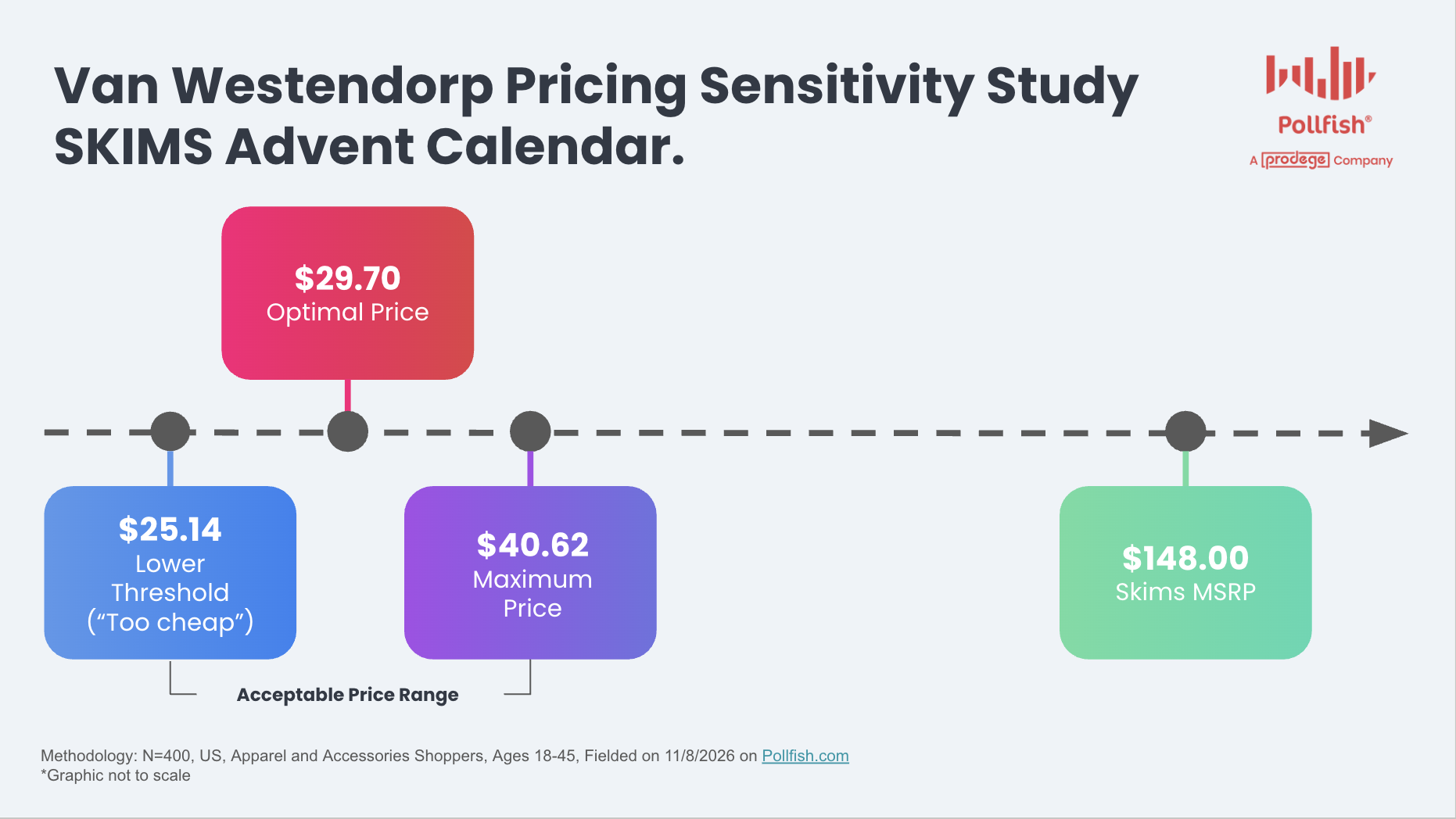
To measure the gap between consumer expectations and retail pricing without online bias, Pollfish conducted a blind Van Westendorp Price Sensitivity Meter. To complete the Van Wes pricing study, respondents reviewed the physical 12-item inventory and an image of the calendar and established four distinct pricing thresholds prior to seeing the actual $148 MSRP or knowing about the social media backlash.
The model established three clear price points:
- Point of Marginal Cheapness (PMC): $25.14. This is the lowest price threshold; below this point, consumers begin to question product quality.
- Optimal Price Point (OPP): $29.70. This is the exact price where the fewest respondents consider the item either too cheap (questionable quality) or too expensive.
- Point of Marginal Expensiveness (PME): $40.62. The absolute upper threshold of market tolerance. Above $40.62, resistance completely outpaces demand.
At $148, SKIMS priced the accessories box 264% above the highest acceptable consumer threshold. When the $148 price tag was subsequently revealed, 59% of respondents rated it unfavorably (34% stated the contents did not justify the price, and 25% labeled the pricing exploitative). Only 16% viewed the $148 price tag as justified.
Advent Calendar Spending Caps: 68% of Holiday Shoppers Refuse to Pay Over $100
The negative response to the SKIMS drop was not driven by disinterest in holiday countdown sets. Consumer demand for the category is high heading into the holiday shopping period:
- 86% of shoppers hold an overall positive opinion of advent calendars (45% love them; 41% like them).
- 60% of respondents state they definitely plan to purchase an advent calendar this year, with an additional 31% considering one.
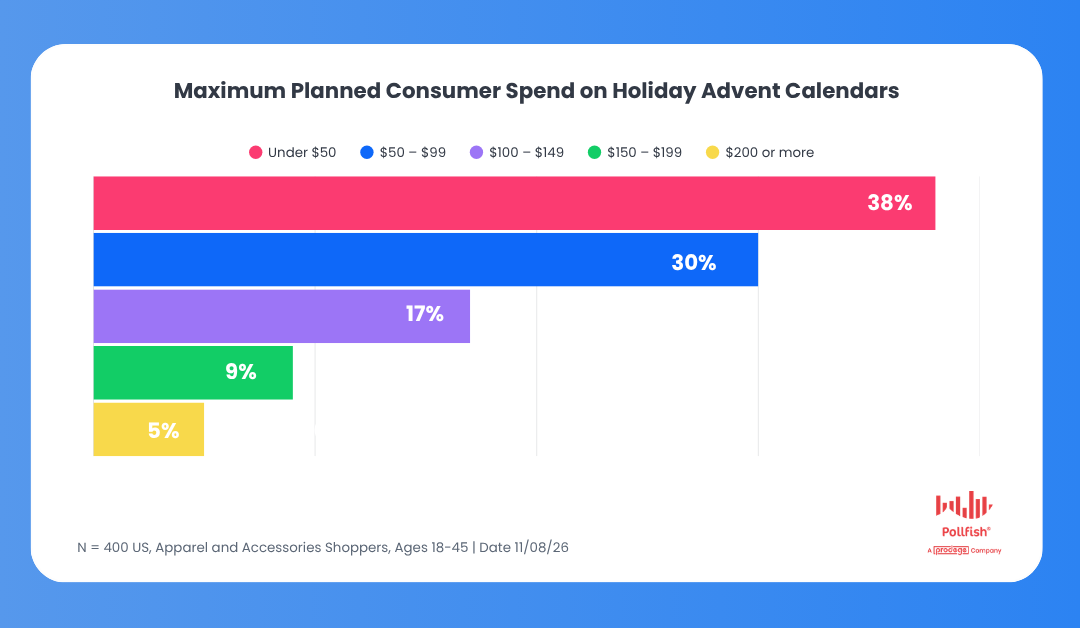 While category appetite is strong, spending boundaries are rigid: 68% of consumers cap their advent calendar budget below $100, and 84% spend under $150.
Luxury apparel and beauty calendars that successfully clear the $150 threshold generally do so by packaging full-size hero products, numbered presentation cases, or proprietary formulations. Consumers rejected the SKIMS calendar because commodity items like elastic bands and clips failed to cross the triple-digit value threshold.
Brand Fallout: 62% of Consumers Are Less Likely to Purchase Core SKIMS Products
A common assumption in retail is that limited-edition novelty drops carry little downside because inventory is small and sells out quickly. Our study findings indicate that product miscalculations in seasonal releases actively undermine core product sales.
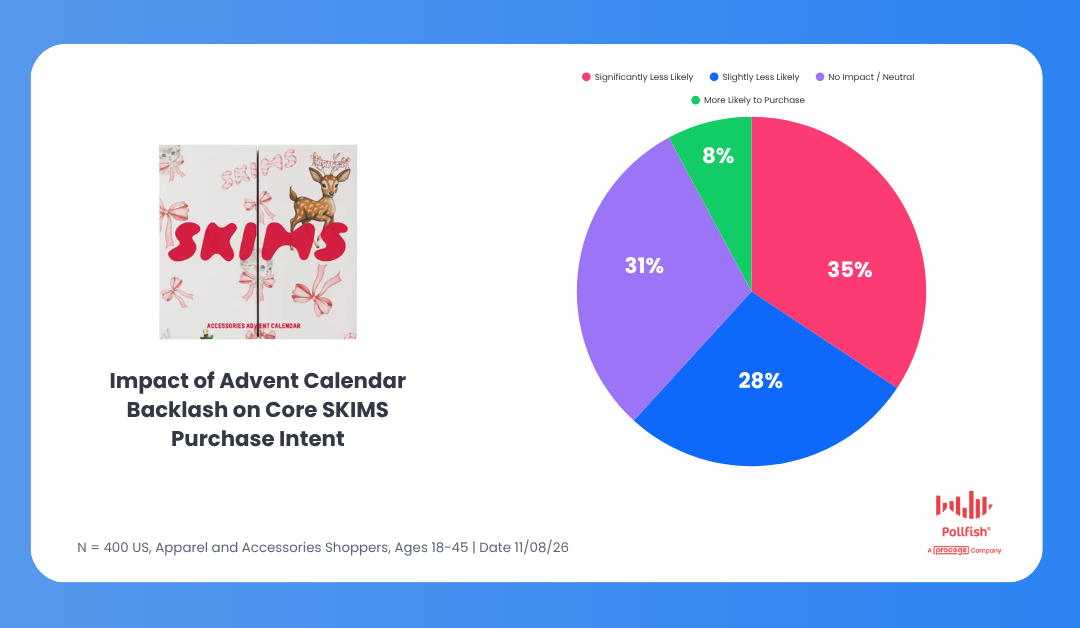
- 62% of consumers reported that this controversy makes them less likely to purchase core SKIMS items, such as shapewear, loungewear, and underwear (35% significantly less likely; 28% slightly less likely).
- Gen Z shoppers showed the highest churn risk: Among respondents aged 18–24, the purchase drag increased to 70%.
- Female shoppers: 63% of women familiar with the drop reported a decreased likelihood to buy from the brand going forward.
When novelty products fail to meet physical quality expectations, consumers re-evaluate the price-to-value equation of the brand’s staple catalog.
49% of Shoppers View Kim Kardashian More Negatively Post-Launch
For direct-to-consumer businesses with prominent founders, executive reputation and product positioning are closely linked.
- 49% of respondents stated that the advent calendar controversy made their personal impression of Kim Kardashian as an entrepreneur and businesswoman more negative (29% significantly more negative; 20% slightly more negative).
- Baseline founder sentiment: Before this release, 46% viewed Kardashian favorably as an entrepreneur, while 24% viewed her unfavorably—a negative baseline higher than peer founder-entrepreneurs such as Rihanna (6% unfavorable) and Jessica Alba (5% unfavorable).
While consumers routinely tolerate provocative marketing or brand campaigns from celebrity founders, products perceived as overcharging for basic goods directly erode commercial credibility.
Discovery Channels: 74% of Consumers Discovered the the SKIMS Launch on TikTok Under Negative Framing
The study highlights the risk of losing narrative control to creator-led social platforms:
- 50% of all respondents had prior knowledge of the SKIMS calendar controversy before taking the survey, rising to 71% among 18-to-24-year-olds.
- 74% of aware consumers learned about the product through TikTok, and 55% encountered it on Instagram.
- Only 14% discovered the product via direct SKIMS channels (email, website, or owned social accounts).
Because discovery was driven by unboxing creators, the dominant framing was overwhelmingly critical: 73% of respondents who saw the calendar on social media encountered negative or mixed sentiment (36% overwhelmingly negative; 36% mixed).
When brands rely on viral social distribution for product drops without aligning physical product value, creator algorithms will naturally favor call-outs and de-influencing over organic promotion.
Strategic Implications: How DTC Brands Can Test Pricing Before Launch
The commercial fallout from the SKIMS holiday drop demonstrates the importance of pre-launch consumer validation for seasonal merchandise:
- Conduct Blind Price Sensitivity Testing: Utilizing the Van Westendorp methodology, or other pricing research methodology, prior to production identifies the exact dollar figure where consumer demand breaks ($40.62 in this study), preventing over-indexing on perceived brand equity.
- Assess Concept Risk: Concept testing helps teams evaluate whether a seasonal extension or PR stunt will increase brand buzz or introduce risk to long term purchase intent. A drop that generates short-term novelty revenue and viral attention is counterproductive if it decreases purchase intent of 62% of shoppers.
- Anchor Multi-Item Bundles with Flagship Products: When pricing above the category threshold ($100), product architecture must feature at least one core, recognizable product to validate the total box value.
Study Methodology
This national pulse survey was conducted via the Pollfish Consumer Insights Survey Platform in November 2026. The sample includes 400 U.S. adult consumers aged 18–45 weighted to be 75% women but balanced across age, and region who actively shop apparel, beauty, and lifestyle categories. The survey utilized a Van Westendorp Price Sensitivity Meter, brand perception batteries, and channel attribution tracking.
